UCEP is a Thai government health policy that covers patients in a critical emergency, whichever public health fund they belong to. A patient can go to the nearest hospital and pay nothing until the danger has passed and the patient can be moved safely, for no more than 72 hours. The rule comes from the UCEP handbook of the National Health Security Office (NHSO), the agency that runs Thailand's universal health coverage scheme.
Many people only learn about the right after an emergency happens. In a sudden, serious illness, relatives are often unsure whether they must first go to the hospital linked to their own coverage, and they fear paying upfront. The main details here come from the NHSO's 2021 UCEP handbook. The criteria may be revised later, so check with the NHSO at nhso.go.th before relying on them.
What UCEP is and who it covers
UCEP covers critical emergency patients who are Thai nationals under any public health fund. It also covers people with status and rights problems, and foreign nationals or migrant workers who hold social security rights. The shared condition is that the patient must be in a red-level critical emergency, as assessed under the criteria of the National Institute for Emergency Medicine (NIEM).
The same criteria apply to patients under the Gold Card (universal coverage) scheme, the Social Security scheme and the civil servant scheme. In a critical emergency, a patient's own coverage is not tied to one particular hospital, so there is no need to be transferred to a designated hospital before receiving treatment.
The Thai report lists foreign nationals only if they hold social security rights. It does not say whether tourists or other foreigners with no such rights are covered. If you are in that position, ask the hospital and your travel or health insurer about costs.
Red-level symptoms that qualify
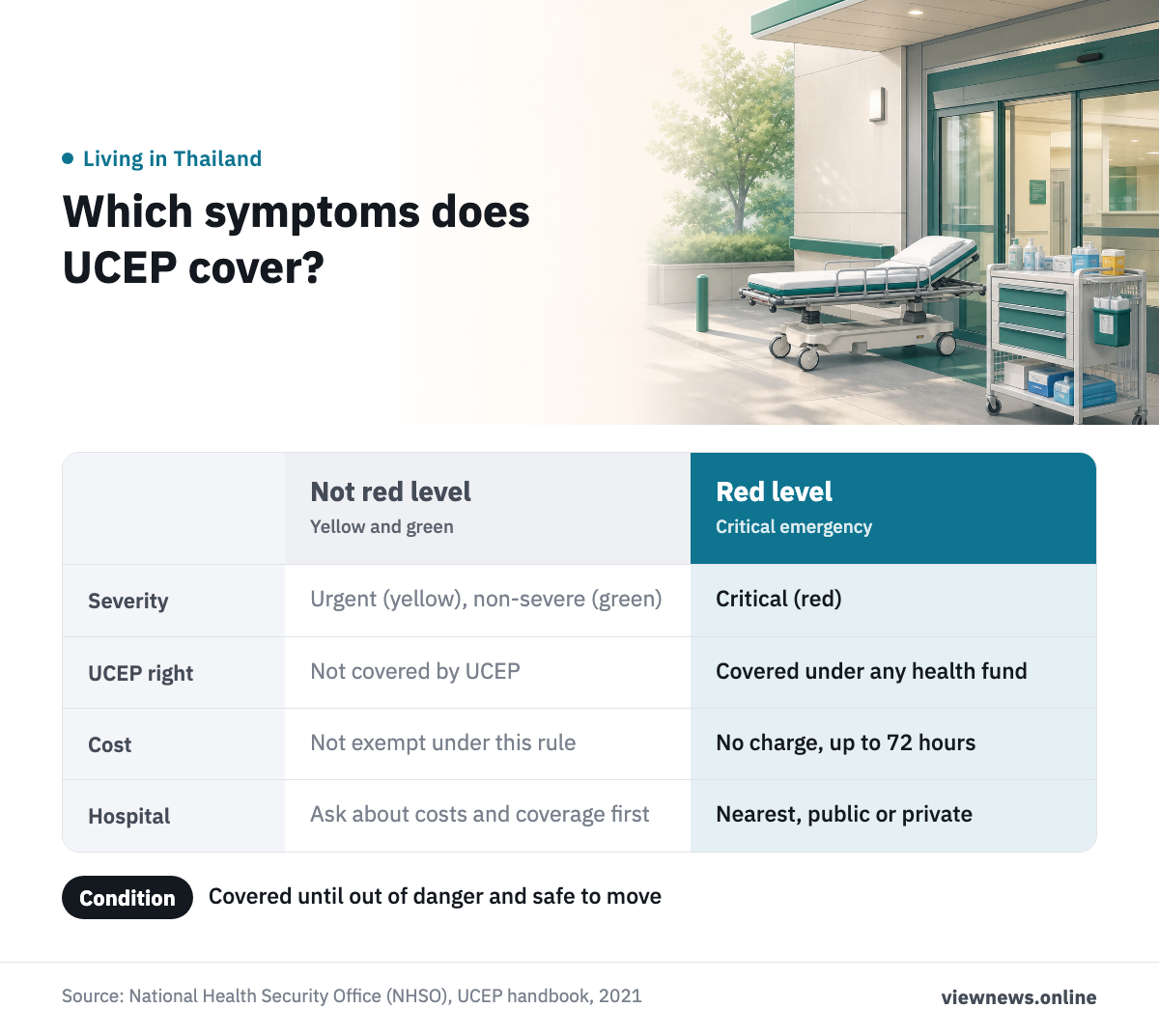
Emergency patients are divided into three levels: critical (red), urgent (yellow) and non-severe (green). UCEP covers and pays for treatment at the red level only. According to the NHSO handbook, red-level symptoms fall into six groups:
- Loss of consciousness, unresponsiveness or not breathing
- Rapid breathing, severe breathlessness, laboured breathing or noisy breathing
- Drowsiness, sweating, cold skin or seizures alongside these signs
- Sudden, severe chest pain
- Weakness on one side of the body, sudden slurred speech, or seizures that do not stop
- Other symptoms affecting breathing, blood circulation and the brain that may threaten life
This list is only an overview taken from the handbook. It is not a tool for diagnosing yourself. If someone near you has a sudden, severe condition, call for help and take them to the nearest hospital immediately. Medical staff will then assess whether the case is red level. The assessment uses NIEM's Emergency Pre-authorization system, which hospitals follow as a common guideline.
Nearest hospital, public or private, no upfront payment
Patients can go straight to the nearest hospital, public or private, and pay nothing while they are in critical condition. For private hospitals, the law is explicit. The fourth amendment (No. 4) to the Medical Facilities Act of 2016 bars private medical facilities from charging critical emergency patients. The Cabinet approved the criteria on 28 March 2017, and a Public Health Ministry announcement took effect on 1 April 2017.
The Cabinet also approved that all public facilities follow the same criteria. Private hospitals do not carry the cost alone. They are reimbursed under a fee schedule of listed services, not the earlier DRGs (diagnosis-related groups) system. The method is designed to reduce cases where patients or relatives are billed the difference.
After 72 hours, public hospitals take transfers
The no-payment right lasts until the patient is out of danger and can be moved safely, but not longer than 72 hours. The 72 hours is a maximum. It does not mean every patient will get the full 72 hours.
If treatment must continue after that period, the Cabinet has approved that public hospitals accept critical emergency patients as transfers. Patients or relatives should ask the hospital caring for them where the patient will be moved, and what the cost will be beyond 72 hours. UCEP does not cover every treatment cost after 72 hours.
Not red level: not covered
Yellow and green patients are not covered by UCEP, because the right applies only to red. These patients are not exempt from charges under this rule. When the patient's condition allows, ask the hospital about treatment costs and which coverage you can use before receiving care.
If you are unsure whether you or a relative qualifies, or a hospital charges you even though the patient was assessed as red level, contact the NHSO through nhso.go.th about the treatment and the patient's symptoms. For medical questions, consult the doctor treating the patient directly.
Source: National Health Security Office (NHSO), UCEP handbook, 2021 edition, pages 2, 14 and 18-25.
This article is adapted from ViewNews' Thai-language report.