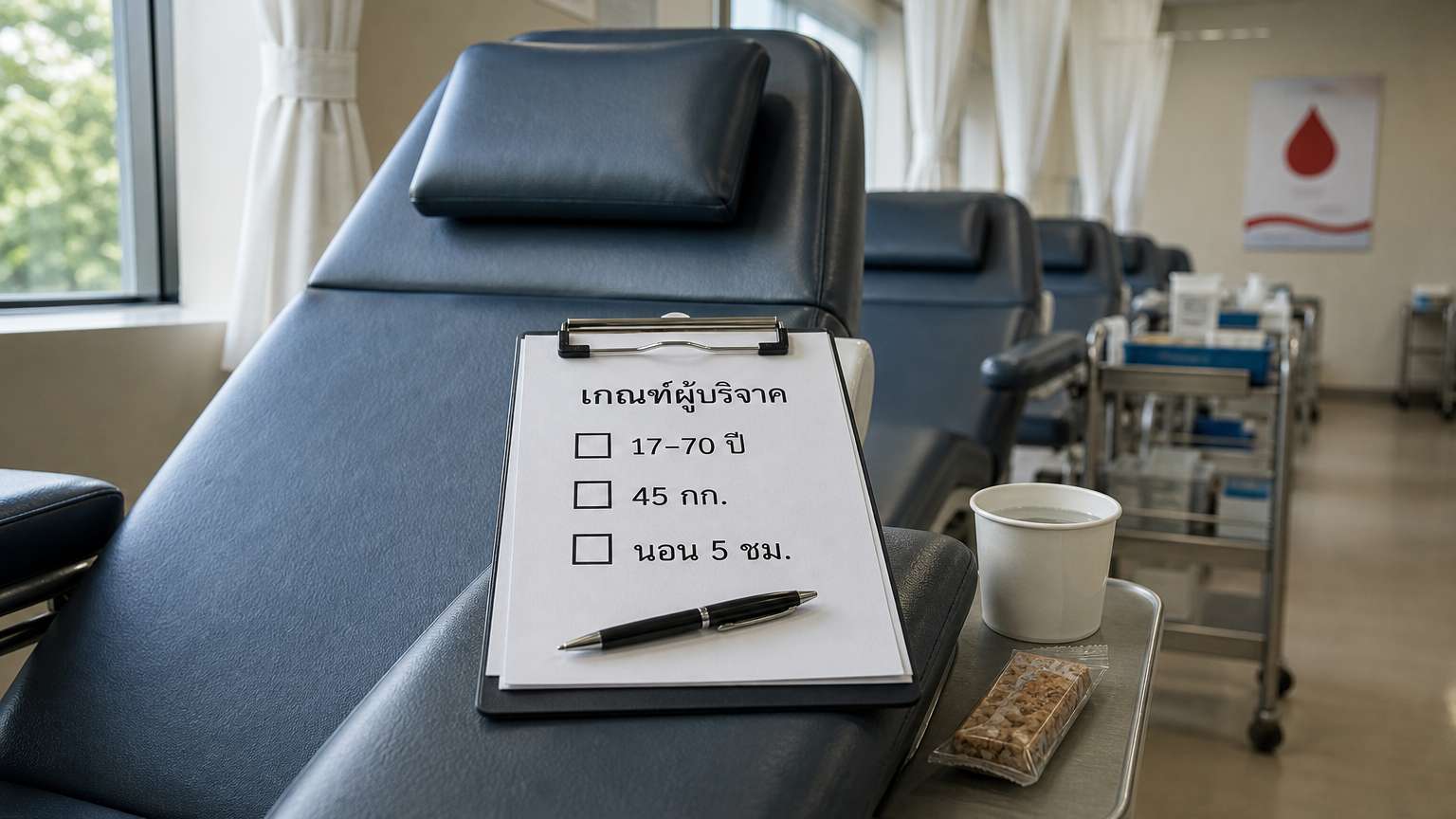
People aged 17-70 who weigh at least 45 kilograms and have slept at least 5 hours meet the basic requirements to give blood at the National Blood Centre of the Thai Red Cross Society. Whether you can actually donate also depends on recent events, such as a vaccination, a tattoo, medication or an illness. The centre publishes its criteria and waiting periods, so you can check yourself before you go.
Basic rules: age, weight, sleep and donors over 60
Donors must be aged 17-70. A 17-year-old needs a consent form from a parent or guardian. A first-time donor must be 60 or younger. This matters for people nearing retirement: if you pass 60 without ever having donated, you cannot start as a first-time donor. You must weigh at least 45 kilograms and have slept at least 5 hours.
Sleep is often overlooked. Someone who stayed up all night and stops by in the morning may be turned away even if age and weight are fine. Plan to rest properly before donation day.
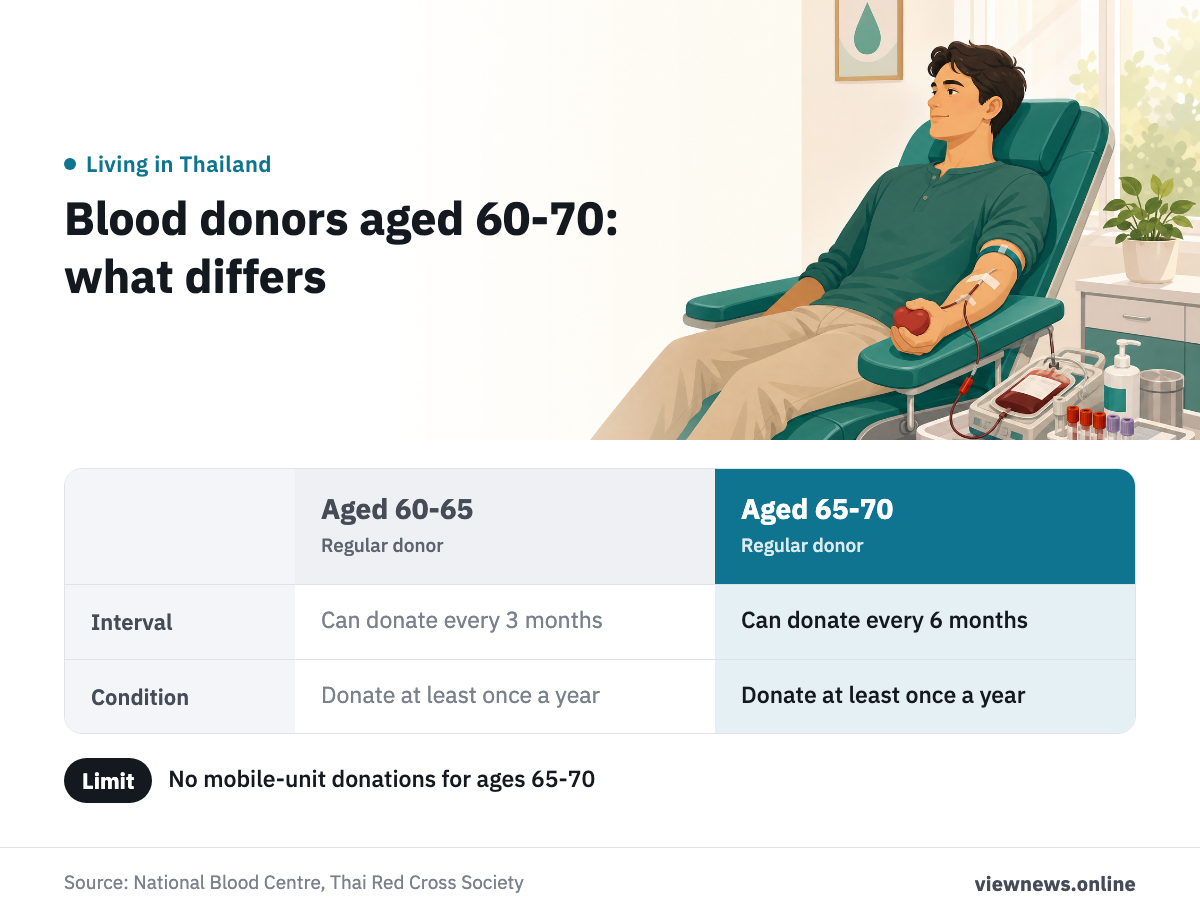
Donors aged 60-65 and 65-70 must both be regular donors, meaning they give blood at least once a year. The difference is the interval. The 60-65 group can donate every 3 months. The 65-70 group can donate every 6 months. The centre does not take donations from the 65-70 group at mobile units.
For the interval between donations for other donors, ask centre staff, especially if you gave blood recently.
Each donation takes 350-450 millilitres of blood, depending on the donor's body weight, according to the Thai Red Cross. The process takes about 20 minutes from registration to finish.
Food and alcohol before donating
Avoid alcohol for 24 hours before and after donating. Regular drinkers must abstain for 7 days. On food, the Thai Red Cross advises avoiding fatty, very sweet and very salty food in the 6 hours before donating. The stated reason is that fat makes plasma cloudy, which can make the donated blood unusable. In that 6-hour window, skip fried and greasy dishes.
Waiting periods after vaccines, dental work, tattoos and medication
Waiting periods depend on what has happened to your body recently. These are the ones people ask about most:
- Antibiotics: wait 7 days after the last pill.
- Diarrhoea: wait 7 days after recovery.
- Dental scaling or filling: wait 3 days. Tooth extraction or root canal treatment: wait about 7 days.
- Ear piercing, tattoos or acupuncture done outside a hospital: wait 4 months.
- Minor surgery: wait 7 days. Major surgery: wait 6 months.
- Influenza: wait 2 weeks after recovery. Dengue fever: wait 1 month. Chikungunya and Zika: wait at least 6 months.
Vaccine waiting times fall into three groups. Rabies, tetanus, HPV, influenza, pneumonia and hepatitis A vaccines: wait 24 hours. Hepatitis B vaccine: wait 21 days. Measles, mumps, rubella, chickenpox, shingles and dengue vaccines: wait 4 weeks. The condition that you have no side effects after the shot applies to the 24-hour group and the 4-week group. Hepatitis B follows the 21-day rule set by the Thai Red Cross.
For women, anyone who is pregnant must hold off for now. After childbirth or a miscarriage, wait 6 months. Rules on COVID-19 and COVID-19 vaccines can change, so ask the centre every time before you go.
Tattoos and piercings are the common trap. If done outside a hospital, you must wait 4 months, so someone who got a tattoo last month cannot donate yet. Anyone who has just recovered from dengue fever must wait 1 month from recovery.
Diabetes, high blood pressure and permanent exclusions
People with diabetes controlled by oral medication, without insulin and without complications, can donate. People with high blood pressure that is under control can donate too, if the top number is no higher than 160 and the bottom number no higher than 100. Those who use insulin or whose blood pressure is not under control do not qualify, according to the centre.
Anyone who has had any type of cancer is permanently barred. For other chronic conditions not listed above, ask centre staff directly. The final decision rests with a doctor or nurse at the centre after a health interview and a physical check. If you are on medication or being treated for an illness, talk to a doctor or pharmacist before starting or changing treatment, and before deciding to donate.
Booking and contacting the National Blood Centre
The National Blood Centre, Thai Red Cross Society, is on Henri Dunant Road in Pathum Wan district, Bangkok 10330. You can book online at bdbooking.redcross.or.th or call 0 2263 9600-99 or 0 2256 4300. If you are unsure whether your situation qualifies, call staff ahead of time.
Before you go, run through age, weight, hours of sleep, recent medication, dental work, tattoos, vaccinations and recent illness. The criteria can change, so confirm with the centre first to avoid a wasted trip.
The Thai Red Cross pages used for this report do not say what identification foreign donors must bring, or whether non-Thai residents face extra rules or can get help in English. Ask the centre before you go.
Source: National Blood Centre, Thai Red Cross Society, donor eligibility page, and the English website of the Thai Red Cross Society. This article is adapted from ViewNews' Thai-language report.