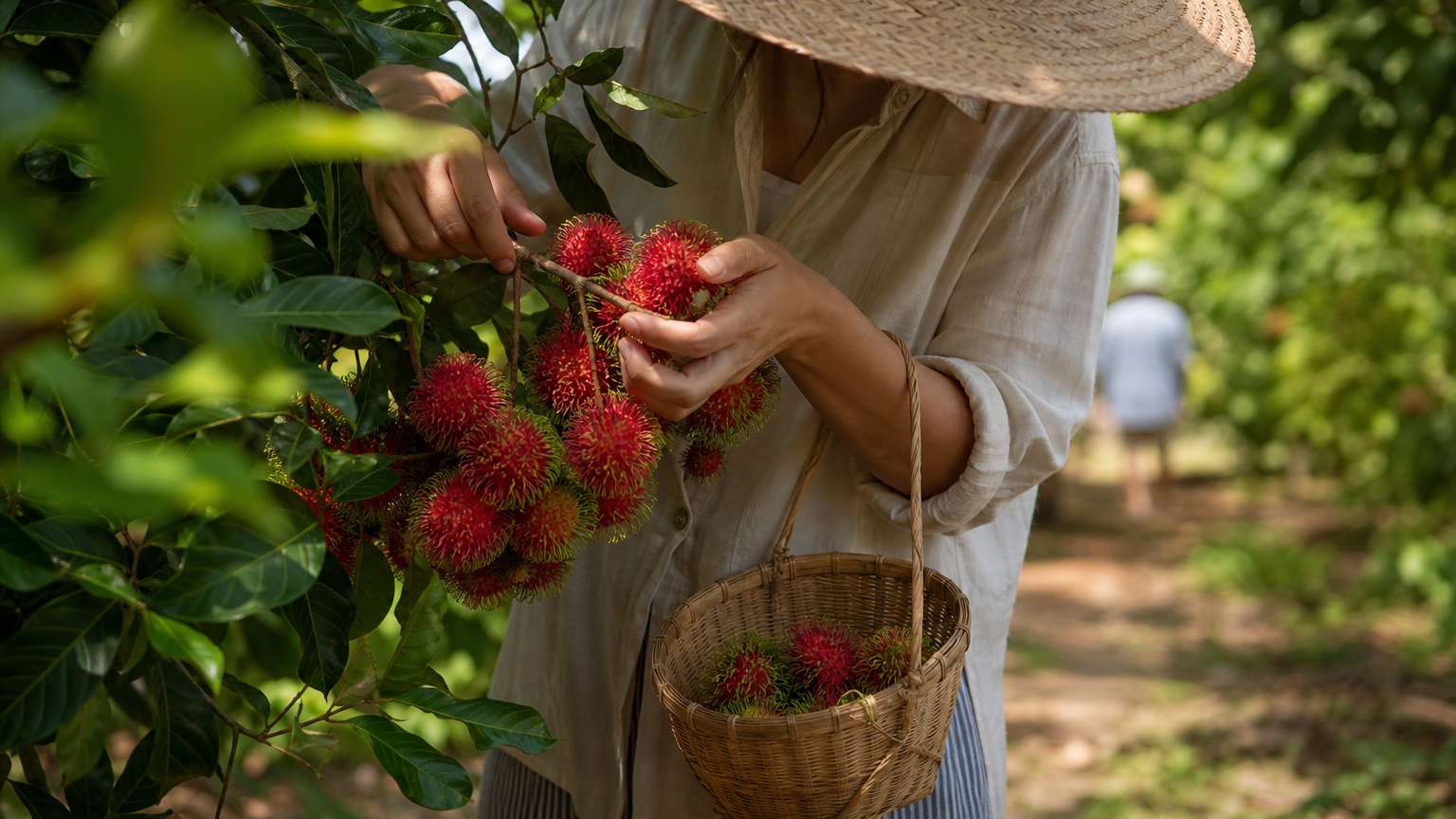
Agro-tourism in Thailand is travel built around hands-on time on farms and in farming communities. Visitors take part in real farm activities and learn how farmers live and work. The Agricultural Land Reform Office (ALRO) summarised the concept in a publication issued in July 2022. The topic matters to travellers who want something more active than sightseeing, and to farmers who want extra income without expanding their land.
This article covers the official definitions, typical activities, the difference between a homestay and a farmstay, and the standards a farm must meet to receive visitors.
What agro-tourism means
The Department of Tourism defines agro-tourism as travel that focuses on learning about the farming way of life in rural areas. Visitors are expected to take part in activities. The aim is to generate income for the community and the farmer, while conserving the area so that tourism does not harm the community or the environment.
The World Tourism Organization (UNWTO), cited by ALRO, describes it as travel to farmland, orchards, agroforestry areas, herb gardens or livestock farms. Visitors enjoy the scenery, gain knowledge and have new experiences, on the basis of responsibility toward the environment.
ALRO also separates two terms that are often mixed up. Agro-tourism is the visitor's side: going to learn and relax on farms or in farming communities. Tourism-oriented agriculture is the farmer's side: setting up a farm to receive visitors, with activities that include production, processing, cooking with farm ingredients and selling farm products.
A farm tourism site has 3 main parts: interesting farm activities and surroundings, a market of visitors who are interested in agriculture, and tourism services such as lodging, food and guiding.
Activities and places to stay
ALRO groups agro-tourism sites into 3 types.
- Individual farms, such as rambutan, durian, mango or lychee orchards, flower gardens, organic vegetable farms and dairy farms.
- Agro-tourism communities or villages run jointly by members, offering either overnight stays or short trips of up to 1 day.
- Festivals or seasonal events, such as the Rakam Wan (sweet salak) fair or a silk mulberry festival.
Activities depend on the location. Examples listed by ALRO include riding buffalo or horses, taking a cart ride through an orchard, fishing, picking fruit and organic vegetables, collecting eggs from free-range hens, and training in modern farming and local wisdom. Visitors can also buy processed farm products and souvenirs from villagers. Some sites welcome people who want to explore agribusiness opportunities.
For accommodation, a homestay and a farmstay are not the same thing.
A homestay means staying under the same roof as the host family. Under the Department of Tourism's Thai Homestay Standard announcement of 2011, a homestay has no more than 4 guest rooms, hosts no more than 20 guests in total, and is registered with the department under its rules.
A farmstay is run by a farmer or farm owner who provides lodging, either in an adapted existing house or a new building. Meals focus on produce from the farm, and guests can join in farm work. ALRO says the benefits are low impact on the land and a wider spread of income, so farmers do not rely only on crops whose market prices swing.
Benefits for farmers and communities
ALRO says visitors who join activities give farmers direct income, and farmers can sell produce without sending it out of the community. Some farmers gain repeat customers who reorder products. Income comes from several sources: entry fees, processed goods, souvenirs, lodging and food. Because integrated farming methods work on small plots, farmers can earn more without more land.
Visitors also bring improvements to local facilities such as roads, electricity, tap water and internet networks. ALRO sees this as spreading development to the regions.
On the social side, ALRO says the business draws young people back to local work and lets retirees run their own businesses. Farmers gain pride in their occupation, which helps reduce out-migration and land sales. Communities also become places where students and the public can learn about farming and local culture.
What a farm must prepare to host visitors
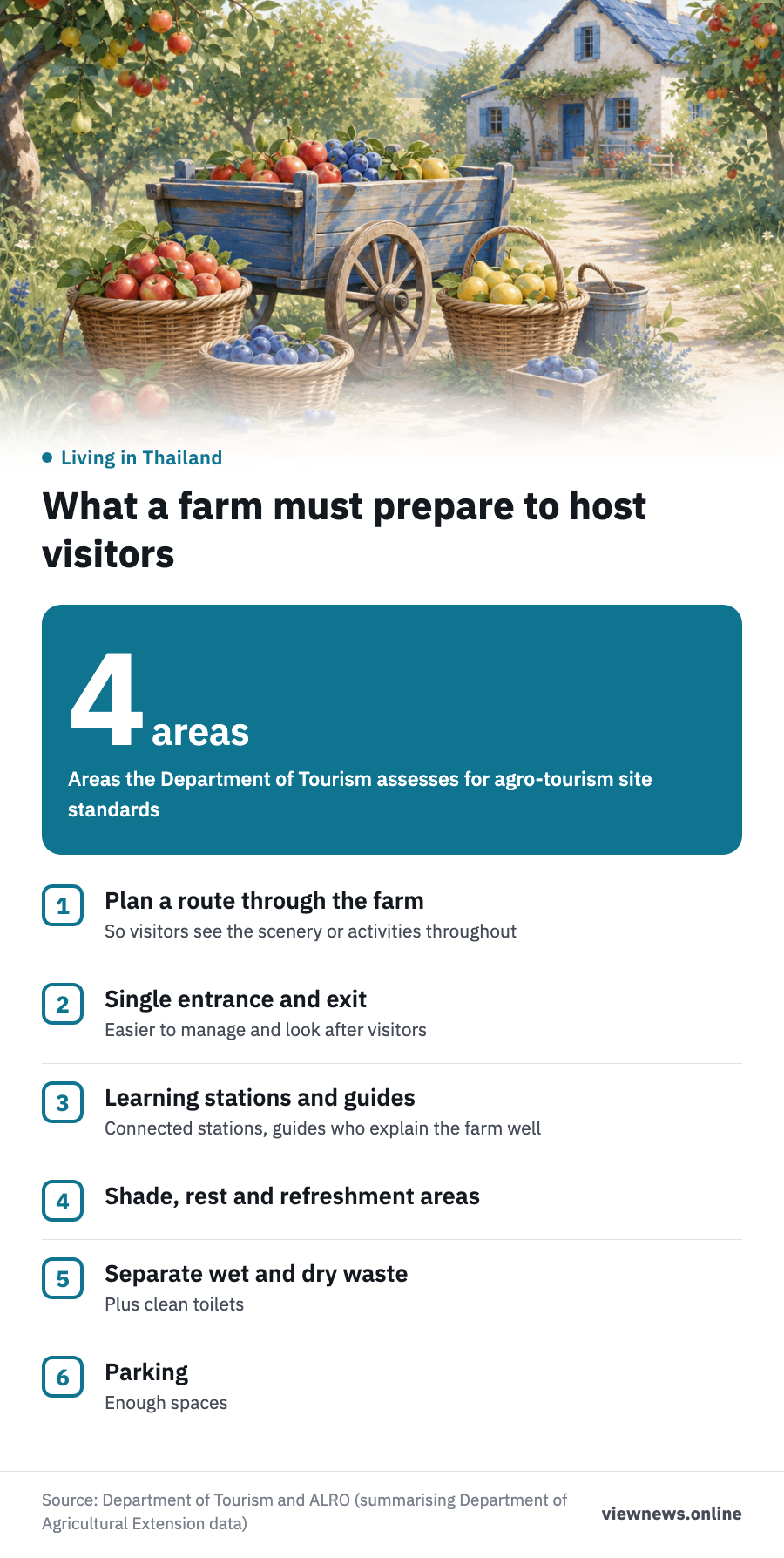
A farm cannot open to visitors on good intentions alone. It must meet quality standards. The Department of Tourism's assessment criteria for agro-tourism sites, as summarised by ALRO, look at 4 areas: management, capacity to receive visitors, service and attractiveness. Management indicators include visitor safety, waste handling, and conservation of natural resources and the environment. The capacity area looks at access routes, utilities, lodging, food and keeping visitor numbers suited to the size of the site.
ALRO, drawing on Department of Agricultural Extension information, lists these preparation steps:
- Plan a route so visitors see the scenery or activities across the farm.
- Use a single entrance and exit so visitors are easier to manage.
- Set up learning stations that connect on foot, with guides who can explain the farm well.
- Provide shade, rest areas, and areas for food and drinks.
- Prepare separate bins for wet and dry waste, and clean toilets.
- Provide enough parking.
ALRO also advises keeping visitor numbers within the site's carrying capacity, spreading visits across the year by running activities in several periods, and setting rules such as no picking flowers and no feeding animals. Anyone planning to invest should check the rules for nearby areas, such as conservation land under the Department of National Parks, Wildlife and Plant Conservation, forest land under the Royal Forest Department, and agricultural land reform zones.
Before you go, and where to look
If you plan to stay at a homestay, check whether it is registered with the Department of Tourism under the Thai homestay standard, since a homestay by definition must be registered. According to ALRO's summary, farmstays have no registration criteria yet, so ask the farm owner directly about rooms, meals, prices and rules.
The Office of the Permanent Secretary of the Ministry of Tourism and Sports publishes an open dataset on its CKAN data portal titled Thailand Tourism Directory, Agriculture. It was last edited on 15 August 2024 and can be used to look up agro-tourism sites. Farmers who want to open to visitors can read ALRO's publication on tourism-oriented agriculture and agro-tourism site management as a starting point.
Source: Agricultural Land Reform Office (ALRO), publication no. 645 on tourism-oriented agriculture and agro-tourism site management (July 2022), and the Office of the Permanent Secretary, Ministry of Tourism and Sports, agro-tourism directory dataset.
This article is adapted from ViewNews' Thai-language report.