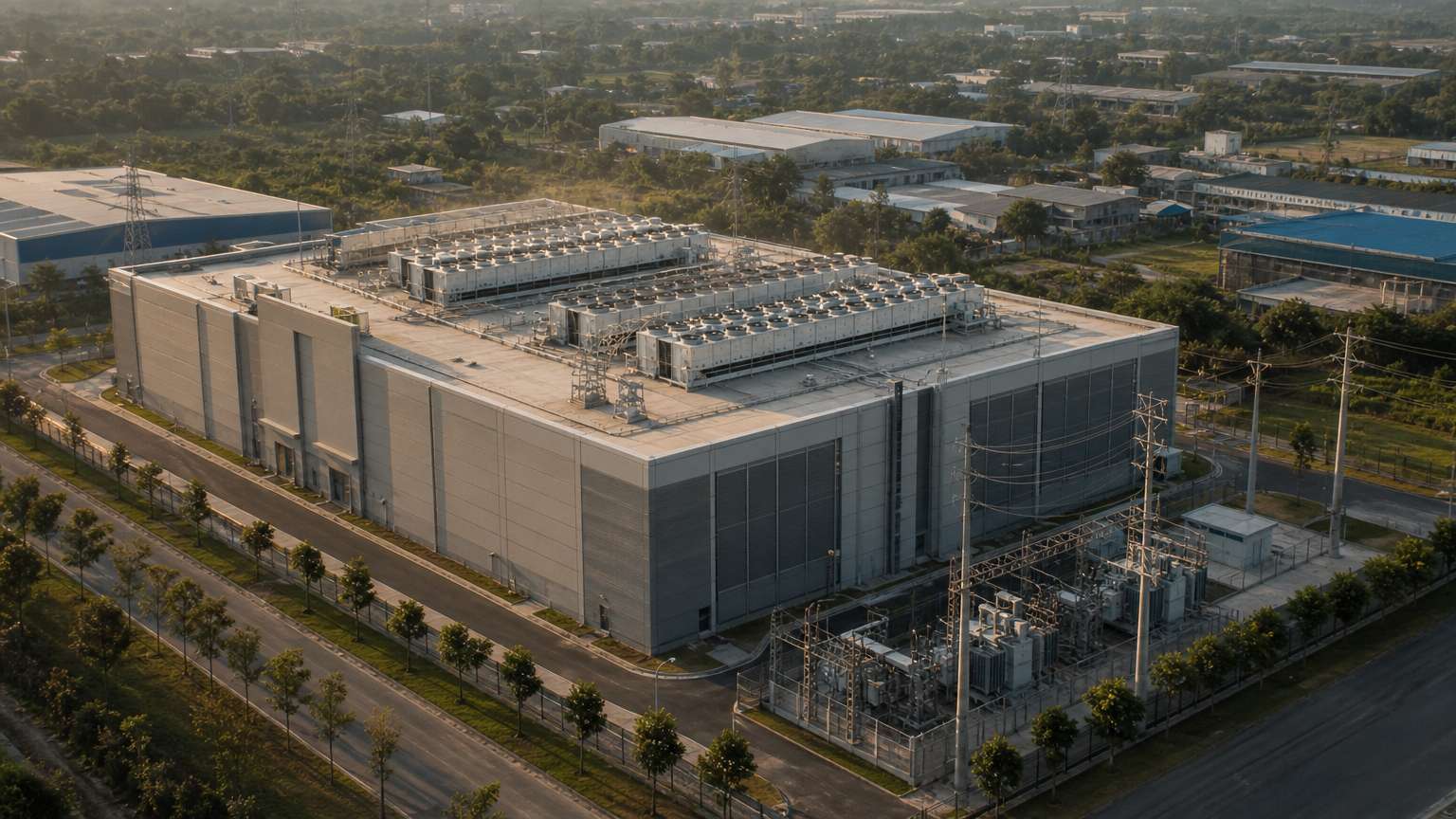
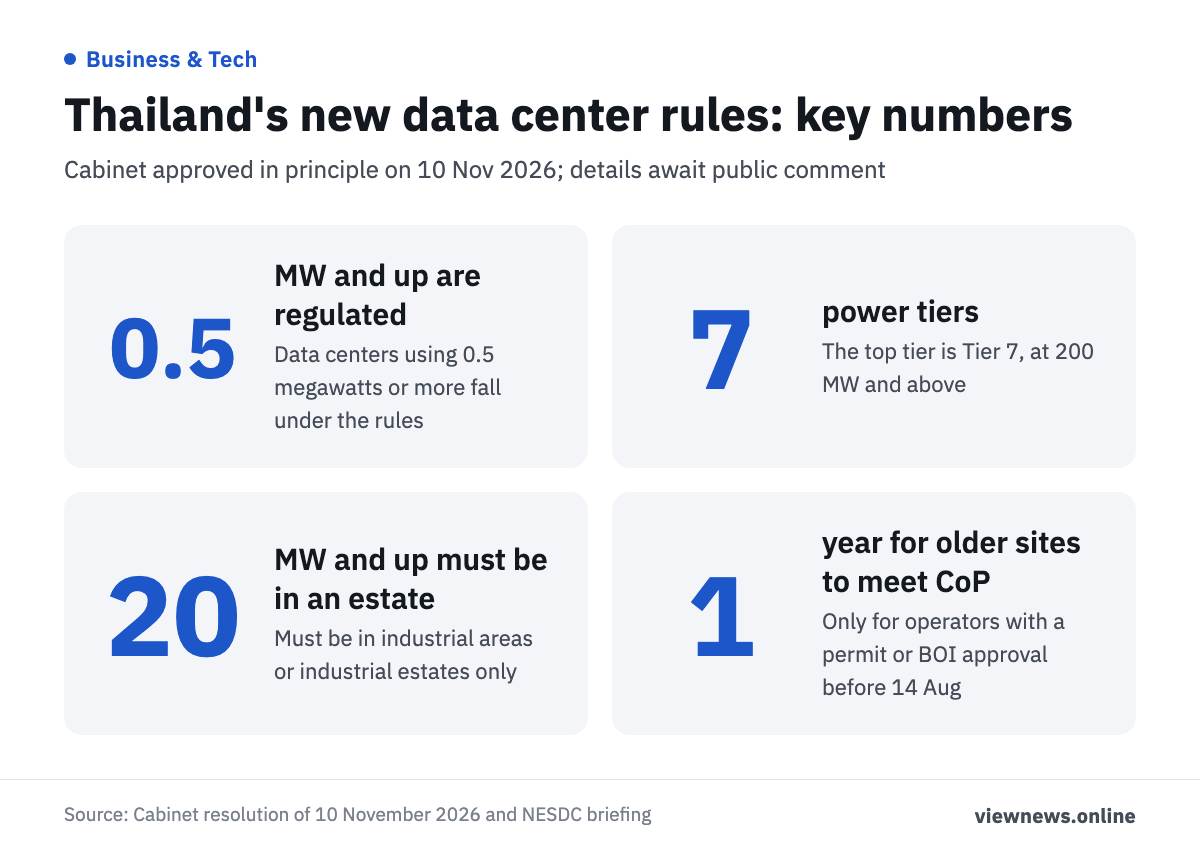
Thailand's Cabinet approved new rules for data centers on 10 November 2026. Facilities that draw 0.5 megawatts (MW) of power or more will be regulated and split into 7 tiers by power use. Data centers drawing 20 MW or more must be built in industrial areas or industrial estates. This is an approval in principle. The detailed requirements still have to go out for public comment.
Anyone who runs, builds or plans to invest in data centers in Thailand should know the framework.
The policy sorts operators into existing ones, those that received a construction permit after a cut-off date, and new entrants. Each group follows a different process. The Ministry of Digital Economy and Society (DES) is to set up a One Stop Service (OSS) centre. It will also publish a dashboard showing how many data centers exist and where they are.
How the 7 tiers and location rules work
Danucha Pichayanan, Secretary-General of the National Economic and Social Development Council (NESDC), said the rules cover data centers using 0.5 MW or more. The tiers are:
- Tier 1: below 0.5 MW
- Tier 2: 0.5 to 5 MW
- Tier 3: 5 MW to below 10 MW
- Tier 4: 10 MW to below 20 MW
- Tier 5: 20 MW to below 50 MW
- Tier 6: 50 MW to below 200 MW
- Tier 7: 200 MW and above
Tier 1 sits below the 0.5 MW line, so it falls outside the new rules.
Location rules split at 20 MW. Data centers below 20 MW can still be built in commercial zones. Those at 20 MW or more, which means Tiers 5 to 7, must be in industrial areas or industrial estates only. Tiers 5 and above also face stricter oversight.
Environmental code of practice instead of an EIA
The NESDC said data centers will not need an environmental impact assessment (EIA), because they are not classed as heavy industrial plants. They must instead follow a minimum environmental Code of Practice (CoP). It covers noise, heat or temperature, and the efficiency of water and electricity use.
The NESDC said the detailed CoP requirements will be opened for public comment again.
Three groups of operators
The first group holds a construction permit issued before 14 August. It also includes operators approved by the Board of Investment (BOI) before that date that have applied for a construction permit. They can continue. The OSS will check their documents, and they must adapt to the CoP within 1 year. The NESDC gave 14 August as the cut-off date.
The second group received a construction permit after the cut-off. These operators must be screened against criteria set by a committee.
The third group is new investors. They must apply through the OSS that DES will set up.
- Existing operators with a permit or BOI approval before 14 August: continue, with OSS document checks and CoP compliance within 1 year.
- Operators with a construction permit issued after 14 August: screened under the committee's criteria.
- New investors: apply through the OSS.
Ekniti Nitithanprapas, Deputy Prime Minister and Finance Minister, said new projects will be judged on more than the size of the investment. The government will look at job creation, skills development for Thai workers, bringing supply chains into the country, and the use of clean energy.
The government also said power capacity has been booked in bulk for resale, and it wants the new rules to curb this. Requiring new investors to apply through a single OSS, and publishing data on a dashboard, are part of the framework the Cabinet approved.
What has been decided and what comes next
As of 10 November 2026, the Cabinet has approved the policy and framework. That covers the 0.5 MW threshold, the 7 tiers, the 20 MW line for location, the CoP in place of an EIA, and the OSS and dashboard. It is not yet a fully binding rule, because only the principles have been approved.
The BOI has approved 57 data center projects. Of these, 17 are already operating, 20 have construction permits, and 20 are in preparation.
Two things are worth watching. The first is the public comment round on the CoP, which will set the formal standards for noise, heat, water and electricity. The second is the DES OSS and dashboard.
The Thai report does not say whether foreign-owned operators face separate requirements. Foreign investors should check with the BOI or the DES ministry before planning a project.
Source: Cabinet resolution of 10 November 2026, and briefings by the Deputy Prime Minister and Finance Minister and the NESDC Secretary-General.
This article is adapted from ViewNews' Thai-language report.