Thailand's Cabinet endorsed a report on 27 October 2026 that concludes the Land Bridge project is not cost-effective. The report was produced by the committee set up to study how to move the project forward. It also found the project has low commercial viability and risks leaving the state with budget burdens and debt in the future.
The decision gives shippers, exporters and coastal communities in the south, particularly around Ranong and Chumphon, a partial answer from the government. After the vote, the Deputy Prime Minister and Transport Minister said the Land Bridge name no longer exists. He added that a smaller deep-sea port and a link between the two coasts will still be studied.
What the Cabinet approved
The Cabinet approved the committee's summary report on its work. The committee was chaired by Ekniti Nitithanprapas, Deputy Prime Minister and Finance Minister.
The report has three main conclusions. The project is not cost-effective, its commercial viability is low, and it could burden the state with budget costs and debt. These are the committee's findings, and they are what the Cabinet endorsed at that meeting.
Transport Minister Phiphat Ratchakitprakarn said the Land Bridge name is gone. That is the minister's statement. What the Cabinet approved was the committee's report, so the two points should be read separately.
The committee's findings
The committee found the project not worthwhile and commercially weak, and it warned of possible future budget and debt burdens. Those findings are the core of the report.
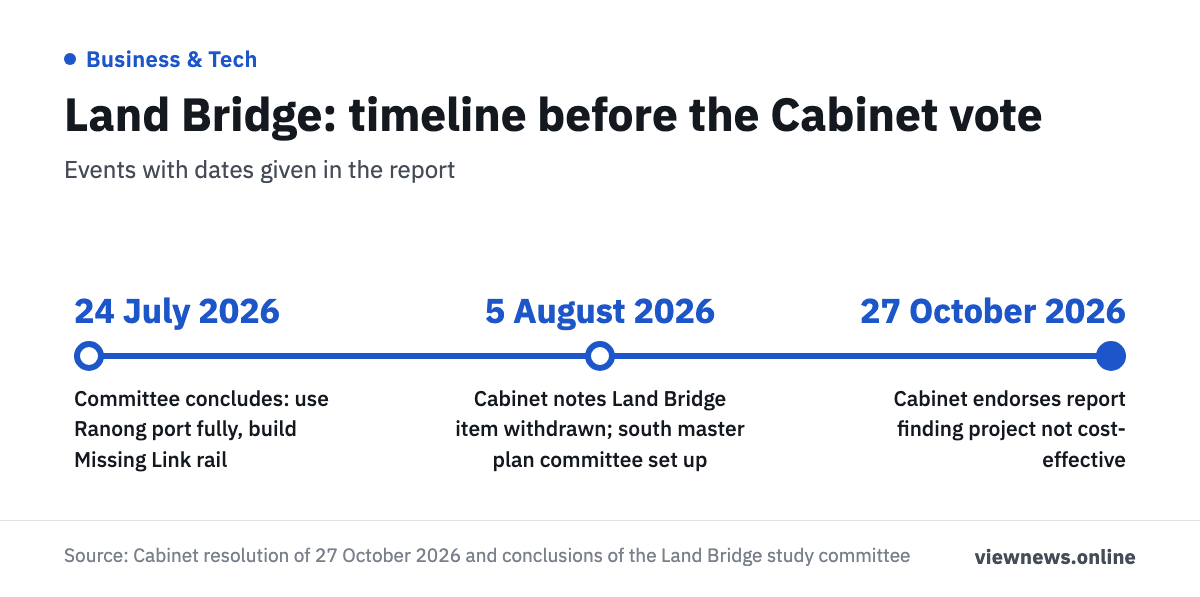
A committee conclusion dated 24 July said there has been no damage from land investment or construction, because the project has not started. The same conclusion also set out directions for ports and rail, covered below.
Ranong port, rail and a deep-sea port
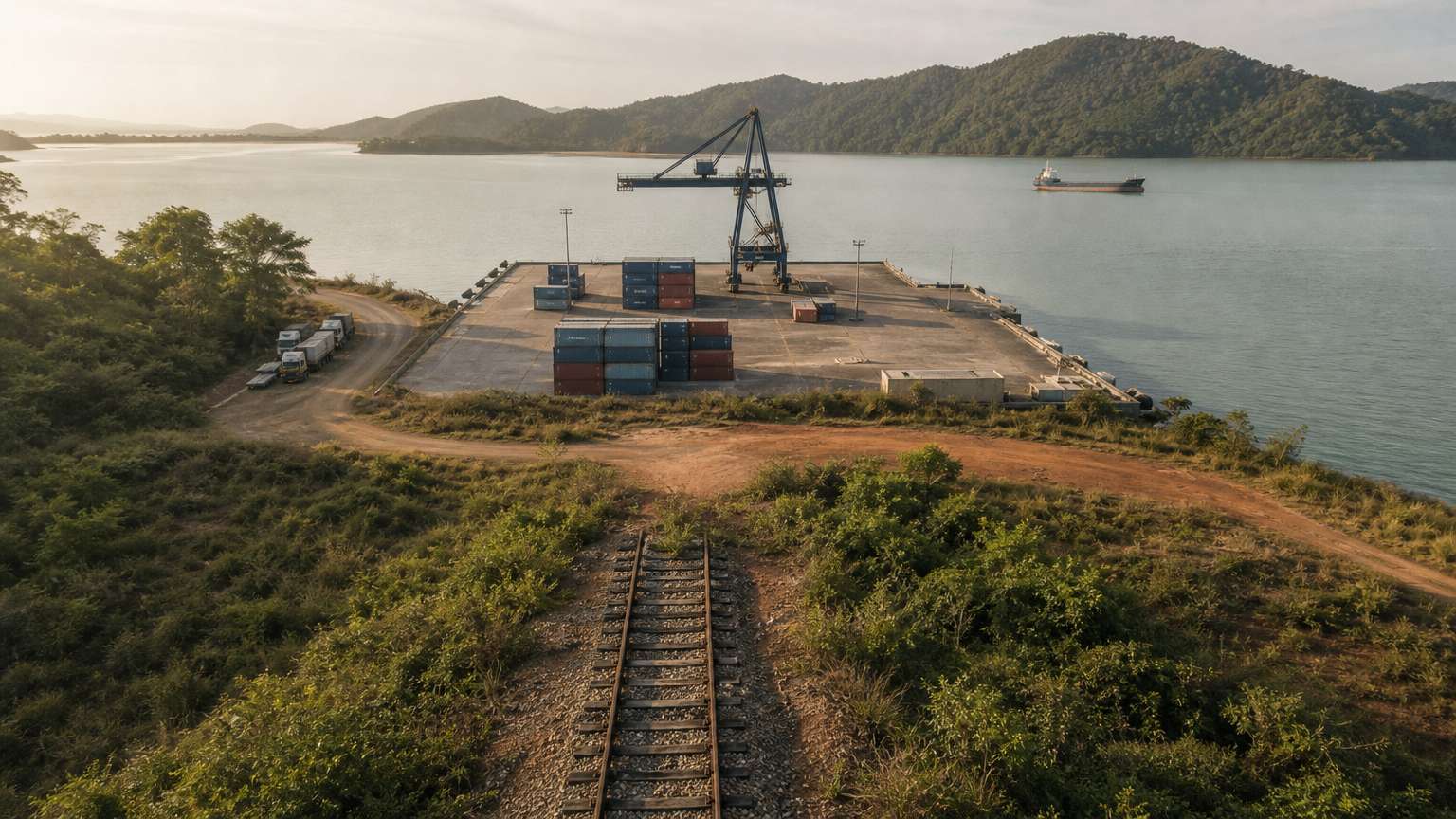
The committee's conclusion was to use Ranong port to its full capacity. It also called for developing a rail line linking Ranong port to the main rail network, known as the Missing Link. It said no further investment is needed for ports on the Gulf of Thailand side.
After the Cabinet vote, Phiphat said Ranong and Chumphon are still suitable for a deep-sea port. How to develop it, and how to connect the two coasts, remain open questions. He asked the Office of Transport and Traffic Policy and Planning (OTP) to study development models and the link between the two coasts, and to fit them to current conditions as closely as possible.
The investment model may also change. The original Land Bridge was planned as a 100% privately funded project. Phiphat said the new project could be state-funded because it is smaller than before. The government has not said where the money would come from or how much would be needed.
What is still unclear
The government has not disclosed a budget, timeline or scale for the Ranong port and the rail link to the main network. What exists now is the direction set out in the committee's report and the instruction to the OTP to study a deep-sea port model and a two-coast link. No timeframe for the study has been announced.
Earlier, on 5 August 2026, the Cabinet acknowledged the withdrawal of the Land Bridge item from its agenda and the creation of a committee to draft a master plan for developing the south. The project was not cancelled at that point, and the plan was expected to be finished within 1 year. The government has not explained how that master plan relates to the OTP study after the latest Cabinet decision.
What can be confirmed now falls into three layers:
- The Cabinet endorsed the committee's report finding the project not cost-effective.
- The transport minister said the Land Bridge name is gone and told the OTP to keep studying.
- The committee's conclusion on Ranong port and the Missing Link stands, but it has no detail on money or timing.
Several things are worth watching. Exporters in the south should look for the details and schedule of the Ranong port upgrade and the Missing Link rail line. Coastal communities should watch where a smaller deep-sea port would be placed in Ranong or Chumphon, and whether local hearings are held. Those following public finances should watch how a state-funded project would be budgeted, and how it would differ from the original 100% private-investment concept.
Source: Cabinet resolution of 27 October 2026, the summary report of the Land Bridge study committee, the committee's conclusion of 24 July 2026, and statements by Phiphat Ratchakitprakarn, Deputy Prime Minister and Transport Minister.
This article is adapted from ViewNews' Thai-language report.