The United States has not banned AI chip exports to Thailand. But Thailand is named in US export controls on AI chips, which have applied since 2025. The Bureau of Industry and Security (BIS), part of the US Department of Commerce, added license requirements for AI chip exports to Malaysia and Thailand. It cited "known diversion cases", meaning goods rerouted to other destinations. The measure matters to anyone planning to buy or rent GPUs in Thailand, including data center operators, AI startups and universities that research large models.
US policy has shifted several times since then. It eased chip rules for China in early 2026 and for the United Arab Emirates (UAE) in mid-2026. Through those changes, BIS has kept Thailand among the countries with added license requirements.
How Thailand is named in the US measures
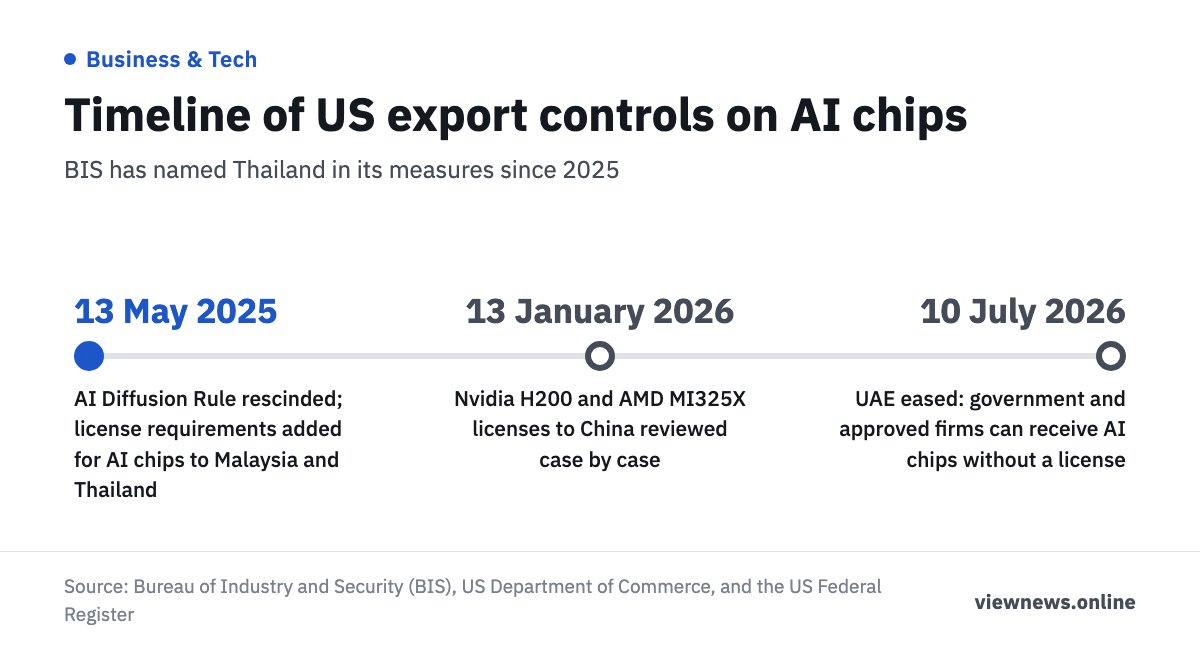
On 13 May 2025, BIS announced the rescission of the Framework for Artificial Intelligence Diffusion, known as the AI Diffusion Rule, which was issued by the previous US administration. BIS said it would issue a replacement rule later.
In the same announcement, BIS set out four chip-related measures:
- Guidance warning industry about the risks of using advanced computing chips made in China.
- Guidance warning about the consequences of allowing US chips to be used to train or run Chinese AI models.
- Guidance to help US companies protect their supply chains from diversion tactics.
- Added license requirements for AI chip exports to Malaysia and Thailand.
The wording matters. BIS said it was adding license requirements. It did not say chips cannot be sold to Thailand. The announcement does not give the details of the conditions that apply to Thailand. The reason BIS gave was known diversion cases, and it did not name any Thai agency or company.
How the US eased chip rules for China
The idea that the US has shut off AI chips to China entirely changed in early 2026. On 13 January 2026, BIS announced a change in license review policy for exports of Nvidia H200 and AMD MI325X chips, and similar chips, to China. The policy moved from a presumption of denial to case-by-case review. The rule was followed by publication in the US Federal Register.
Applicants must show that:
- Exports to China will not reduce the global supply of semiconductor manufacturing capacity available to US customers.
- The buyer in China has procedures to comply with export rules, including customer screening.
- The products have been tested by a third party in the US to confirm their performance and security.
Jeffrey Kessler, the Under Secretary of Commerce for Industry and Security, said in the same announcement: 'Export controls should evolve with changes in technology, while protecting national security.' The statement signals that the US keeps its security criteria but adjusts how it applies controls as technology changes.
The UAE gets an easing, with conditions
On 10 July 2026, BIS announced an easing of export controls for the UAE. The UAE government and approved companies can receive advanced computing items, including AI chips and servers, without a license. BIS said the change reflects the UAE's role as a key US defense partner and referred to an earlier US-UAE AI cooperation framework.
The key condition is that the UAE must keep its commitments to prevent diversion and misuse of sensitive US technology. BIS cited diversion as the reason for license requirements on Malaysia and Thailand. The US is therefore treating each country differently, and the July easing applies only to the UAE.
What AI chip users in Thailand should watch
Data centers, startups and universities in Thailand should ask the vendor two questions before agreeing to buy or rent GPUs. Is the model covered by US license requirements? Has the delivery date changed?
The other point to watch is the rule that will replace the AI Diffusion Rule. BIS said it will be issued later, and no details appear in the announcements reviewed. Anyone affected should keep following BIS announcements and the US Federal Register.
Source: the Bureau of Industry and Security (BIS), US Department of Commerce, announcements of 13 May 2025, 13 January 2026 and 10 July 2026, and the US Federal Register.
This article is adapted from ViewNews' Thai-language report.