
Thailand plans to sort data centers into 7 tiers by the electricity they use, from up to 0.5 megawatts (MW) to 200 MW and above. The higher the tier, the stricter the requirements. The data center policy committee approved the draft at its meeting 4/2569 on 27 October 2026. It is still a draft that must go to the Cabinet. It is not yet law.
The draft matters to two groups: communities living near, or possibly near, a data center, and businesses that buy data storage and processing from providers in Thailand. The committee said the minimum standards are meant to ensure that data centers do not endanger the lives and property of people and communities nearby.
Seven tiers by power demand
Under the draft, a data center is a building or facility that uses electronic equipment to collect, store, process, hold or transmit data for parties other than its affiliated companies, and that needs 0.5 MW of power or more. A facility that serves only its own affiliates falls outside the definition.
The committee set the tiers by the power a facility needs:
- Tier 1: 0 to 0.5 MW
- Tier 2: more than 0.5 to 5 MW
- Tier 3: more than 5 to 10 MW
- Tier 4: more than 10 to 20 MW
- Tier 5: more than 20 to 50 MW
- Tier 6: more than 50 to 200 MW
- Tier 7: 200 MW and above
The table starts at 0 MW, but the definition starts at 0.5 MW. The committee's statement does not say how Tier 1 (up to 0.5 MW) would be regulated.
The rules differ by tier. Tiers 1 to 4, or up to 20 MW, would follow a basic Code of Practice (CoP). Tier 5 would follow a stricter version. Tiers 6 and 7, or 50 MW and above, would face the strictest. The contents of each CoP have not been released.
For example, a facility needing 15 MW is Tier 4 and follows the basic CoP. One needing 60 MW is Tier 6, in the strictest group.
Minimum standards, existing projects and new projects
The minimum requirements cover four areas: location and land-use plans, including storage of backup fuel for power generation; connection to the national electricity and water systems; an environmental CoP report; and economic and social benefits. Each area is graded across the seven tiers.
The Deputy Prime Minister and Finance Minister, who chairs the committee, said the standards will cover power use, water use, town planning, safety and the environment. They apply inside and outside industrial estates. The aim is to balance attracting investment with protecting national interests. New investments will be judged on economic value, links for Thai businesses to supply chains and Thai workforce skills, not just on investment size.
The committee said the new framework cannot, in principle, be applied retroactively to operators that built lawfully under valid construction permits. It therefore set transition rules in groups.
- Operating data centers: the Ministry of Digital Economy and Society (DES) must prepare rules within 1 year so operators comply with the CoP the committee will announce. Operators file their CoP through DC-OSS.
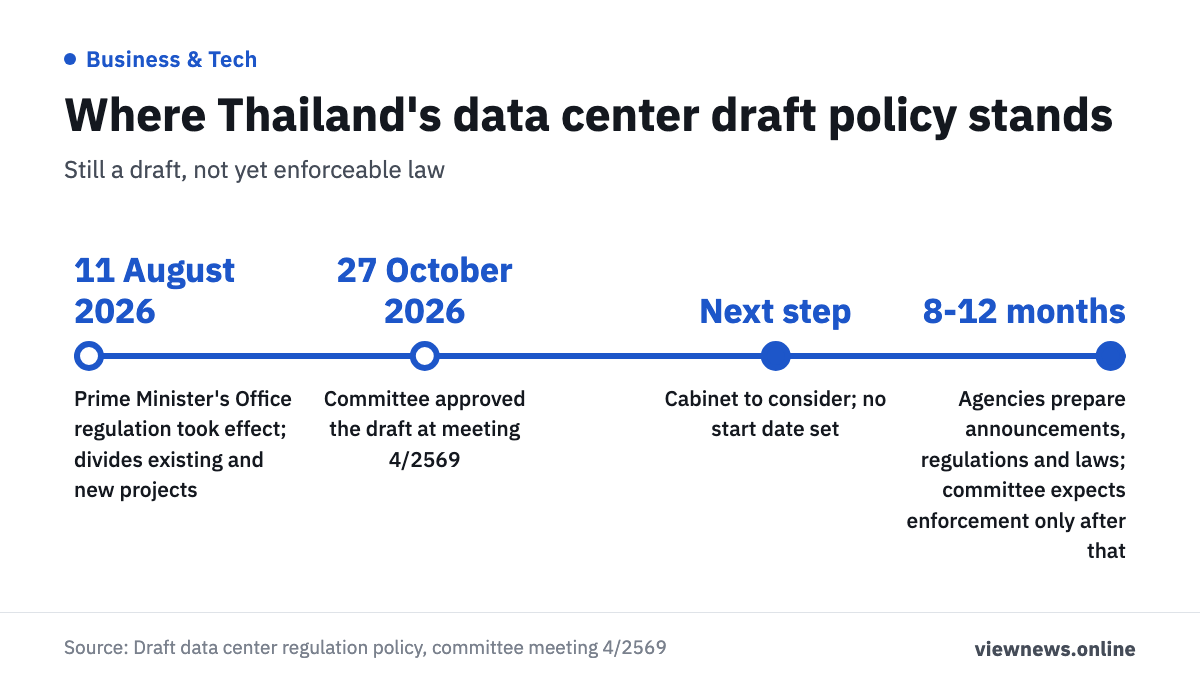
- Projects permitted before 11 August 2026: this is the date a Prime Minister's Office regulation took effect. Projects with a construction permit (Form Or.1 or Section 39 bis) before that date, and completed and ready to open, are reviewed by the responsible agency under existing rules. The agency then informs DES.
- New projects without a construction permit: they must be screened and compete by showing how they will benefit the economy, such as developing people, building supply chains and giving small and medium-sized enterprises (SMEs) access.
The committee said about 63 operators are open and 20 more are under construction, 83 in total, all with a 1-year adjustment period. The Secretary-General of the Office of the National Economic and Social Development Council (NESDC), who serves as the committee's secretary, said more than 100 new projects have been proposed.
Where the draft stands
The committee approved the draft and tasked its secretariat with sending it to the Cabinet. The Cabinet's review is the next step. The draft has no effect yet, and no start date has been set.
Agencies must then prepare or revise announcements, regulations and laws, because the minimum standards add to existing rules. The committee expects this to take about 8-12 months before enforcement.
Two preparatory tasks are under way. DES has been tasked with building the TH-DC Dashboard, which will gather data center approvals and permits from the agencies involved. Subcommittee 1 must draft the step-by-step process operators follow to seek approvals (the User Journey).
Questions for communities and cloud users
The draft is not law, but the tiers already make it easier to ask operators and agencies pointed questions. Communities near a facility and businesses can ask:
- How many MW does this data center need, and which of the 7 tiers is it?
- Does the project already have a construction permit? If not, will it count as a new project that must be screened?
- When does the operator plan to file its environmental CoP report with DC-OSS?
- What are the project's location, backup fuel storage and electricity and water connections?
- Will the project appear on DES's TH-DC Dashboard?
Agencies that approve projects permitted before 11 August 2026 must report the outcome to DES, so DES will hold the data in one system.
For businesses using cloud services in Thailand, a facility that serves parties outside its affiliates and uses 0.5 MW or more meets the draft's definition. Customers can ask their provider which tier its data center falls in and which CoP applies. The committee's statement did not address effects on service fees or customer service.
Source: the draft data center regulation policy, based on the resolution of the data center policy committee's meeting 4/2569, and the committee's statement.
This article is adapted from ViewNews' Thai-language report.