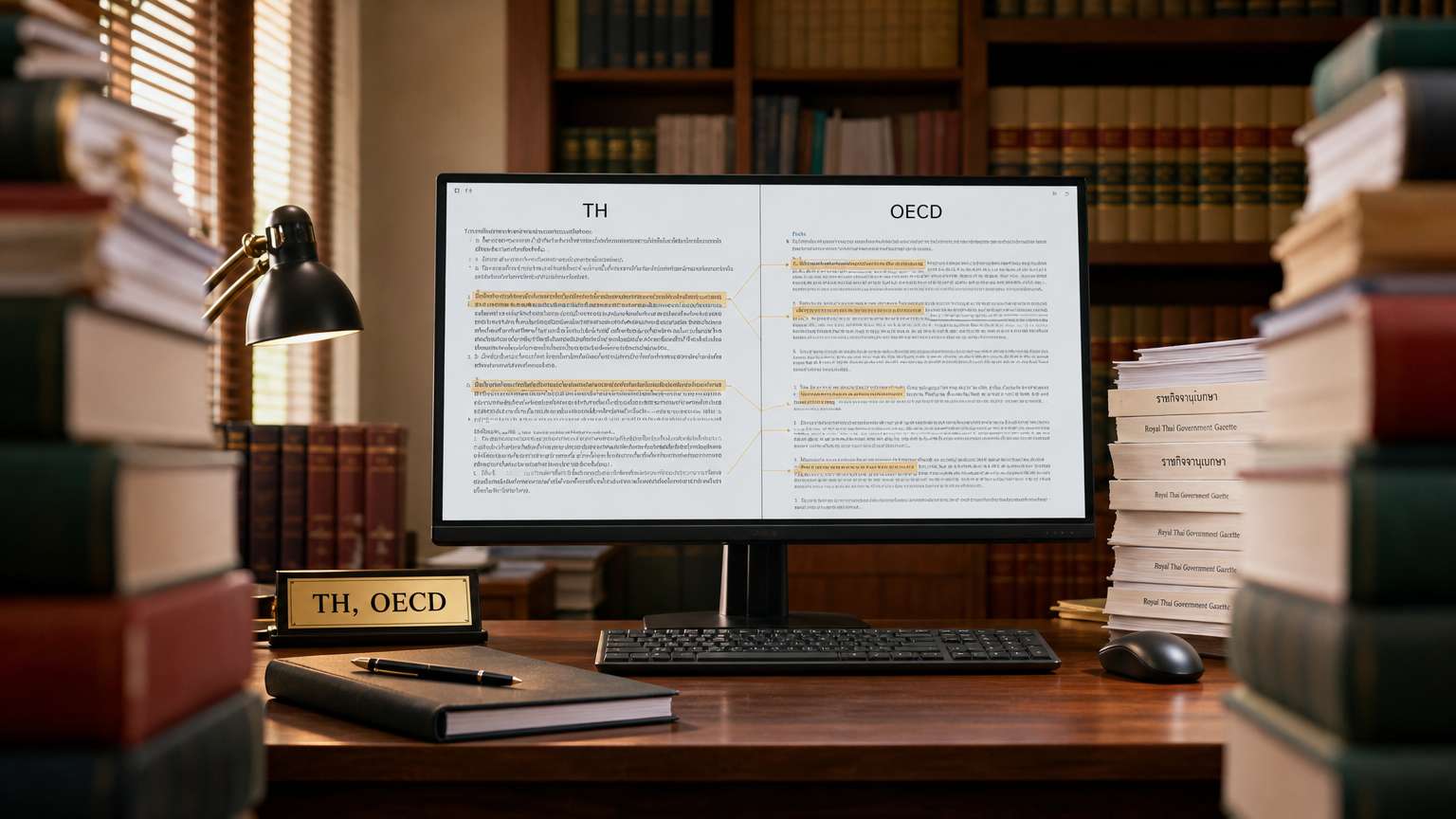
Thailand's Office of the Council of State, the government's legal adviser, is using an AI system called TH2OECD to compare more than 70,000 laws and legal documents with more than 270 legal instruments of the Organisation for Economic Co-operation and Development (OECD). The system was developed with STelligence, a Microsoft partner. Microsoft published an account of the project on 30 June 2025. The aim is to bring Thai law closer to international standards as Thailand works toward OECD membership. The system finds where Thai law and international standards differ. Officials still decide what to do about it.
How the AI comparison works
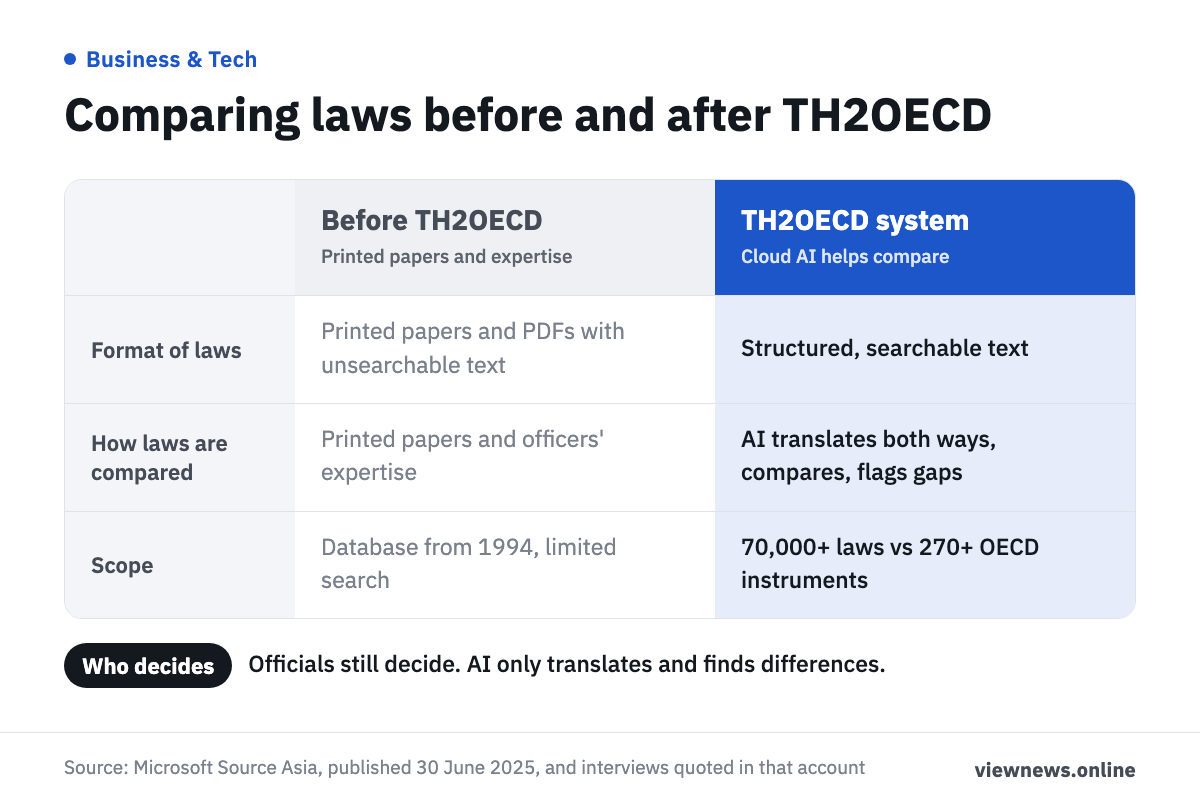
TH2OECD runs on Microsoft's Azure OpenAI service. It automatically translates Thai laws into English and OECD requirements into Thai. It then uses natural language processing to compare the content and point out differences. Council of State legal officers use the results to judge how closely Thai law matches international standards and to suggest where changes may be needed.
Pakorn Nilprapunt, the Council of State's secretary-general, said in Microsoft's account that language is one of the main obstacles to aligning Thai law with international standards. AI translation and comparison helps reduce that obstacle. A Microsoft executive interviewed for the same account said the comparison of more than 70,000 laws with OECD instruments was finished in less than one year.
Before the digital tools, Council of State staff relied mainly on printed documents and the expertise inside the agency. Its earlier legal database, introduced in 1994, had limits in search, data structure and access. The laws and legal documents are deeply linked to each other and must also fit with the constitution and international standards. Working out which law relates to which was hard when the data sat in formats that were difficult to search.
The Council of State used cloud systems to move laws out of PDF files whose text could not be searched and into structured, searchable legal text. Officials can now find the provisions they need more precisely. The structured data is also ready for the comparison system to use.
Staff also use Microsoft 365 and Copilot in daily work. Microsoft says this makes collaboration easier, speeds up document revisions and lets staff analyse policy from anywhere in the country. The account does not say what kinds of tasks these tools are used for.
Why Thailand is comparing its laws with the OECD
The OECD is an international organisation headquartered in Paris. Thailand aims to become a member. According to Microsoft's account, membership would open opportunities in trade, investment and international cooperation. To join, a country's domestic laws and practices must be in line with OECD standards. That is why the Council of State has to check so many laws against OECD instruments.
The Council of State is the Thai government's legal advisory body and has overseen the country's legal framework for nearly a century. Microsoft's account says it is leading a digital shift in how laws are drafted, amended and accessed. The work supports aligning Thai law with international standards and Thailand's OECD application.
Pakorn said OECD membership means a commitment to international standards, transparency and innovation. He said TH2OECD helps Thailand get there faster by restructuring laws to match global good practice. Whether to change a law, and how, remains the job of the people responsible. The AI helps only with translation and with finding differences.
Pakorn is quoted in the Thai version of Microsoft's account as saying: “Digital transformation is not about technology, but about people.”
Plans to extend the system
According to Microsoft, the Council of State plans to extend the system to other government agencies. It also plans to link databases held by the Office of the Cabinet Secretariat and other bodies, and to build a central legal data hub, with AI support, that officials and the public can use. If that happens, people who need to look up Thai law, such as business owners, law students and local officials, could find it in one place more easily.
Microsoft gave no timeline for the expansion. It also did not say that the Council of State uses AI to help draft new laws. The account says only that the agency's wider role will cover drafting, amending and accessing laws, without saying which tools will be used for drafting.
For foreign residents and business people, the report describes a back-office tool and a stated direction rather than a change in any rule. It does not say that any specific Thai law will be amended.
Source: Microsoft Source Asia, “Thailand's Digital Leap: Council of State uses AI and cloud to modernize laws” (English and Thai versions), published 30 June 2025. All information comes from Microsoft and from interviews quoted in that account.
This article is adapted from ViewNews' Thai-language report.