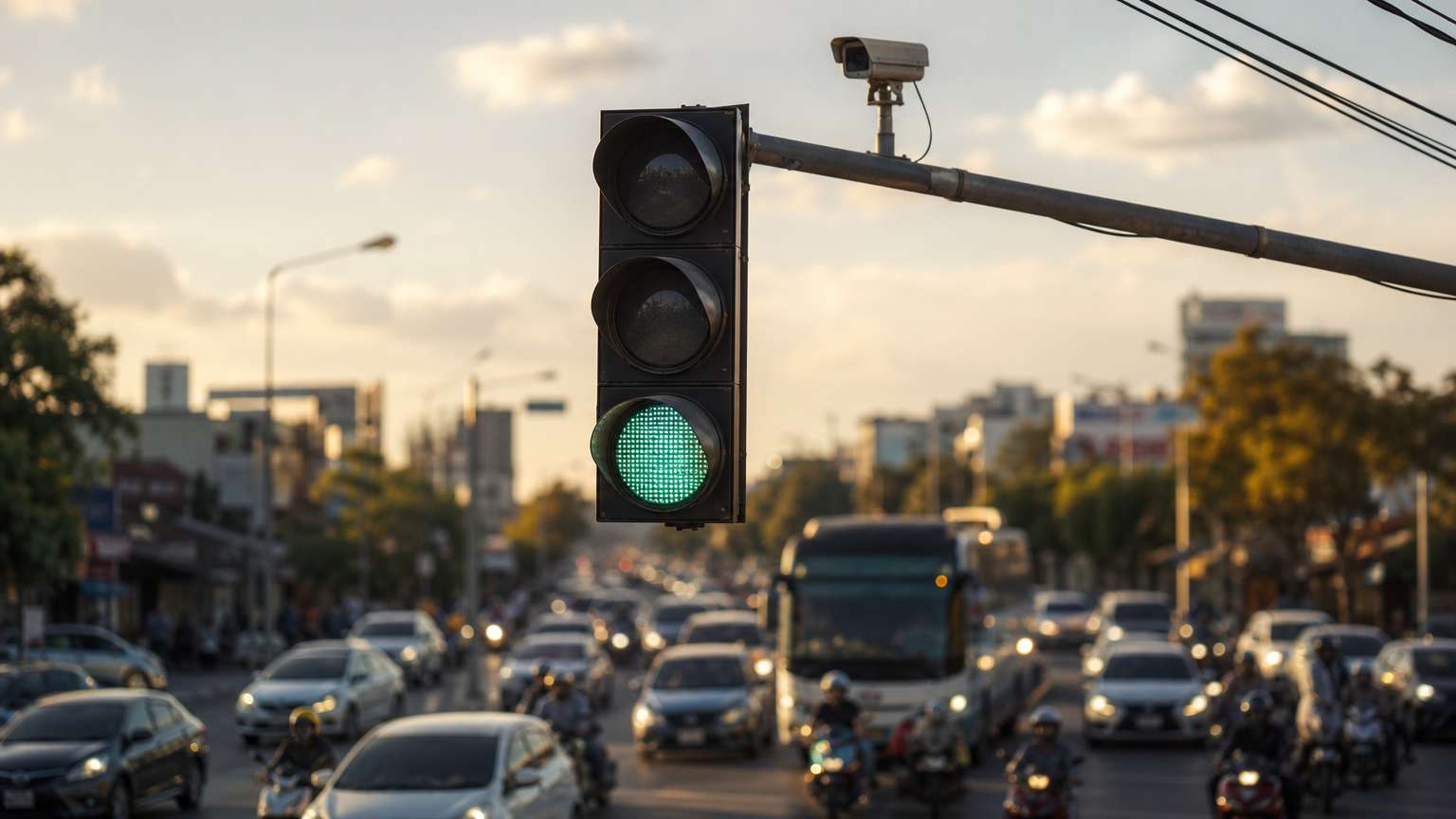
The Bangkok Metropolitan Administration (BMA) changed the traffic signals at 72 junctions in 2024-2025 so they adjust their timing to the actual number of vehicles. The city says delays at those junctions fell by 10-40%. Most of Bangkok's signalised junctions still run on fixed timers, so drivers, motorbike riders and bus passengers will notice the change only at the junctions already upgraded.
Traffic lights: Bangkok has started, most junctions have not
According to the BMA's Bangkok Open Policy page, Bangkok has 561 junctions with traffic signals. Of these, 490 still use fixed-time control, meaning green and red phases change on a set schedule whether traffic is heavy or light. Only 71 use loop detectors, which adjust timing to the volume of vehicles. Fixed timing causes delays because the lights do not respond to traffic that changes through the day.
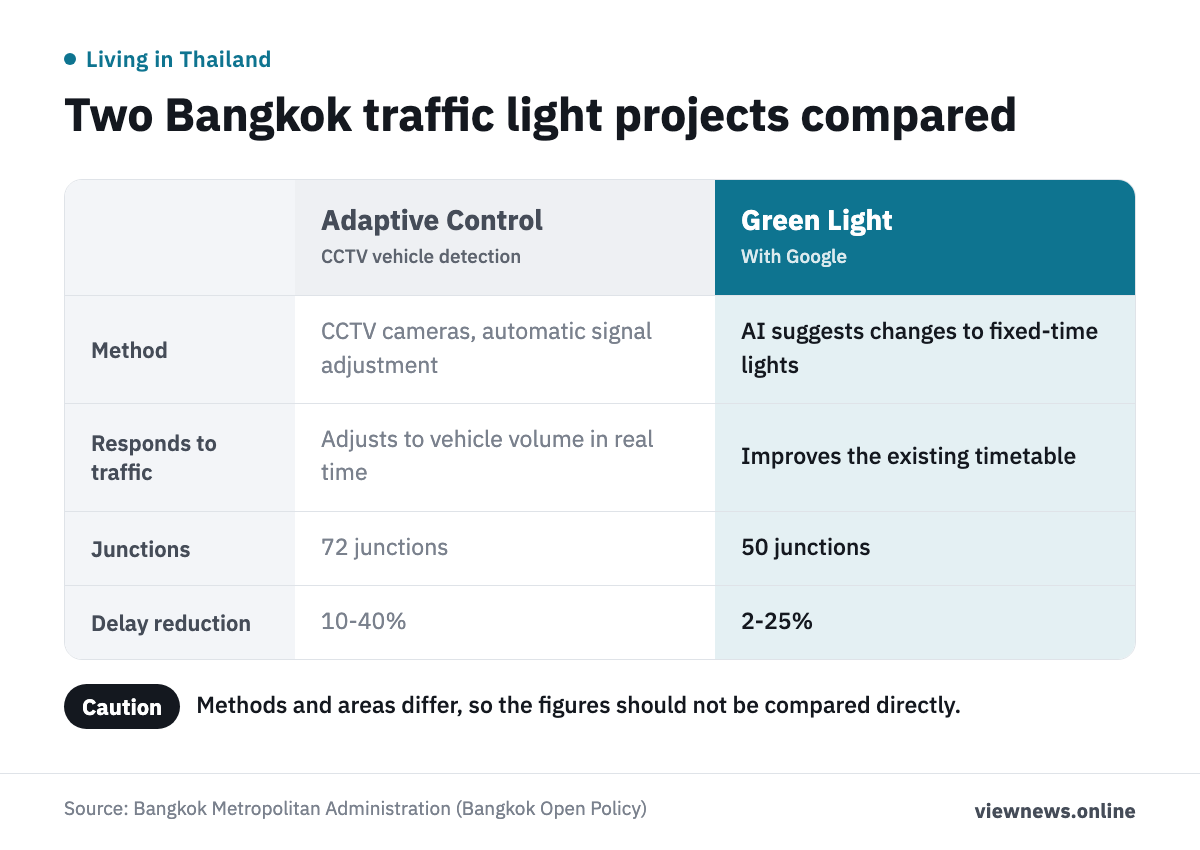
The BMA says that in 2024-2025 it installed CCTV cameras that detect vehicles in real time, together with adaptive control software, at 72 junctions. Delays fell by 10-40%. A separate pilot with the Japan International Cooperation Agency (JICA) used area traffic control on 13 junctions along main roads in 2024. It shortened queues at red lights by 15-30%.
A third project is Bangkok Green Light, a collaboration with Google. It uses travel data and AI to suggest changes to fixed-time schedules. The BMA says it has been applied at 50 junctions and cut delays by 2-25%.
The two sets of figures differ because the methods differ. Adaptive control changes the equipment so lights respond to real traffic. Green Light improves the existing timetable. The numbers should not be compared directly.
The BMA also names one obstacle. It owns the signal equipment, but traffic police operate the signals. It must keep meeting local police to show the benefits so that the officers who control the lights are confident enough to switch the systems on.
How Seoul and Barcelona compare
The Thai report looked at two other cities. Their examples show that much of what is called smart-city technology starts with sensors and data, with AI playing a smaller role.
In Barcelona, the city council installed its first smart junction in the Les Corts district on 8 May 2014. It used 21 sensors embedded in the road to detect vehicles and adjust phase timing, at a cost of 59,000 euros. The council said it cut waiting times at red lights but did not publish measured figures. That system is sensor-based and is not AI as the term is used today.
AI features in a challenge announced on 16 April 2026 by the council's Barcelona Innova Lab Mobility (BILM). Barcelona has 1,823 signalised junctions with about 40,000 signal units, and most still run on pre-set programmes. The council offers funding of up to 100,000 euros, or up to 80% of project cost. Pilots are due to start in late 2026 and run into 2027. The city has not released results.
In Seoul, the city government announced a points scheme for households that cut food waste in 2026, linked to its Eco Mileage system. It relies on data from RFID food-waste bins that record how much each household throws away. Households that cut waste by at least 10%, 20% or 30% against the same period a year earlier earn 2,000, 3,000 and 5,000 points respectively. Seoul has not published results from the first application round.
What it means for road users in Bangkok
The Thai report suggests three questions when a city says it is using AI. First, what is being measured? The BMA measures vehicle delay at junctions. Second, what is it compared with? Third, how far can it spread? With 490 junctions still on fixed timers, much of the work remains.
For anyone driving, riding or taking a bus in Bangkok, the practical effect is that waits at red lights should be shorter, but only at junctions that have been upgraded.
Source: Bangkok Metropolitan Administration (Bangkok Open Policy page), the Seoul Metropolitan Government, and the Barcelona City Council. This article is adapted from ViewNews' Thai-language report.