Thailand plans to add a physical check to company registration, to stop people from registering businesses at addresses they have no right to use. On 6 November 2026, Kittiwat Patchimanan, Director-General of the Department of Business Development (DBD) under the Commerce Ministry, said the department has held talks with Thailand Post. Under the plan, postal workers would help confirm that the address on a registration application is a real location, using GPS coordinates and photographs.
The plan matters to two groups: owners of homes or buildings who do not want their address used to register a company, and entrepreneurs, including foreign investors, who are about to register a new legal entity. It is still at the preparation stage. The DBD said it will draw up a memorandum of understanding (MOU) with Thailand Post in late November or early December 2026. Nothing has been signed and no start date has been set.
Postal workers would photograph the address and record GPS coordinates
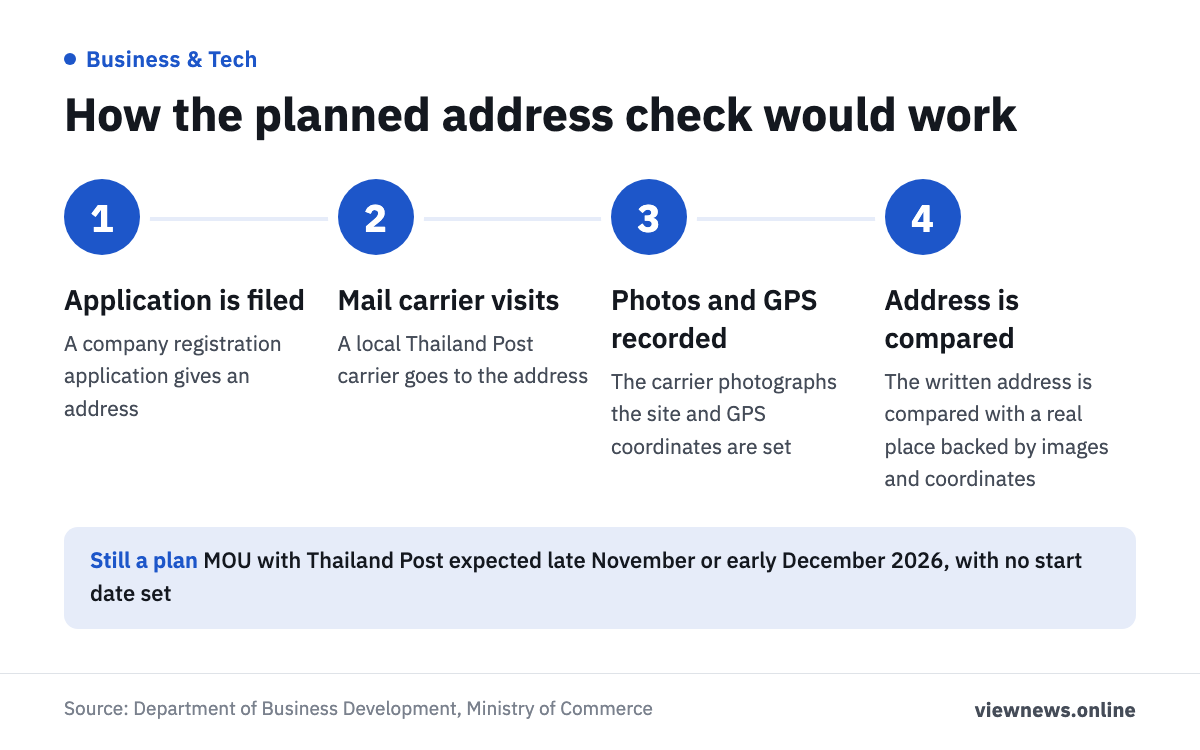
The DBD said it will use two strengths of Thailand Post: its location data and its network of mail carriers across the country. The check has two parts. The first is setting GPS coordinates for the address. The second is photographs of the actual site.
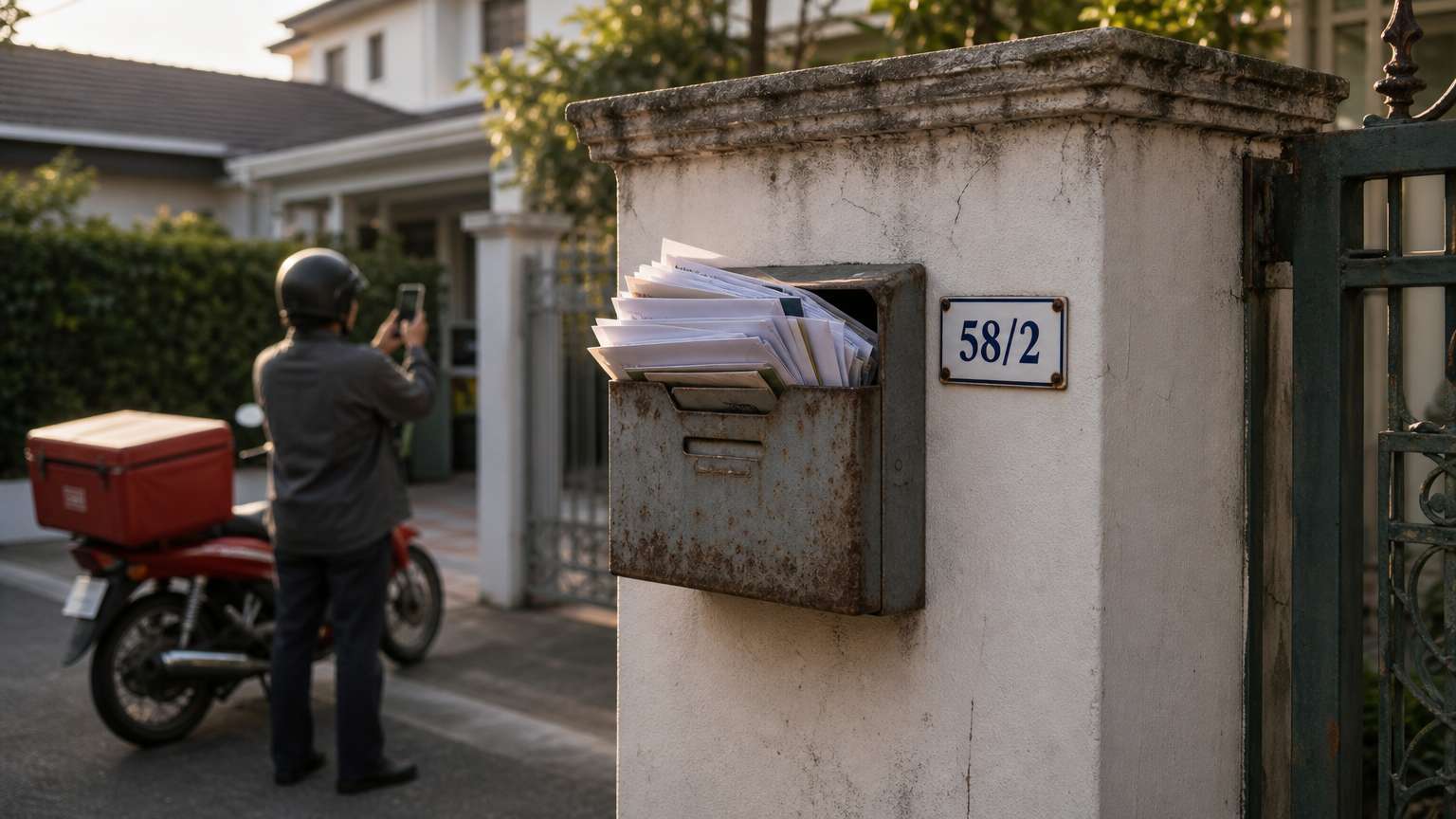
In practice, a local mail carrier would visit the address given in a registration application and photograph it. The address written on the paperwork would then be compared with a real place backed by images and coordinates.
The DBD gave three goals:
- Stop fraudsters from registering companies at phantom addresses.
- Make records traceable, accurate and easy to check later.
- Screen high-risk cases that use nominees to run a business. Nominees are people who hold shares or positions on behalf of someone else. The department said this is the starting point for opening mule accounts in company names to defraud the public.
These are goals stated by the department. There are no results from real-world use to assess yet.
The DBD said the cooperation follows measures against nominee businesses and illegal business operations led by Suphajee Suthumphun, Deputy Prime Minister and Commerce Minister. She has told the department to coordinate quickly with partner networks to tackle the problem firmly.
Digital Post ID and Corporate D/ID would link addresses to coordinates
Beyond the field checks, the DBD said it will develop the use of Digital Post ID (D/ID). This system links personal data, addresses and GPS coordinates. It also named Corporate D/ID, a digital address code service for businesses and government agencies, which lets them connect their address databases directly with Thailand Post.
The department said both systems would be used to exchange documents and electronic data and to link digital infrastructure. It said this would make the data and services of both agencies more efficient and reliable. It also said the systems help protect the personal data of individuals and organizations under the Personal Data Protection Act (PDPA).
No timetable has been given for this part. The department has not said who would have to use the systems or how they would connect to the registration process. It said only that it will "develop the use" of them, which suggests they are still being planned.
What is still unknown
So far, the only thing that has happened is a discussion between the DBD Director-General and the chief executive of Thailand Post. The MOU is meant to set out clear guidelines and the scope of the cooperation, so most details are likely to emerge only after it is signed.
The department has not said:
- Whether the check will apply to every registration application or only some.
- Whether companies already registered will be included.
- How much extra cost or time it will add for applicants.
- How people whose addresses have been misused can report it under the new system.
What address owners and new company founders should know
The problem the DBD wants to fix is the use of addresses without the owner's permission to register a business. The announcement does not describe any channel for owners to ask for a check or report a case. Owners of homes or buildings should watch for DBD announcements and the department's website after the MOU is signed.
For anyone planning to register a new company, the DBD said mail carriers will photograph the address stated in the application. That suggests the address should be a real, usable place that matches what exists on the ground. The announcement does not say what extra documents may be required. Applicants should check the latest requirements with the DBD before filing.
The department also said it wants to bring transparency for both Thai and foreign investors and to improve the country's economic infrastructure for doing business. Whether it reaches that goal will depend on the scope set in the MOU and how the checks work in practice.
Source: Statement by Kittiwat Patchimanan, Director-General of the Department of Business Development, Ministry of Commerce, on 6 November 2026.
This article is adapted from ViewNews' Thai-language report.