Most migrant workers in a Thai government study had never been tested for hepatitis B, and almost nine in ten had never received the vaccine. The Department of Disease Control (DDC) under the Ministry of Public Health and the Health Systems Research Institute released the findings on 5 November 2026. The study covered migrant workers in four provinces: Bangkok, Samut Sakhon, Chiang Mai and Phuket.
The findings matter to employers who arrange health checks for staff and to foreign workers who want to know what to ask for. The numbers come from a sample and need careful reading. The study does not say who is entitled to tests or vaccines, so anyone interested should ask the relevant agency directly.
What the study found among 573 workers
The DDC and the Health Systems Research Institute ran the survey and screening between April and October 2026. They surveyed 578 migrant workers and screened 573 of them. The aim was to see how well screening and monitoring work for HIV, syphilis, and hepatitis B and C among migrant workers. The results are preliminary screening results, not diagnoses.
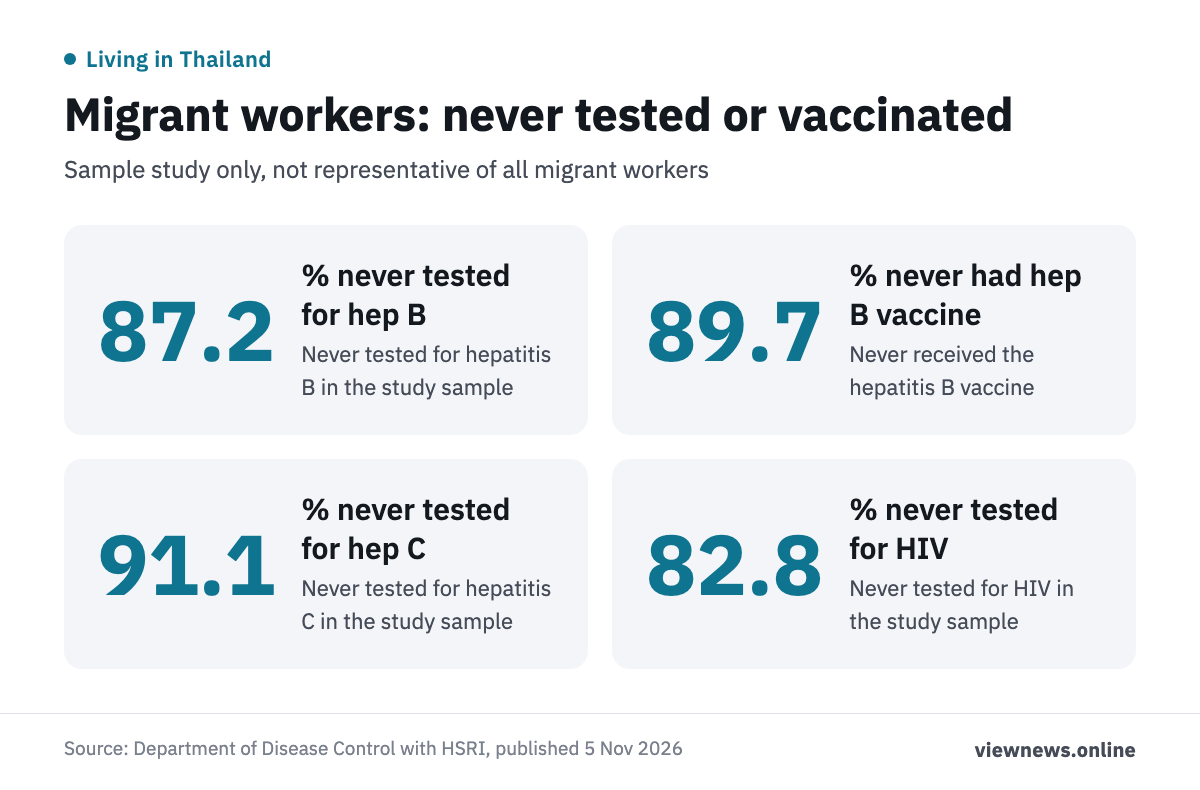
On access to services, 91.1% had never been tested for hepatitis C, 87.2% had never been tested for hepatitis B, and 82.8% had never been tested for HIV. For the hepatitis B vaccine, 89.7% had never received it. The DDC concluded that most migrant workers in the sample still lack access to screening.
The DDC itself warns that the results apply only to the sample and cannot represent all migrant workers. The figures describe the 573 people who took part. They should not be repeated as if the same share holds for all migrant workers in Thailand, or for any single province.
Preliminary positives are not confirmed illness
Among the 573 people screened, 23 (4.0%) had a preliminary positive result for at least one disease. By disease, there were 10 cases of hepatitis B, 8 of syphilis, 4 of HIV and 1 of hepatitis C.
A preliminary positive is not a confirmed diagnosis. The DDC says people with positive results must go through confirmatory testing and treatment. The 4.0% figure should not be read as an infection rate, or as a rate for any group beyond this sample.
The DDC says those with positive results were told privately, given counselling and referred to relevant health facilities for confirmation and care. The agency says a good health system must follow up and help people stay in treatment, not only screen them.
What the researchers recommend
The high share of workers who were never tested or vaccinated suggests services have not reached many people in this sample. Someone who has never been tested does not know their status, and someone never vaccinated against hepatitis B has no vaccine protection.
The researchers proposed four service and policy measures, including including hepatitis B and C screening in routine health checks for migrant workers, together with hepatitis B vaccination. Employers who arrange health checks are directly affected by this proposal. The study does not say who pays for such tests now or what coverage is available.
Stigma, privacy and where to check your coverage
The study also found misunderstandings about how these diseases spread, which can lead to stigma and discrimination. The DDC says health information should be communicated accurately, in languages workers understand and in ways that suit each community.
In practice, employers and co-workers should rely on public health agencies for facts about transmission and should not disclose anyone's test results. People with positive results in this project were themselves informed privately.
The study does not describe entitlements to testing, hepatitis B vaccination or fees under health insurance or social security. Workers and employers should ask the agency that handles their coverage, such as the National Health Security Office (NHSO), the Social Security Office, the Department of Employment, or the clinic or hospital they use. If you are a foreign national, ask about your own eligibility, as this report does not cover it.
This is general information, not personal medical advice. Anyone worried about infection, or wanting to be tested or vaccinated, should see a doctor or health facility.
Source: Department of Disease Control, Ministry of Public Health, report on a study with the Health Systems Research Institute, published 5 November 2026. This article is adapted from ViewNews' Thai-language report.