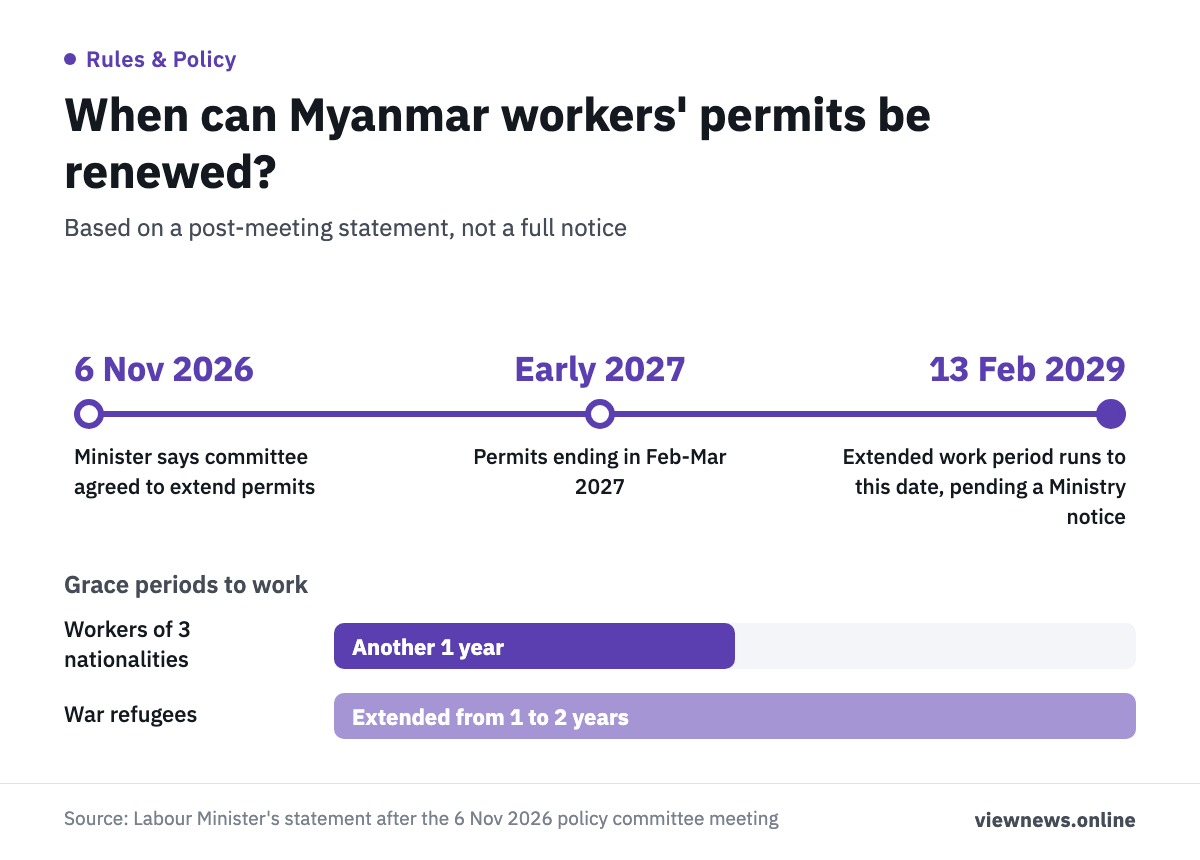
Thailand has not scrapped the CI (identity certification) centres for Myanmar workers. Work permits due to expire in February-March 2027 will be extended so workers can stay on the job until 13 February 2029. Labour Minister Chulapun Amornvivat said so on 6 November 2026, after a meeting of the Foreign Workers Management Policy Committee. The decision matters most to employers of Myanmar staff, because it sets how long those workers can keep working legally.
The remarks came in a post-meeting statement, not a full official notice. The statement did not set out how to renew or which documents are needed. Employers should confirm the actual steps with the Ministry of Labour or the Department of Employment before acting.
Why the government is not abolishing the CI centres
A CI centre issues documents that certify a person's identity. Its main job is to confirm that a foreign worker really holds the nationality they claim. The minister said identity certification is the responsibility of a worker's home country. He compared it to Thai workers sent abroad: the Ministry of Labour may approve the job, but confirming who the person is falls to the country of origin.
Thailand shares a border with Myanmar and hosts many Myanmar workers, so confirming nationality matters, the minister said. Thailand cannot fully verify identities in place of the home country. As he understands it, the CI process uses the home country's national ID card, household registration papers and biometric data together.
He acknowledged that Thailand could verify identities itself, and that it did so alone at times in the past. Going back to that, he said, could lead to people using others' identities and weaken the ability to track workers. He also said the CI centres sit on Thai territory, where Thailand holds 100% sovereignty. That is why the ministry is concerned about the rules under which the centres operate.
There has been a proposal to drop the CI process and use the pink card instead. The minister said it needs careful study. No decision has been made, and neither step has happened. He said the ministry will first negotiate with Myanmar to bring the process in line with international norms.
Permits ending in early 2027 and the grace period for three nationalities
The minister said the committee agreed to extend work permits that end in February-March 2027 so that work can continue until 13 February 2029. Employers with foreign staff whose permits lapse in that window will have longer to plan. The statement gave no filing steps, fees or documents, so the Ministry of Labour's formal notice is still awaited.
The committee also allowed workers of three nationalities who are in the country without proper legal status, hundreds of thousands of people, to stay temporarily and work for another 1 year. The minister said this is meant to keep employment going and let businesses keep operating. The committee also added an option to bring in workers from Sri Lanka under an existing memorandum of understanding (MOU), to fill labour shortages.
On returning home, the minister said that under the MOUs with Myanmar and Laos, workers must still go back to their home country. The trip can be brief: they step onto home soil and then return to work straight away. The aim is to avoid gaps in employment for businesses.
People who fled the war in Myanmar also received relief. The committee let them stay in the district where their temporary shelter is located and extended the permitted work period from 1 year to 2 years. The minister said this eases the state's burden and gives them a legal route into the labour market.
He added that the ministry's main goal is to bring workers of all nationalities into the system and register them properly, so identity and residence can be checked. In some cases, workers whose identity has already been verified can have their permission extended with Cabinet approval, to limit harm to business and the economy.
The 25% remittance issue and what remains unclear
The Thai side said Myanmar requires its workers to send 25% of their income home, and to show transfer slips going back about 3-6 months, as a condition for issuing CI documents. The minister said the money does not go to the Myanmar government. It goes to the workers' families. This is the Thai side's account, and no document from Myanmar confirming the details has appeared.
The Ministry of Labour does not agree. The minister said making this a condition for a CI is wrong in principle, because sending money to family is the right of anyone working abroad. The ministry wants the rules brought in line with accepted international labour standards.
Thailand has invited the Myanmar ambassador for talks 2 times and voiced its concerns clearly. The ministry is now preparing an official letter to Myanmar's labour ministry through the Ministry of Foreign Affairs, and another to the Myanmar Embassy in Thailand. They will say Thailand disagrees and ask for talks to resolve the matter. The minister said he will keep meeting the ambassador and others involved.
Several points are still unclear. The statement does not say which notice created the condition or how it is enforced. There are no official figures on how many workers have completed a CI or been affected. It is also unknown how Myanmar will respond to Thailand's letters. Employers with staff waiting for a CI should ask the responsible agency about progress.
What employers should check
Employers can start by checking each employee's work permit expiry date to see who falls in the February-March 2027 window. Staff in the irregular-status group covered by the 1-year grace period should be tracked separately. Keep watching for Ministry of Labour announcements.
Do not assume the renewal process has begun. Filing steps, documents and fees have not been given. Follow notices from the Ministry of Labour or the Department of Employment directly, and confirm that the 13 February 2029 date and the grace period for three nationalities take effect in the formal notice before making long-term hiring plans.
Three things are worth following: the notices or guidelines issued under the committee's decision, the outcome of Thailand's letters and talks with Myanmar on the 25% remittance condition, and any decision on the proposal to drop the CI process in favour of the pink card.
Source: Statement by Labour Minister Chulapun Amornvivat after the Foreign Workers Management Policy Committee meeting on 6 November 2026.
This article is adapted from ViewNews' Thai-language report.