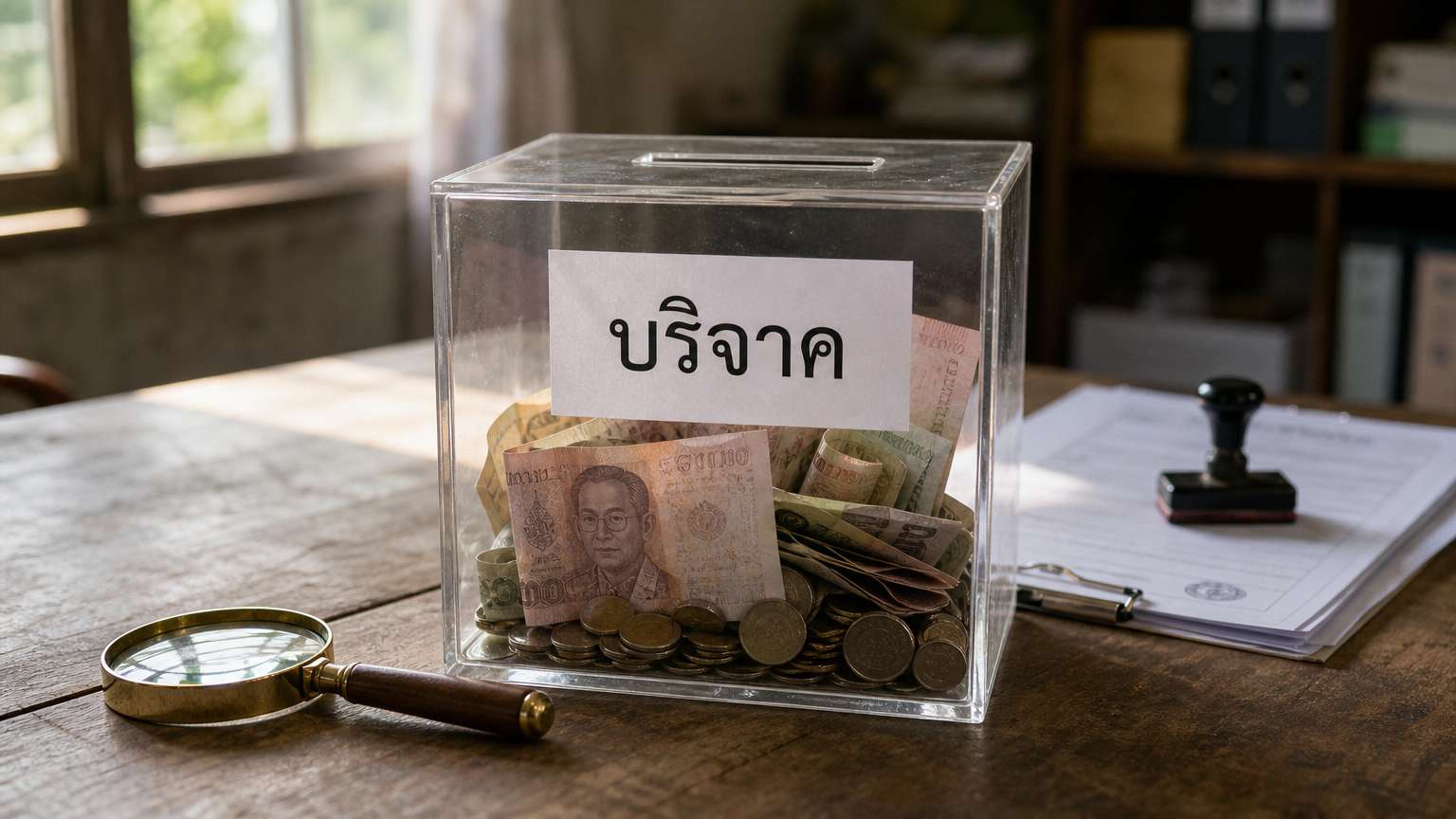
People who donate to charities in Thailand should check a foundation before giving, after the Cabinet asked the Department of Provincial Administration to examine foundations. The instruction came at the Cabinet's provincial meeting in Udon Thani on 3 November 2026. The government spokesperson at the Prime Minister's Office announced it after the meeting. The department sits under the Interior Ministry. It said foundations must operate in line with the purposes they were set up for.
The Cabinet decision and the department's statement set out general principles. They do not name any foundation, and they do not say any foundation or person did something wrong. This article explains what the law already allows when a foundation strays from its purpose, and what donors can ask before they send money.
The Cabinet orders a check on foundations
The Cabinet's action was an assignment of work. It asked the Department of Provincial Administration to check that each foundation operates according to its stated purposes. The detail comes from the government spokesperson's briefing on the meeting.
At this stage it is only an order to examine. No foundation has been found to have acted rightly or wrongly. No foundation has had its directors removed or been ordered closed because of this decision.
The department also stressed that a news report or an allegation is not proof that wrongdoing took place. Readers should not conclude that a particular foundation is guilty because of something they have heard or seen shared online.
When a court can remove directors or dissolve a foundation
On 30 October 2026 the department explained that the law covers two situations. Both are in the Civil and Commercial Code.
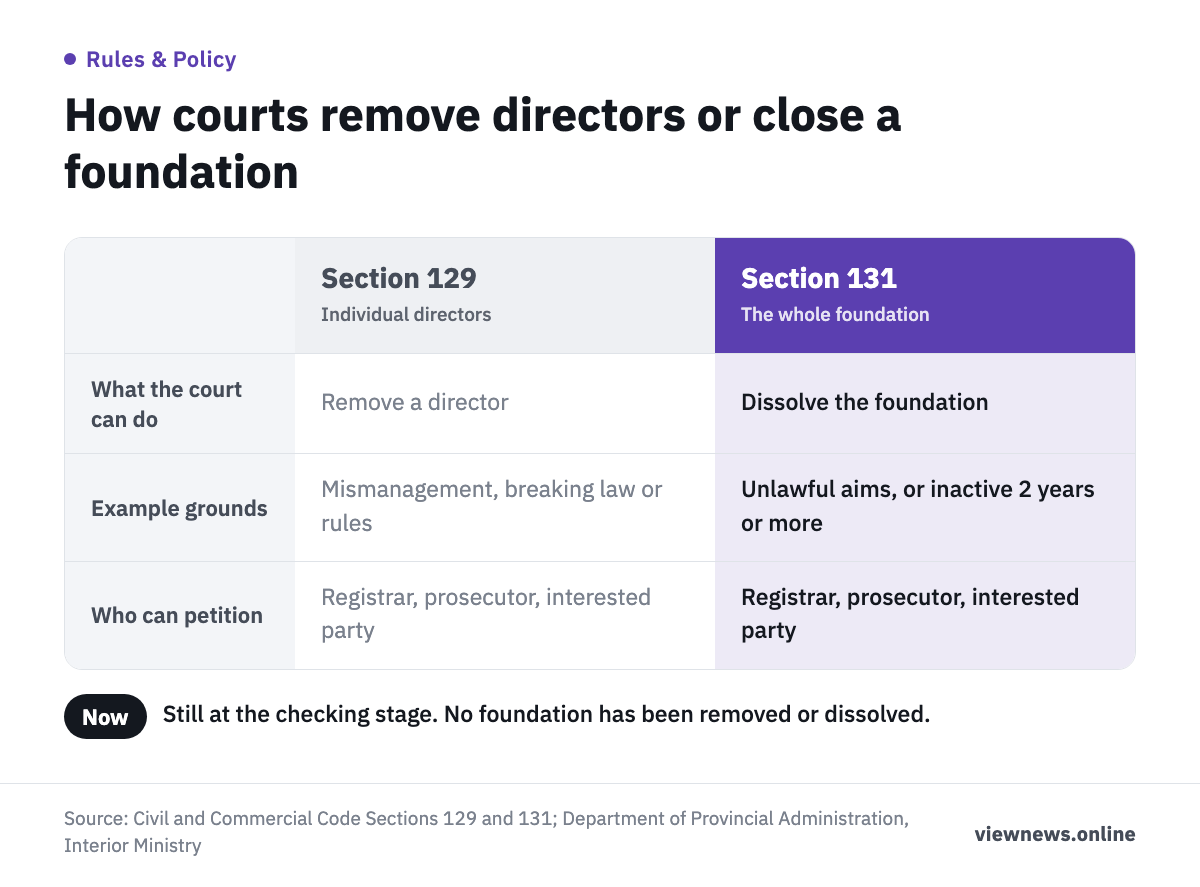
The first is wrongdoing by a foundation's directors, under Section 129. A court can be asked to remove a director or board member who:
- runs the foundation badly enough to damage it;
- breaks the law or the foundation's own rules; or
- is unsuitable in status or conduct to carry out the foundation's purposes.
Three parties can ask the court to act: the registrar, a public prosecutor, or an interested party. The person asking must file a petition with the court.
The second situation is a foundation acting against the law, under Section 131. A court can order a foundation dissolved in several circumstances. Examples include a foundation whose purposes or activities are contrary to law or public morals, that may threaten public peace or state security, that cannot continue operating, or that has stopped operating for 2 years or more.
The same three parties can petition under Section 131. The difference is the target. Section 129 concerns individual directors. Section 131 concerns the whole foundation and whether it should continue to exist.
How to check a foundation before you donate
The department said a foundation's work must follow the principles of transparency, accountability and adherence to its registered purposes. This applies especially to how it manages donations and assets. A donor can use these principles as questions before transferring money. Does the foundation's work match its registered purposes? Is it open to scrutiny over how it spends money?
The department gave its reasons for these principles. They protect the public interest, maintain the confidence of the public and donors, and prevent foundations from being used as a tool for unlawful gain.
The statements released so far do not say where to look up a list of foundations or where to file a complaint. Be careful with links or contact channels that circulate without a clear source. If you are unsure, ask the foundation directly for its registered purposes and for information on how donations are used.
The department also noted that any legal action against a foundation needs facts and evidence from a thorough examination. It must be fair to all sides and follow the steps set by law. Donors should therefore separate allegations from findings, and wait for conclusions from the authorities with the power to decide.
What happens next
The matter is still at the stage of the department being asked to check foundations. No foundation has received a finding. None has been dissolved, and no directors have been removed under this decision. The statements released so far do not say when the checks will be finished.
Sections 129 and 131 are the legal framework. They allow the registrar, a public prosecutor or an interested party to ask a court to act.
Source: Department of Provincial Administration, Interior Ministry (statement of 30 October 2026); government spokesperson at the Prime Minister's Office (briefing on the Cabinet's Udon Thani meeting, 3 November 2026); Civil and Commercial Code, Sections 129 and 131.
This article is adapted from ViewNews' Thai-language report.