The Thai Cabinet has approved a new Social Security bill that would raise the maximum age for Section 33 insured employees from 60 to 65. The bill is not yet law and has no legal effect. Insured people and employers remain under the current Social Security Act of 1990. The Cabinet met in Udon Thani on 3 November 2026 and endorsed the draft proposed by the Ministry of Labour. A deputy spokesperson for the Prime Minister's Office announced the decision, as reported by The Standard, Krungthep Turakij and Thansettakij.
Section 33 covers people employed by a company. The bill also changes benefits for childbirth, disability and old age. None of the new rules described below can be used now.
The age 65 limit is not a pension age
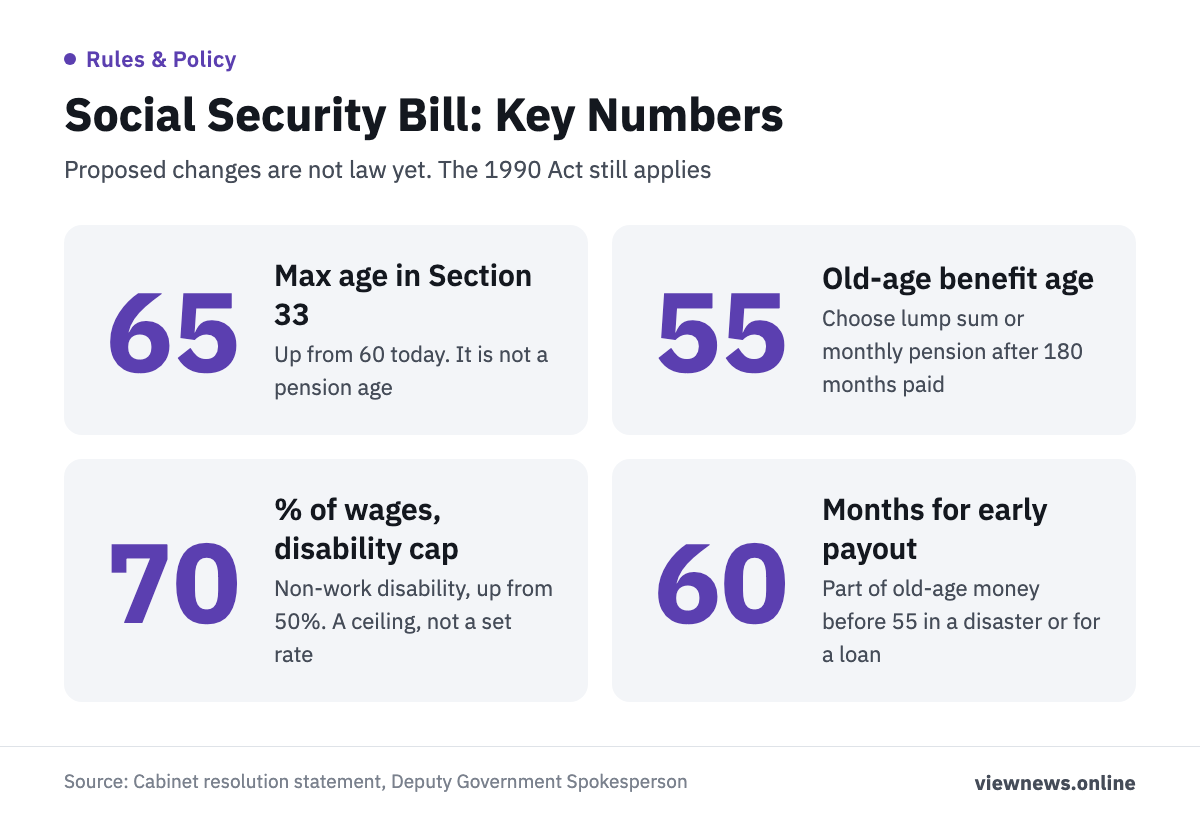
The most common point of confusion is the number 65. It is the maximum age at which an employee can stay in Section 33. The current limit is 60. The bill raises it to no more than 65 full years.
It is not the age at which a pension starts. The age tied to the old-age benefit in the bill is still 55. Anyone who has paid contributions for 180 months can choose either a lump-sum old-age payment or a monthly old-age pension. They can choose at age 55 or when their insured status ends. The first number says who can stay in Section 33. The second says when old-age payments can be chosen.
What the bill changes compared with the current Act
For disability not caused by work, the current Act pays compensation for lost income at 50% of wages. The bill raises this to no more than 70% of wages. The deputy spokesperson described 70% as a ceiling. How the actual rate would be set in each case has not been explained.
For children, the bill would continue child allowance payments for 6 months after an insured person leaves work. On childbirth, it would align the allowance for time off with labour protection law. The report does not say what the current amounts are or what the new figures would be, so it is unclear how much more anyone would receive.
The government says the 1990 Act has been in force for a long time and some of its provisions no longer suit current conditions. The bill is meant to prepare for an ageing society and add protection for insured people.
Early old-age payments, pensioners and employers
People who have paid contributions for at least 60 months could ask for part of their old-age money before age 55 in two cases:
- A serious disaster affects their livelihood.
- They use part of the money as security for a loan from a financial institution that has an agreement with the Social Security Office. The amount cannot exceed 30% of the old-age money or 2 times the maximum wage base. No baht figure has been given.
Old-age pensioners who have left work could join the system again under the bill. The government would contribute 1 part and the insured person 2 parts. Cover would include sickness, disability and death.
For employers, the bill would change penalties in some cases, such as failing to file forms on time. These would move from criminal penalties to administrative fines under the Administrative Fines Act of 2022. The stated reason is fairness and proportion. Employers must still follow social security law. Only the form of the penalty changes in the cases the bill names.
What happens next and what is unclear
So far only the Cabinet has approved the bill. The next step is review by the House of Representatives coordination committee, then submission to the House. It has not passed the House, so it is not law. Until then, the current rules apply as usual.
The Cabinet also noted a plan for 18 pieces of secondary legislation, to be completed within 60 days after the law takes effect. Finer details of the benefits may be set there.
Not yet disclosed are the contribution rate for insured people aged 60 to 65, the loan or withdrawal limits in baht, and the revised childbirth allowance figures. The report does not say how the bill would apply to foreign employees. Foreign workers should check with their employer or the Social Security Office, and watch for official announcements as the bill moves through Parliament.
Source: statement by the Deputy Government Spokesperson on the Cabinet resolution, as reported by The Standard, Krungthep Turakij and Thansettakij.
This article is adapted from ViewNews' Thai-language report.