
Thailand does not yet have a binding law dedicated to artificial intelligence. What exists is a draft AI Act, pushed by the Ministry of Digital Economy and Society (DES) and the Electronic Transactions Development Agency (ETDA) as the country's first overarching AI law. The rules that finally emerge will decide how transparent and accountable AI systems must be, including those that affect people living and working in Thailand.
What the draft AI law would require
Thai PBS Policy Watch reported on 1 August 2026 that the draft regulates AI by risk level. Low-risk AI would follow general guidelines. High-risk AI would face stricter measures. A national committee that drives the national AI plan would decide which types of AI count as high-risk, while sector regulators, such as those for finance, health and transport, would oversee their own areas.
Thansettakij reported on 17 July 2026 that users of systems classed as high-risk would have to assess risks, monitor impacts and apply measures to reduce them.
Both outlets reported that the draft lists banned uses. These include unfair discrimination against large numbers of people through large-scale data processing, and hidden techniques that steer or distort users' decisions. The list can be expanded later. Some types of AI may also have to notify authorities, register or obtain a licence before launching a service.
For AI-generated images and audio, known as deepfakes, the draft sets transparency duties at four levels:
- AI providers must make outputs machine-detectable and keep logs.
- Ordinary users must tell audiences that content comes from AI where it involves defined risks.
- Businesses that deploy AI have extra risk-management duties.
- Online platforms must have systems to detect AI-generated content and label it when someone reports it and a review is under way.
On penalties, Thai PBS Policy Watch reported that the draft would let the state suspend services and impose penalties for non-compliance. Thansettakij added that people harmed could claim civil damages, and that regulators could order fixes within a set time, recall products or order a system to stop. Neither report gave fine amounts.
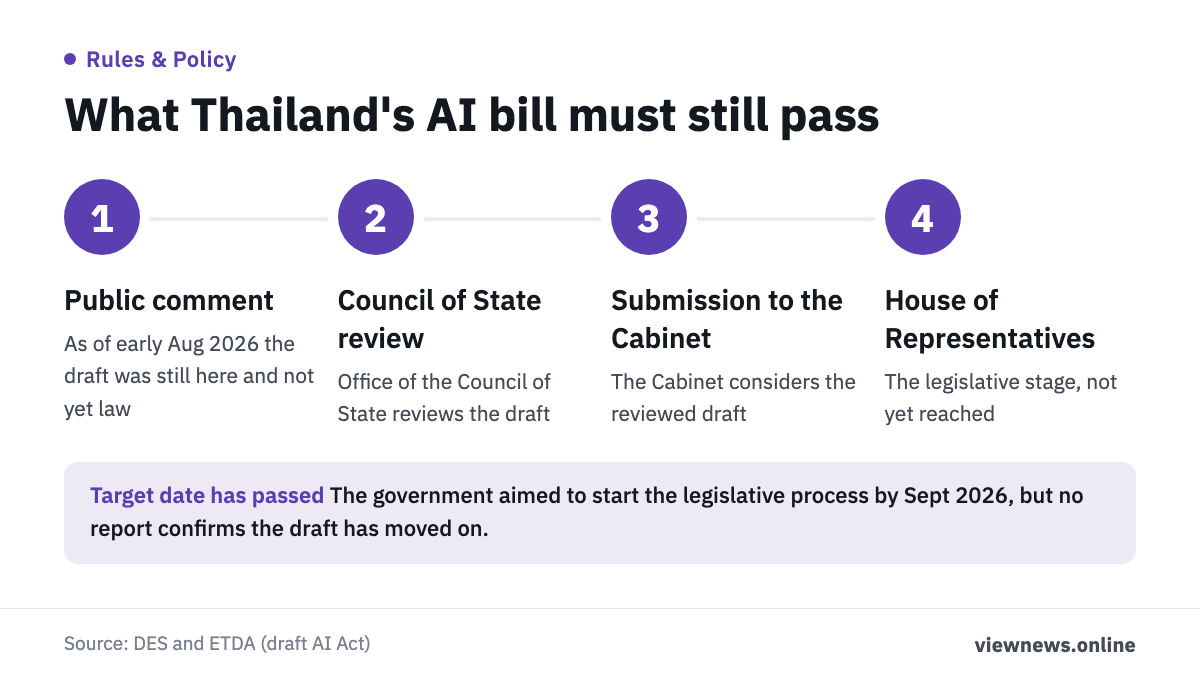
Where the draft stands
The latest status confirmed by those reports is early August 2026, when the draft was still open for public comment and was not law. The next steps are review by the Office of the Council of State, then submission to the Cabinet and the House of Representatives.
The government had aimed to send the draft into the legislative process by September 2026. That target has passed. As of early November 2026, no government agency or news outlet has confirmed that the draft has reached the Council of State, the Cabinet or Parliament. Anyone running a business or building AI systems in Thailand should treat the details as subject to change and wait for announcements from ETDA and DES.
In the meantime, ETDA runs the AI Governance Practice Center (AIGPC). According to ETDA's official page, it works in four areas: developing ethics and governance frameworks and tools for AI, tracking overseas incidents and standards, building skills through training, and linking expert networks.
ETDA also describes an AI Sandbox as a framework where developers test AI in a closely controlled setting. Regulators help assess risks to human rights and user safety before a system reaches the market. ETDA says Thailand's version is still at the concept stage.
Public AI tools already in use
Traffy Fondue is a system developed by the National Electronics and Computer Technology Center (NECTEC), part of the National Science and Technology Development Agency (NSTDA). It lets residents report local problems to the responsible agency. NSTDA's 2023 performance report said it had received more than 500,000 reports, with 11,808 agencies using it and 54,768 officials active across 53 provinces.
The same report said reports reached officials faster, falling from 1.1 days to 0.6 days, and problems were solved faster, falling from 16 days to 4 days. These figures are for 2023.
AI For Thai is a NECTEC project built by its AI research group. It offers AI services through APIs in three groups: language processing (word segmentation, translation, sentiment analysis), vision (optical character recognition, or OCR) and conversation (speech-to-text, text-to-speech and chatbots). It focuses mainly on the Thai language.
What to watch
The draft touches several accountability questions. These include the duty to disclose AI-made content, platforms' duty to label it when reported, and harmed people's right to claim civil damages. How strict the rules become depends on the final text, which must still pass the Council of State, the Cabinet and Parliament. Readers who use online platforms or work with AI systems should watch whether these provisions survive.
Source: Thai PBS Policy Watch (1 August 2026); Thansettakij (17 July 2026), citing DES and ETDA; ETDA (AIGPC and AI Sandbox pages); NSTDA 2023 performance report; NECTEC (AI For Thai page).
This article is adapted from ViewNews' Thai-language report.