Thailand will charge a 35% excise tax on imported battery electric vehicles (BEVs) and range-extended electric vehicles (REEVs) from 1 January 2027. BEVs were previously taxed at 10% and REEVs at 15%. The Cabinet approved the change at a meeting held in Udon Thani province on 3 November 2026. Anyone in Thailand planning to buy an imported electric car, and the dealers who sell them, will need to factor in the new tax from the start of next year.
Finance Minister and Deputy Prime Minister Ekniti Nitithanprapas announced the decision, according to reports by News1Live and Business Today. The measure does not cover every electric car sold in Thailand. Business Today reported that it targets vehicles imported from abroad, especially those not covered by government investment promotion schemes. A model you are considering may or may not fall into the affected group.
The new rates compared with the old ones
The higher rate applies to two vehicle types. A BEV runs only on battery power and an electric motor. A REEV is driven by an electric motor and can be plugged in, but it has a combustion engine that generates electricity to extend its range.
- Imported BEVs: 35%, up from 10%. That is 25 percentage points higher, or about 3.5 times the old rate.
- Imported REEVs: 35%, up from 15%. That is 20 percentage points higher.
These are tax rates, not retail prices. Prices depend on several factors, and no carmaker has announced new prices yet.
Why the government says it is doing this
The finance minister said the change follows decisions by the National Electric Vehicle Policy Committee, known as the EV Board, at its first meeting of 2025 on 25 November 2025 and its first meeting of 2026 on 10 September 2026. The stated aims are to encourage investment in making or assembling key vehicle parts in Thailand, and to protect the stability of the Thai auto industry as competition grows from imported cars outside the government's support schemes.
The government set out three principles for the tax restructuring:
- Investment-driven imports, linking imports to investment and production in Thailand.
- A regional and global EV hub, making Thailand a center for producing and exporting environmentally friendly vehicles.
- High value-added local content, increasing the use of locally made parts, especially higher-value ones.
These are the government's stated reasons. The actual effect on the EV market will only be clear after the new rate takes effect.
Who is affected and what buyers should check
The clearly affected group is BEVs and REEVs imported from abroad that are not covered by government investment promotion. Dealers who import these cars will have to recalculate their costs.
Cars under investment promotion may not be affected, since the measure is not a tax rise on all EVs. However, no document yet confirms which models or brands are in that group. It is also unclear how the change applies to cars under the government's EV 3.0 and EV 3.5 schemes. Do not guess from a brand name or from where you heard a car is built.
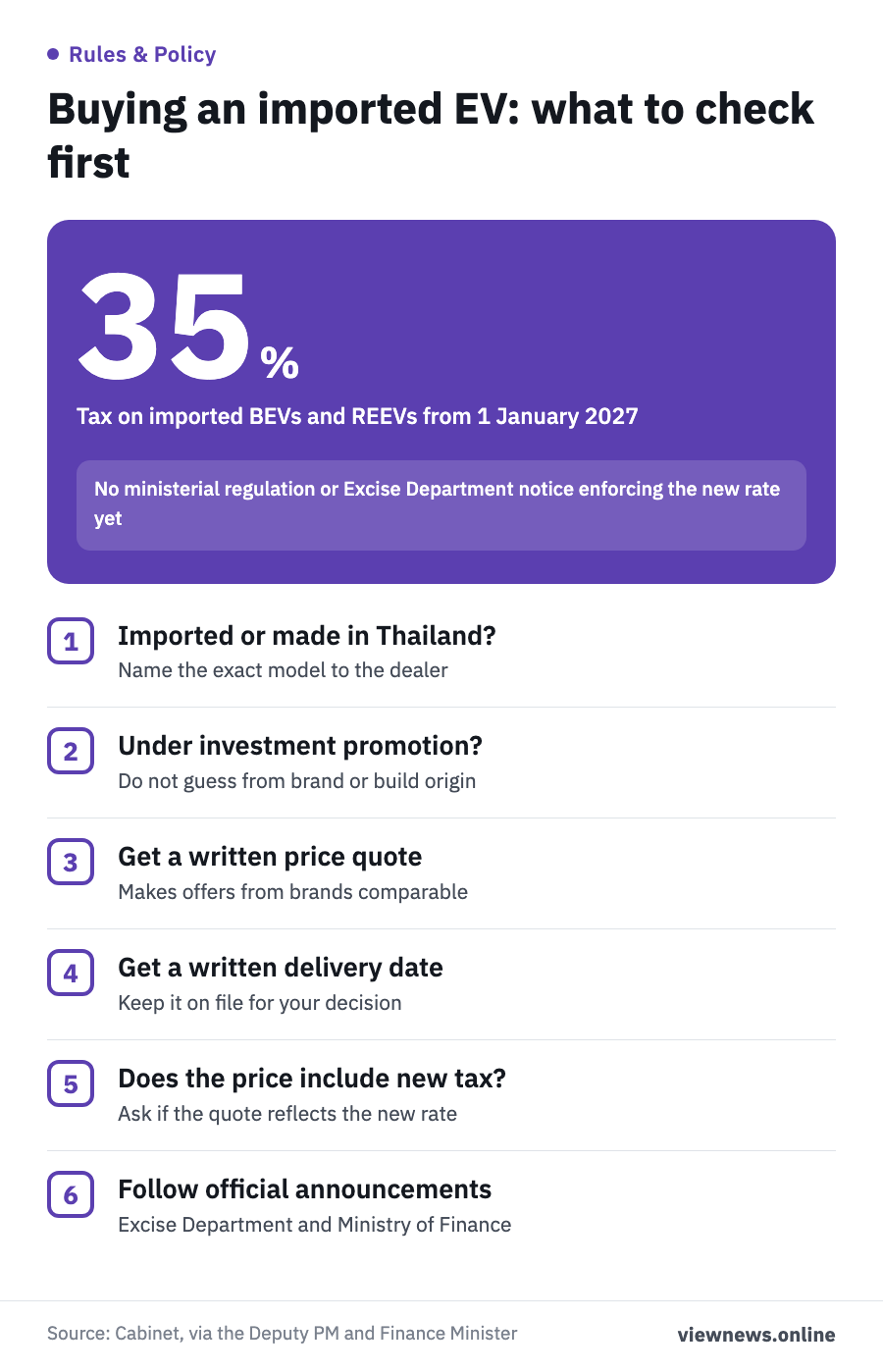
The Thai report does not say whether anything differs for foreign residents or tourists buying a car. Ask the dealer directly. Here is what to ask, and get the answers in writing:
- Is the model you want imported, or built in Thailand?
- Is it covered by a government investment promotion scheme?
- Can you have a written price quotation?
- Can you have a written delivery date?
- Does the quoted price already include the new tax rate?
- Follow announcements from the Excise Department and the Ministry of Finance.
Written answers make it easier to compare offers from different brands. Decide based on your own budget and needs, not on price rumors.
What is still unclear
The Cabinet has approved the 35% rate and the start date. However, no ministerial regulation or Excise Department notification enforcing the new rate has been issued yet. Details of how it will work depend on those official documents.
Three main questions remain open:
- Retail prices: no one has said which models or brands will rise, or by how much.
- Exemptions: it is not clear how cars under EV 3.0 and EV 3.5, or cars made in Thailand, will be treated.
- New investors: conditions for new investors have not been detailed.
If you are comparing car prices, check the rate and any exemptions again once the official notice is published.
Source: Cabinet of Thailand, via statements by the Deputy Prime Minister and Finance Minister, as reported by News1Live and Business Today.
This article is adapted from ViewNews' Thai-language report.