Thailand received 308,942 Chinese tourists in October 2026, down 13.57% from the same month last year, according to the Ministry of Tourism and Sports. The Association of Thai Travel Agents (ATTA) says it is the first monthly decline for the Chinese market since February 2026. China is still Thailand's top source market, and its year-to-date total remains above last year's. Hotel owners, tour companies, restaurants and other tourism workers should read the monthly and cumulative figures together.
What the October figure says
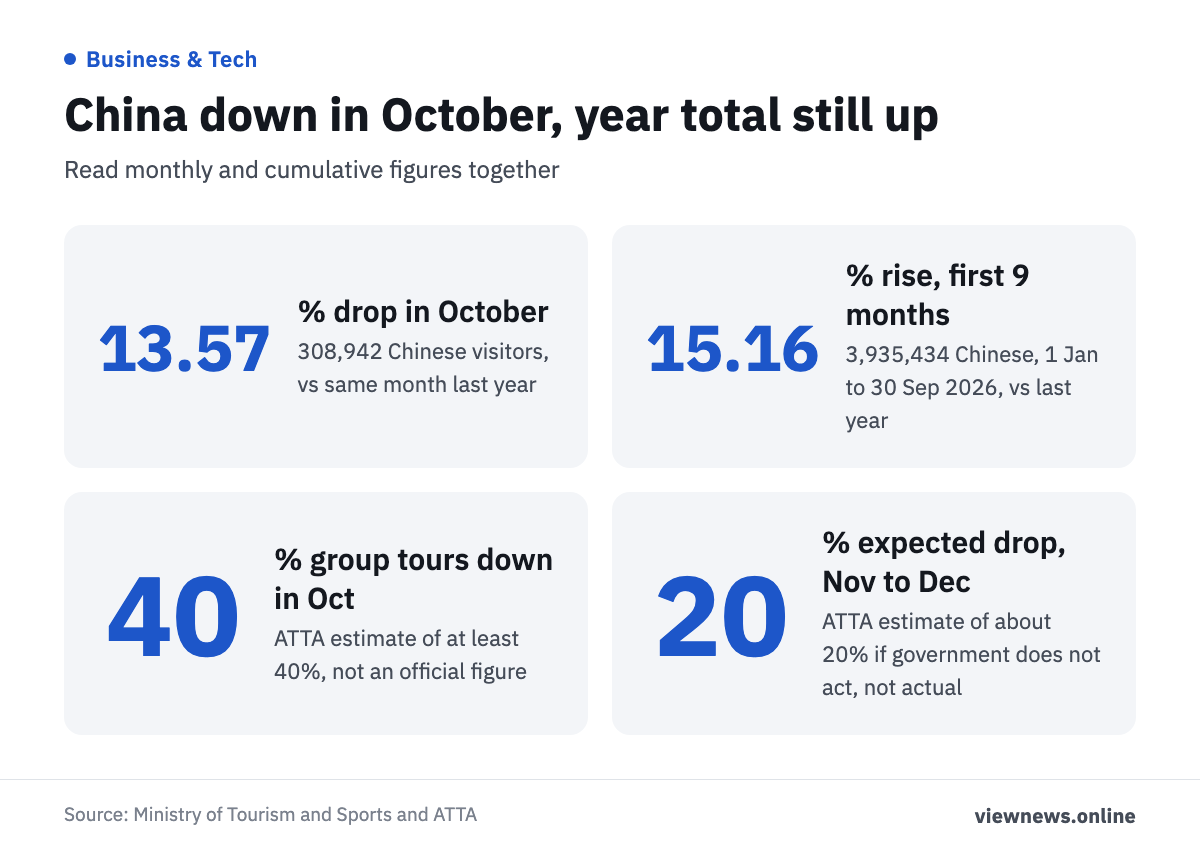
The ministry reported 308,942 Chinese arrivals in October, down 13.57% from October last year. ATTA says this is the first time since February 2026 that the Chinese market has fallen. In the months between, the market was not in decline, so October marks a reversal in direction.
For group tours, ATTA estimates that October was down by at least 40%. This is the association's own estimate, not an official ministry figure. It suggests group tours were hit much harder than the 13.57% headline number.
Why the year-to-date total is still higher
The reason lies in the base of the numbers. The ministry's figures for the first nine months (1 January to 30 September 2026) show 3,935,434 Chinese visitors, up 15.16% from the same period last year. China ranks first. Malaysia is second with 2,950,327 visitors, down 15.19%.
Adding October to the nine-month total gives 3,935,434 + 308,942 = 4,244,376 visitors. This is our own calculation, not a cumulative figure published by the ministry. It does show that China sent more than 4.2 million visitors to Thailand from January to October. With the first nine months up 15.16%, one month at minus 13.57% is not enough to pull the Chinese total below last year's.
The picture for all foreign arrivals is different. In the first nine months, Thailand had 23.2 million foreign visitors, down 3.8%. Tourism revenue was 1,142,485 million baht, down 2.26%. China is a large market that is growing while the overall total is falling.
Someone who reads only the 13.57% headline may conclude the Chinese market is weak all year. Someone who reads only the cumulative total may see nothing to worry about. Both views are incomplete.
A safer approach is to separate the questions. The monthly figure, compared with the same month last year, shows the current direction. The cumulative figure shows how large the customer base has been over the year. Businesses planning for the high season should watch both.
Two explanations for the drop
ATTA believes a warning from the Chinese Embassy in Thailand about the risk of job-scam gangs has hurt confidence in travelling to Thailand.
One analyst offers another view. They see part of the October decline as a normal slowdown after the long China National Day holiday. With two explanations pointing in different directions, it is too early to say which carries more weight.
What to watch next
October is the latest official figure for the Chinese market. There are no statistics yet for November and December. ATTA estimates that if the government does not act, Chinese arrivals in the last two months of the year could fall by about 20% from a year earlier. It also says Chinese New Year group tours could drop by more than 50%. All of these are the association's estimates, not actual figures.
For business owners and service workers, three things are worth watching:
- Whether the November and December statistics stay negative or turn positive.
- The official full-year cumulative figure from the ministry.
- Group tour numbers compared with the overall total, since ATTA estimates October group tours fell far more than the headline figure.
Businesses that depend mainly on Chinese group tours should track that segment separately from the total and not rely on the headline alone. The overall October figure is down 13.57%, but China's cumulative total is still above last year's. Reading the monthly number, the cumulative total and group tours together gives a more accurate view of the high season.
Source: Ministry of Tourism and Sports tourist arrival statistics, and estimates from the Association of Thai Travel Agents (ATTA).
This article is adapted from ViewNews' Thai-language report.