Thailand is preparing new import duty rules for goods ordered online from overseas and shipped by express courier or international mail. Shoppers should expect the final price to differ from what the app shows. The Cabinet, Thailand's top executive body, met on 10 November 2026 and approved measures to change how import duty is collected on goods bought through foreign e-commerce platforms. The Ministry of Finance proposed the plan.
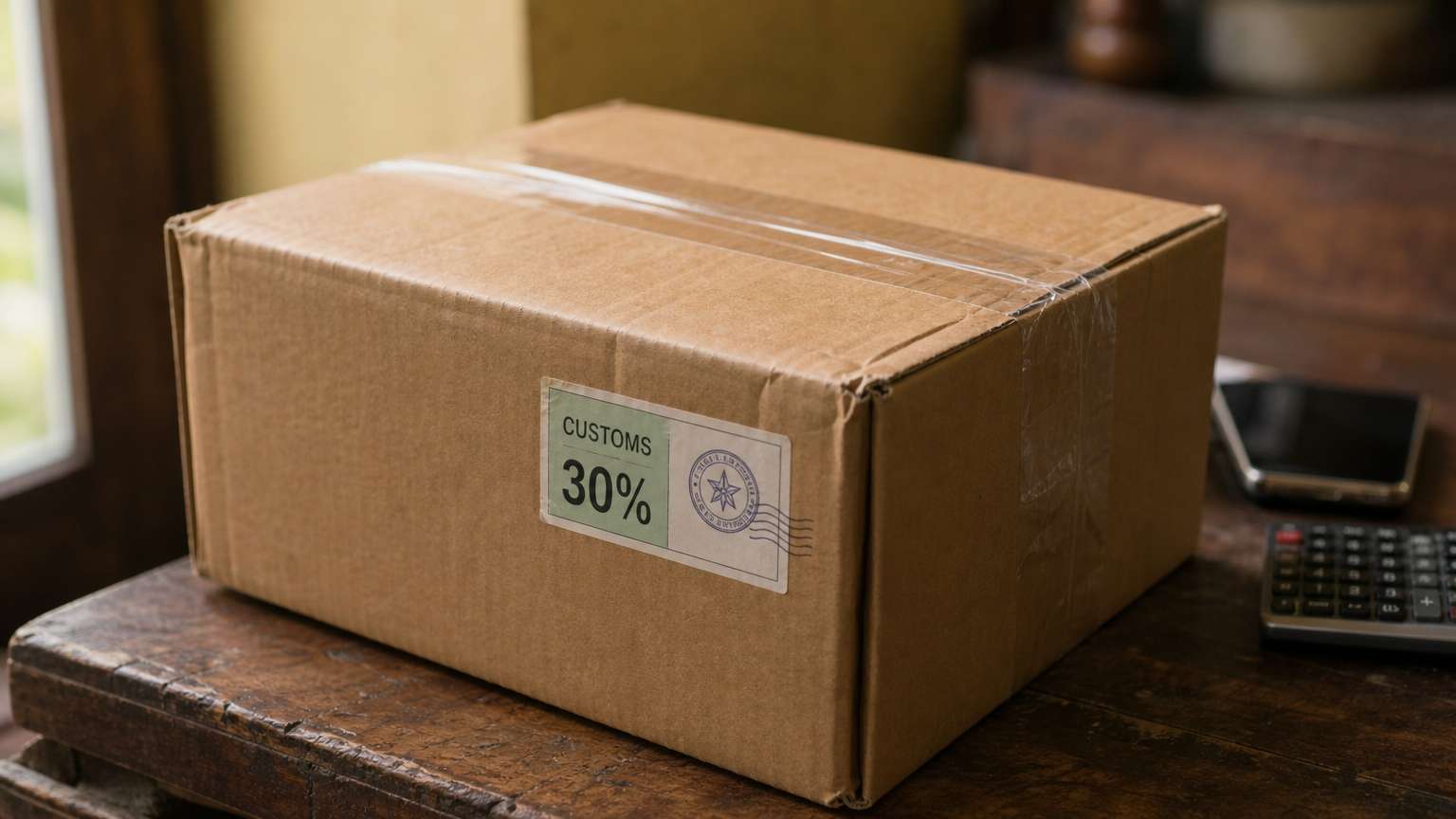
Duty will be charged under the customs tariff category of each product, at a rate of no more than 30%. No start date has been confirmed. The list of affected goods and the rate for each category will be known once the official notice is published. This article explains the principle, a hypothetical price example, and what to check before you order.
The Cabinet adjusts duty rules for express and international mail parcels
The measure covers goods that enter Thailand through express channels and international mail. Under the 10 November 2026 Cabinet resolution, the Customs Department will change how import duty is collected on these goods. Duty will follow the customs tariff category of each type of product.
The Finance Ministry and the Customs Department said the Customs Department will use data from e-commerce platforms to support product declarations and duty collection. This means the product details shown on a seller's page will also be relevant to the import process.
Before the measure takes effect, the ministry and the department will work with the platforms to prepare their systems. The government's stated reasons are to reduce the cost gap with Thai businesses, especially small and medium-sized enterprises (SMEs), and to protect consumers. Officials are concerned about the standards of some low-priced goods. Examples they gave were food, dietary supplements, cosmetics, power banks and car parts.
The 30% cap does not mean every item is taxed equally
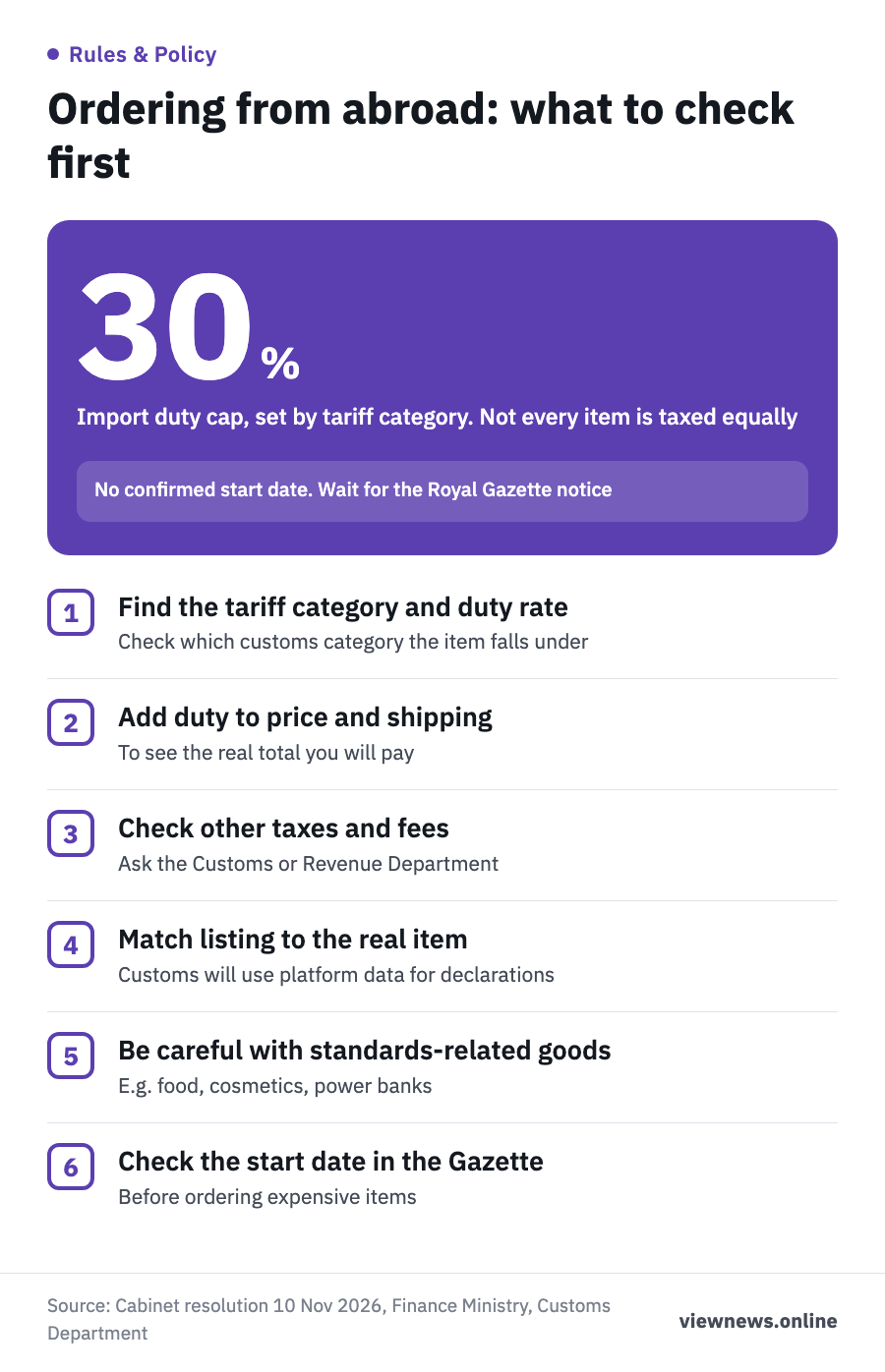
Not every product will face 30%. Duty will be set by the tariff category of each product, and 30% is the ceiling. Rates may differ between products, and some may be lower than the cap. Buyers need to find out which category their item falls under and what the rate is for that category. Do not assume that everything will cost 30% more.
Here is a hypothetical example. It is not the real rate for any product. Say you order an item priced at 1,000 baht. If its category carries a 10% rate, the duty is 100 baht. If the category carries a 30% rate, the duty is 300 baht. The item costs the same, but the extra you pay differs by 200 baht. The example counts duty only. It does not include other taxes or fees that may apply, which you should check with the Customs Department or the Revenue Department.
This makes price comparison across shops more difficult. Two items with similar shelf prices can end up with quite different final prices if they sit in different categories. The listed price alone is not enough. Add the duty for the relevant category before you decide.
Add import duty to your costs before you order
The measure does not ban online shopping. The finance minister said it is not meant to block online trade or limit consumer choice. Buyers can still order as normal. They just need to work out the full cost.
If you plan to buy goods in the categories the government raised standards concerns about, such as food, dietary supplements, cosmetics, power banks and car parts, think about safety as well as price. Very cheap goods can be riskier than they look.
Here is what to check before you order:
- Find out which customs tariff category the item falls under and what the duty rate is.
- Add the duty to the item price and shipping to see the real total.
- Check with the Customs Department or the Revenue Department whether other taxes or fees apply.
- Read the product details on the seller's page and make sure they match the actual item, because the Customs Department will use platform data to support declarations.
- Be careful with goods tied to standards, such as food, cosmetics and power banks.
- Check the start date in the official Royal Gazette notice before ordering anything expensive.
If you plan to buy something important, such as a high-priced device, waiting for the official notice will let you calculate the cost more accurately than guessing. Online sellers who import goods through these channels also need to wait for the category details before setting prices.
Where things stand now
The Cabinet has approved the measure. The next step is a notice in the Royal Gazette, Thailand's official legal journal. The measure takes effect after that notice is published. Check the start date in the actual notice, because no confirmed date exists yet.
Several points remain unclear. They include the list of affected goods and the duty rate for each tariff category, which will be known once the notice is out. For the status of value-added tax (VAT) and any other conditions on imported parcels, check directly with the Customs Department or the Revenue Department.
Things to watch next are the Royal Gazette notice, the preparation of systems with the platforms, and the category details the Customs Department will announce. Once these are available, buyers will be able to calculate real prices more accurately.
Source: Cabinet resolution of 10 November 2026, the Ministry of Finance and the Customs Department.
This article is adapted from ViewNews' Thai-language report.