The Bank of Thailand (BOT) has extended its relief measure for credit card holders until the end of 2026. It keeps the minimum monthly payment at 8% on a temporary basis. The central bank also caps total card costs at 16% a year and links your credit limit to your average monthly income. Anyone holding a Thai credit card, or thinking of applying for one, should know these rules.
A credit card is money that the card issuer lends you to pay merchants, and you repay it later. The issuer can be a bank or a non-bank card company. The BOT says cards can also be used to withdraw cash from ATMs, and many come with reward programs. The BOT material does not say whether every rule below applies in the same way to foreign residents. Ask the issuer about eligibility and documents before you apply.
How credit limits and costs are set
Your credit limit is tied to your average monthly income. Under BOT rules, the limit is:
- 1.5 times monthly income for people earning at least 15,000 baht but less than 30,000 baht
- 3 times monthly income for people earning at least 30,000 baht but less than 50,000 baht
- 5 times monthly income for people earning 50,000 baht or more
You do not choose the limit entirely yourself. You can, however, choose how much of it you use.
Costs have a clear ceiling. Interest, penalties, service charges and other fees together must not exceed 16% a year. Cash withdrawals work differently. Interest starts from the day you withdraw, and the issuer may charge a fee of up to 3% of the amount, plus value-added tax on that fee. If you use the card abroad, a currency conversion fee of 2 to 2.5% of the reference exchange rate may apply.
Before you apply for any card, the BOT suggests comparing these points:
- Joining fees and annual fees
- Costs of the payment channels you will use
- The interest-free period between billing cycles
- The credit limit and the benefits you will actually use
The BOT also advises checking your statements and receipts regularly. Report anything unusual to the issuer right away.
For newcomers and first-time card holders
Under the BOT table, people with an average monthly income of at least 15,000 baht qualify for a credit card. That lowest income band gets a limit of 1.5 times income. For a first card, look closely at the annual fee and the conditions for earning benefits. A card with a high fee whose perks you never reach is a cost with no return.
The BOT says that if you pay late or pay less than the full balance, interest generally runs from the day the issuer paid the merchant. Paying the full amount every month is the most direct way to avoid interest.
For working adults, families and retirees
As income rises, the limit rises with it. A higher limit does not mean you can afford more spending. List your regular expenses first, such as transport, food and household items. Then pick a card whose benefits match those categories, rather than one with an eye-catching sign-up offer.
Families with spending in several categories should read the conditions of each benefit and compare them with the annual fee they would really pay. Retirees whose income shifts from a salary to savings or a pension should check whether their current card still fits their income. The limit is based on average monthly income.
The BOT's security advice applies to everyone. Sign the back of the card as soon as you receive it. Never share your password, card details or CVV with anyone. For online shopping, use the authentication service of your card network: Verified by Visa, Mastercard Secure Code or JCB J/Secure. If a card is lost or stolen, tell the issuer immediately.
The 8% minimum payment: what to know
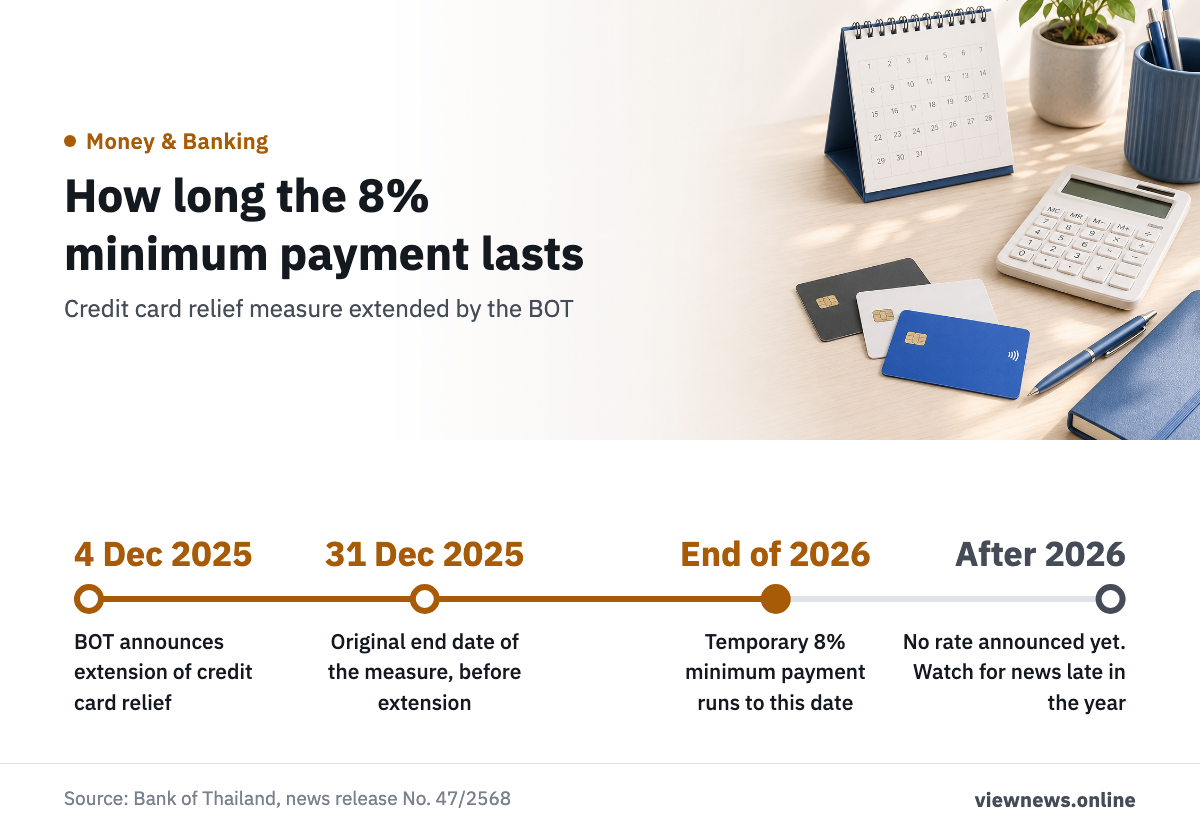
On 4 December 2025, the BOT announced that it was extending its relief measure for credit card debtors to the end of 2026. The measure had been due to end on 31 December 2025. The minimum payment stays at 8% on a temporary basis. The BOT said the aim is to help vulnerable borrowers whose incomes have not fully recovered. It will monitor the results closely before deciding on a suitable rate.
Cardholders who pay at least 8% receive a cash-back credit equal to a 0.25% interest discount on the outstanding balance, paid every 3 months. The BOT has not announced the minimum payment rate for after 2026. If you plan to carry a balance for a long time, watch for BOT announcements near the end of the year. Also ask your issuer how it calculates the minimum payment.
If you cannot pay
The BOT advises contacting the issuer early, before the debt is more than 3 months overdue, because several ways to restructure the debt are still open then. Under the latest announcement, borrowers who cannot afford the 8% minimum can ask to convert the card balance into a longer-term installment loan before it becomes a bad debt. The issuer must then offer extra benefits, such as a lower interest rate.
- Contact the issuer before you are 3 months overdue
- Pay at least the minimum to avoid a late-payment record
- Ask to convert the card debt into an installment loan
- Use the BOT's calculator to estimate what you can pay each month
Some debts may qualify for the debt clinic program, which has its own conditions. Ask the issuer or the BOT for details before deciding.
Source: Bank of Thailand, news release No. 47/2568 on extending the credit card debtor relief measure, and the BOT's pages on credit cards and on restructuring personal debt, credit card and cash card loans.
This article is adapted from ViewNews' Thai-language report.