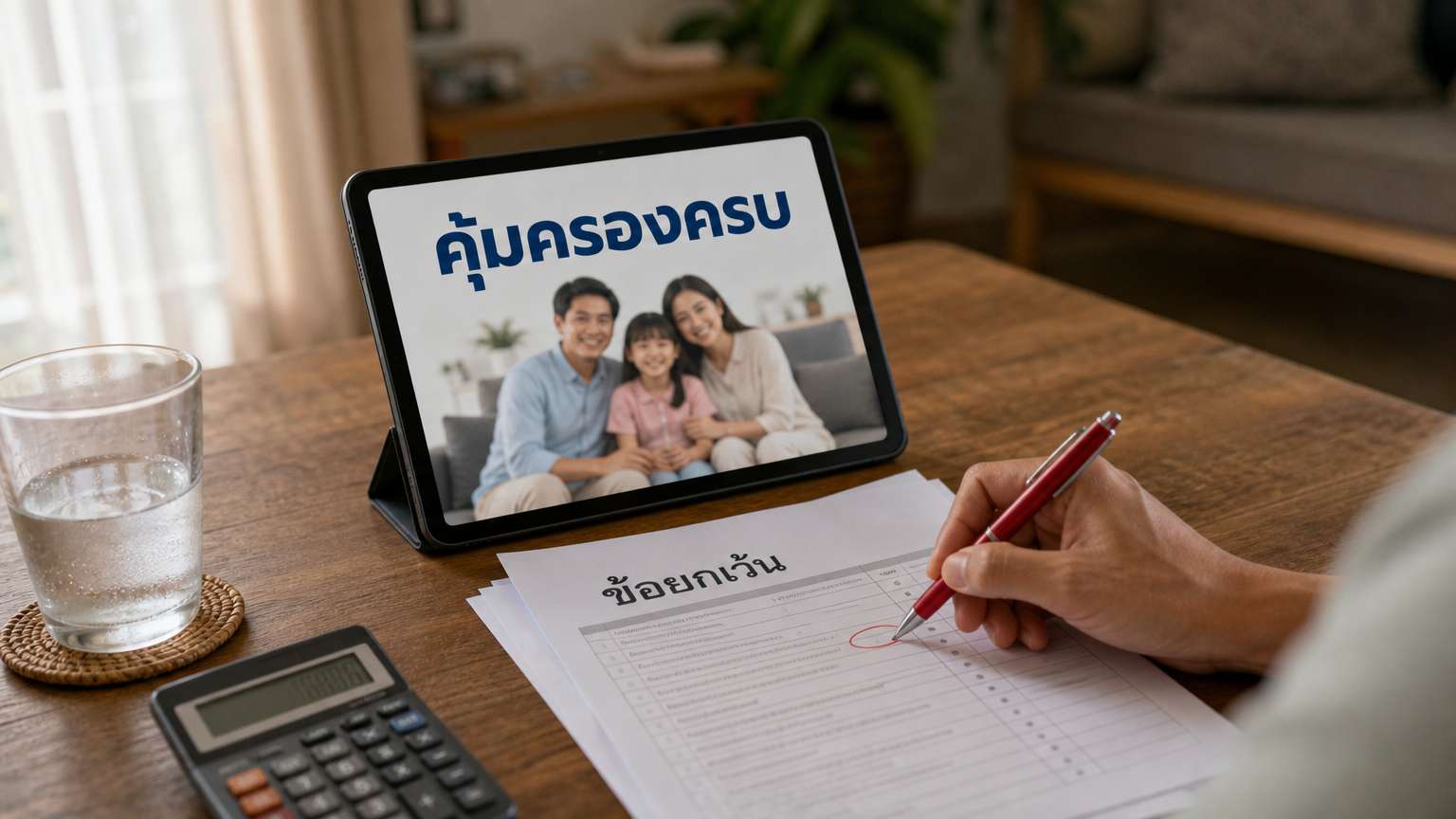
Thailand's Revenue Department lists a set of personal income tax allowances that reduce taxable income. A taxpayer can deduct 60,000 baht for themselves, another 60,000 baht for a spouse with no income, 30,000 baht per child and 30,000 baht for each parent aged 60 or over who is supported. Insurance premiums, funds, home loan interest and donations each carry their own caps.
The limits below follow the Revenue Department's allowance page, the latest version available to read. It has not been confirmed that every item is identical for tax year 2026, so check rd.go.th before filing. Foreign residents who file Thai income tax should also confirm with the Revenue Department which allowances apply to their situation.
Family allowances: you, your spouse, children and parents
Every taxpayer can deduct 60,000 baht as a personal allowance. If your spouse has no income, you can deduct another 60,000 baht. The key condition is that the spouse has no income.
For children, the department allows 30,000 baht each for legitimate children and adopted children. For the second child onward, if born in 2018 or later, the allowance is 60,000 baht each. For example, a family with two children who were both born in 2018 or later can deduct 30,000 baht for the first and 60,000 baht for the second, a total of 90,000 baht.
Prenatal care and childbirth costs can be deducted at actual cost, up to 60,000 baht per pregnancy. The cap applies per pregnancy, not per child.
If you support your parents, you can deduct 30,000 baht for each parent aged 60 or over. The parent must be in your care and have assessable income (income that counts for tax calculation) of no more than 30,000 baht. If you support both parents and both qualify, you can deduct 60,000 baht in total. Supporting a person with a disability is also deductible, at 60,000 baht per person.
Life and health insurance: watch the combined cap
Life insurance and your own health insurance share a combined cap of 100,000 baht, and this is where people often miscalculate. Life insurance premiums are deductible up to 100,000 baht, and the policy must run for 10 years or longer. Your own health insurance premiums are deductible up to 25,000 baht.
For example, if you pay 90,000 baht in life insurance premiums and 25,000 baht in health insurance premiums, the total is 115,000 baht. You can deduct only 100,000 baht. The excess gets no deduction.
Health insurance premiums for your parents are a separate item, deductible up to 15,000 baht. The parents must have assessable income of no more than 30,000 baht. The department's page is written to cover a spouse's parents as well. This item does not count toward the 100,000 baht cap.
Funds, social security and home loan interest
Savings and funds have different caps by type. Provident fund contributions are deductible up to 10,000 baht. Social security contributions are deductible up to 9,000 baht. Interest on a home loan is deductible up to 100,000 baht.
The Super Savings Fund (SSF) has two limits: 30 percent of income and 200,000 baht. You use whichever is lower. Someone with 300,000 baht of income would get 90,000 baht at 30 percent, which is below 200,000 baht, so 90,000 baht applies. For a very high earner, the 200,000 baht cap sets the limit.
This is an explanation of the department's limits, not a recommendation to buy any fund or policy. Investment and insurance decisions should rest on your own finances, not on the tax allowance alone.
Donations: e-Donation versus ordinary giving
Donations made through the e-Donation system for education, sports and public hospitals can be deducted at twice the amount paid. Other donations are deducted at the amount actually paid. For example, a 10,000 baht donation to a public hospital through e-Donation gives a 20,000 baht deduction.
Both types share the same cap of 10 percent of income after expenses and allowances. Because the cap is calculated after other deductions, total your other allowances first to see the maximum you can claim for donations.
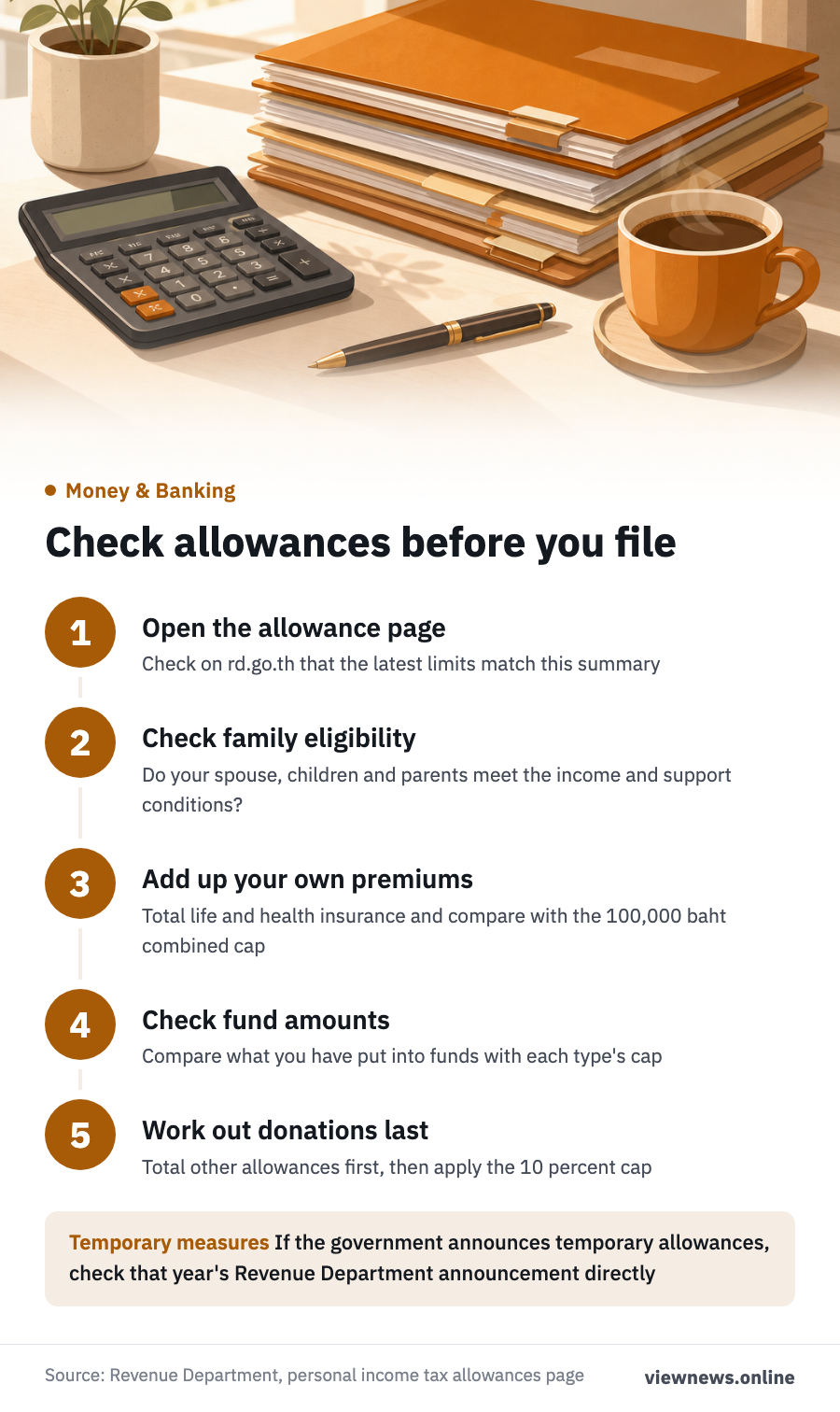
A checklist before you file
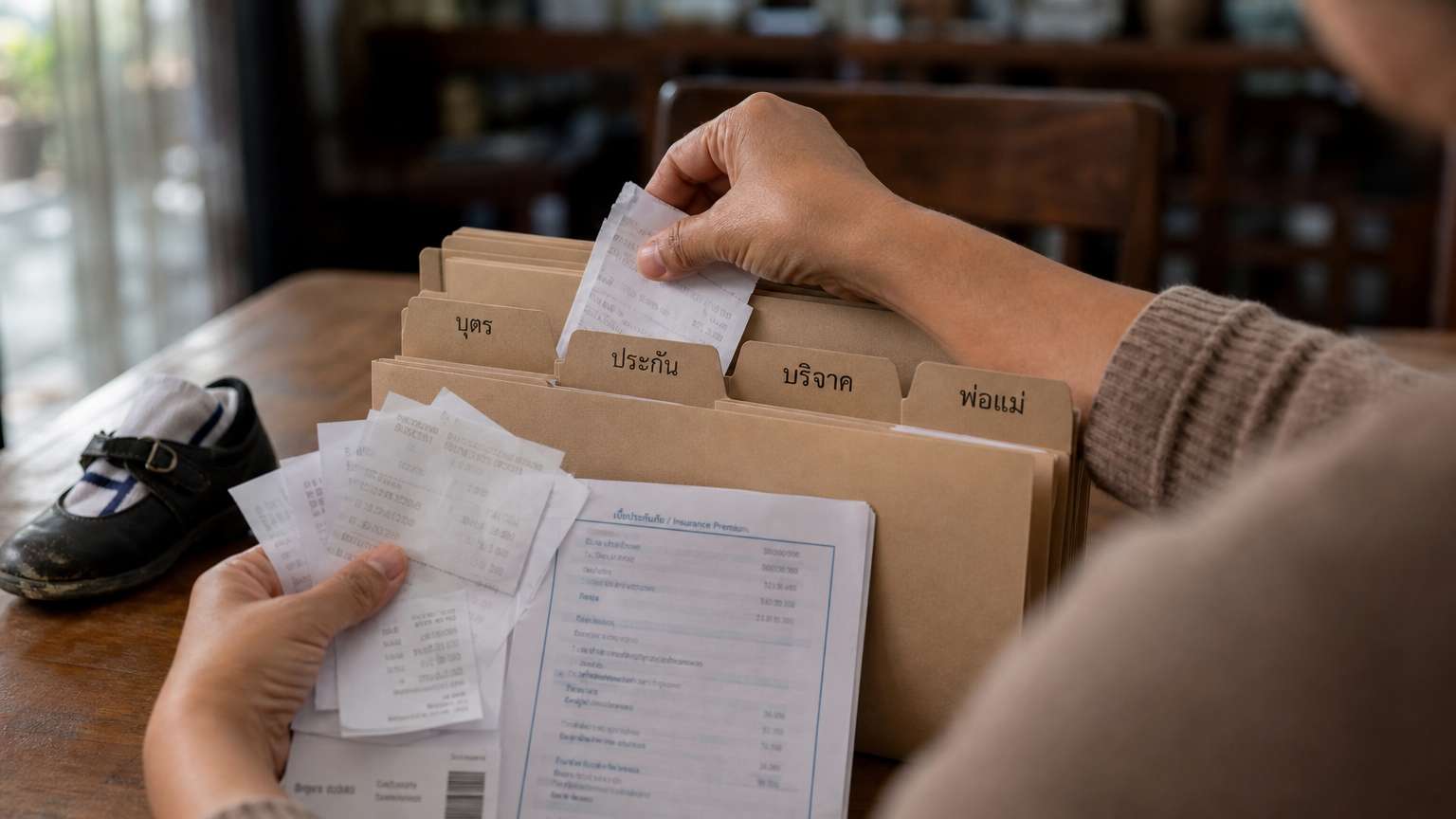
Supporting documents differ by item, and the department's allowance page does not list all of them in one place. Check the details for each item you plan to claim at rd.go.th before filing. The page covers limits and conditions. Before the tax year ends and before you file Form P.N.D. 90 or 91, work through these steps in order.
- Open the allowance page on rd.go.th and check that the latest limits match those above.
- Check whether your spouse, children and parents meet the conditions, especially the income and support requirements.
- Add up your life and health insurance premiums and compare the total with the combined 100,000 baht cap.
- Check the amounts already put into funds against the cap for each type.
- Total your other allowances first, then work out the 10 percent donation cap.
If the government announces temporary allowances in a given year, check that year's Revenue Department announcement directly. Temporary measures are not part of the standard list above.
Source: Thailand's Revenue Department, personal income tax allowances page.
This article is adapted from ViewNews' Thai-language report.