Many people in Thailand feel that food and transport prices do not fall when costs do. The latest official figures show that fuel, a key cost for many goods, is still higher than a year ago. The Trade Policy and Strategy Office (TPSO), part of the Ministry of Commerce, reported on 6 October 2026 that headline inflation in September 2026 was 2.82% compared with the same month a year earlier.
The price you see on a shop shelf reflects several layers of cost. The monthly inflation report shows which categories are getting dearer or cheaper. The question of whether prices rise easily but fall slowly has been tested in a Thai academic study of fuel prices, which found that different fuels respond to costs in different ways.
A Thai study on fuel prices that rise fast and fall slowly
The study is titled "The Effect of Stock, Government Policy, and Monopoly on Asymmetric Price Transmission in Thailand." It was written by Phaisan Pattanakooha and Pongsa Pornchaiwisetgul of Chulalongkorn University and published in the International Journal of Energy Economics and Policy in 2015. The researchers used monthly data on West Texas Intermediate crude oil prices, unleaded petrol prices and high-speed diesel prices. They also used data on Thailand's Oil Fund and on fuel stocks.
The key term is asymmetric price transmission. It means retail prices react differently to a cost increase than to a cost decrease. The study found this pattern in petrol prices but not in diesel prices.
The researchers then looked at what causes the difference. They found that the Oil Fund does not create the asymmetry directly, but it affects how fast prices adjust. It makes petrol prices adjust faster and diesel prices adjust more slowly. Marketing margins had a similar effect on speed. Market power among fuel sellers had an indirect effect on price stickiness, making petrol adjust more slowly and diesel adjust faster. The level of fuel stocks had no effect on the asymmetry. The authors concluded that the asymmetry is mainly shaped by the Oil Fund and marketing margins.
The study covers only fuel and uses data from before 2015. It cannot directly explain food or transport prices, and it does not describe the current situation. It does show that prices in Thailand do not all respond to costs in the same way.
Where prices stand now
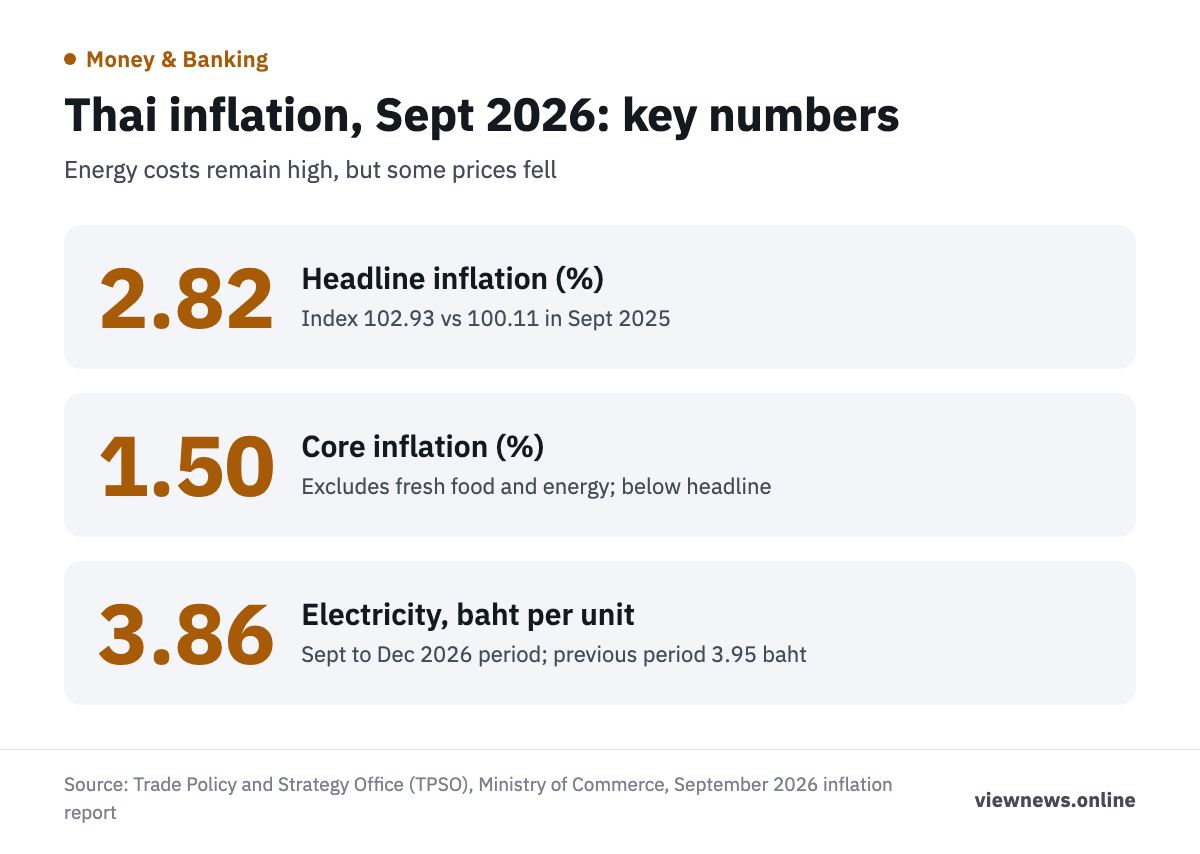
According to the TPSO, the consumer price index for September 2026 was 102.93, compared with 100.11 in September 2025. That gives headline inflation of 2.82%. The TPSO said domestic fuel prices remained high compared with last year because of tension over energy supplies in the Middle East. Anyone who assumed fuel had become cheaper, and that goods would follow, should know that energy costs have not yet come down.
On food, the TPSO said prepared meals rose in price because production costs increased in several areas. It also said that fresh food and prepared food were affected by unstable weather. So when a street-food or made-to-order meal costs more, the reasons given by the authorities are production costs and weather-hit supply.
Not everything is getting more expensive. The TPSO reported that electricity charges, home repair contractor fees and some clothing items fell in price. The electricity rate for the September to December 2026 billing period is 3.86 baht per unit, down from 3.95 baht in the previous period. Core inflation, which excludes fresh food and energy, was 1.50%. That is lower than headline inflation, which suggests fresh food and energy are the main upward pressures. The TPSO expects inflation in the fourth quarter of 2026 to stay positive.
What shoppers can check
Working out whether a specific product is held at a high price while its costs fall requires looking at the costs of that product. The overall inflation figure only gives a broad picture of which categories are rising or falling. For example, if energy costs stay high, transport and food have reasons not to get cheaper.
Readers can do a simple check by comparing the prices of items they buy regularly with the TPSO's monthly inflation report, which breaks down the categories that rose and fell. If an item sits in a category the TPSO says got cheaper, such as electricity or home repairs, but the shop price has not moved, that is worth noting. Comparing prices across several shops before buying is a practical step.
Source: Trade Policy and Strategy Office, Ministry of Commerce, report on headline inflation for September 2026. Research: "The Effect of Stock, Government Policy, and Monopoly on Asymmetric Price Transmission in Thailand," International Journal of Energy Economics and Policy, 2015.
This article is adapted from ViewNews' Thai-language report.