Thailand and the United States signed a joint statement on an Agreement on Reciprocal Trade (ART) in Manila on 17 November 2026, on the sidelines of the ASEAN summit. Prime Minister Anutin Charnvirakul and US President Donald Trump signed it. Whether Thai goods will actually face a 19% US tariff is still not fully answered. The 19% figure is the rate the Thai commerce minister says the US set. Thailand says the talks reached agreement on the main points, but the joint statement is not legally binding.
The United States is Thailand's largest export market. Deputy Prime Minister and Commerce Minister Supajee Suthumpun said Thailand exported 2.37 trillion baht of goods to the US in 2025, tied to about 1.25 million jobs in Thailand. US tariffs on Thai goods therefore affect costs, orders and employment directly. Exporters, and foreign business owners and staff working with them, should separate what is confirmed, what is the minister's statement, and what is still uncertain.
What the signing confirms
Three things are confirmed. The joint statement was signed in Manila. Thailand says the talks reached agreement on the main points. The statement is not legally binding. A Cabinet document says the draft statement does not spell out the details of those points. The 19% figure is the rate the commerce minister says the US set.
After signing, each side must start its own domestic procedures to prepare for signing the full agreement and bringing it into force. The full agreement is therefore different from the statement already signed, because it must pass these steps before it binds either country.
The 19% tariff and Section 301, according to the commerce minister
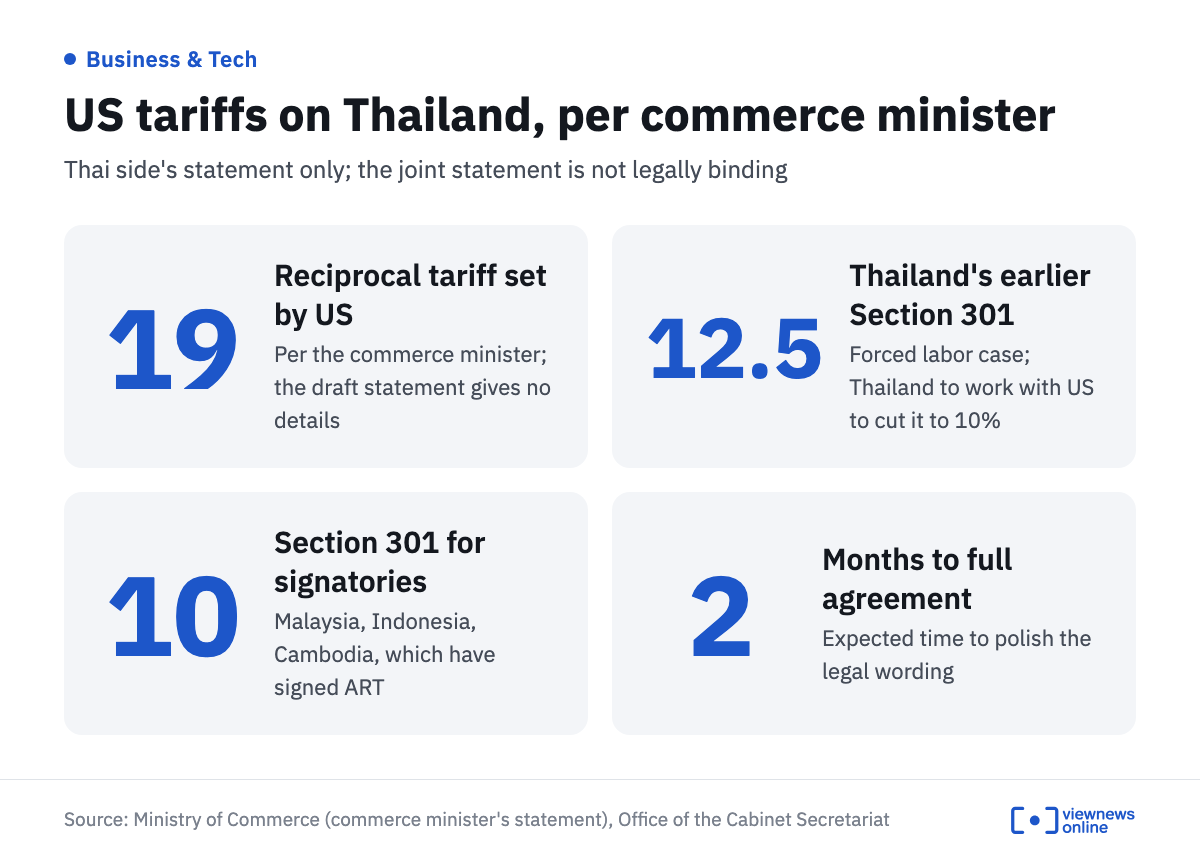
The minister said the reciprocal tariff the US set for Thailand is 19%. She estimated that Thailand's overall tariff rate will not exceed 19%.
A separate issue is the Section 301 tariff over forced labor. The minister said the US had previously set Thailand's rate at 12.5%. Malaysia, Indonesia and Cambodia, which have already signed ART, are at 10%. She said Thailand will use the joint statement as the basis to work with the US to bring its rate down to 10%, starting immediately after signing. What can be confirmed now is the Thai side's statement. Any actual cut depends on action by the US.
The minister also stressed that the tariffs Thailand faces do not depend on the reciprocal tariff alone. The US has other tariff tools under executive authority, including Section 301, Section 232 and Section 122, which can be applied to imports issue by issue. Exporters should check every tariff that applies to their own products, not a single headline number.
What is still uncertain
Some economists estimate that if the base rate under the ART framework is 19%, adding the 12.5% Section 301 tariff could push the ceiling on Thai goods as high as 31.5%. That figure is one analyst's view. No source document supports it, and it conflicts with the minister's estimate that the overall rate will not exceed 19%. It cannot be treated as fact. There are currently two numbers: one is a minister's statement, the other is an opinion with no source document.
Before the signing, reports said the US had proposed conditions in 5 areas in exchange for tariff benefits, covering agriculture, labor, intellectual property and digital. Thailand has 3 red lines: ractopamine, a feed additive used in pork, security, and investment in telecommunications. These were proposals and positions before signing, not agreed content.
For farmers and consumers, the effect cannot yet be judged, because the full text has not been made public. There is no document confirming that Thailand has agreed to open its pork market, cut tariffs on farm goods or accept digital-related conditions. Domestic prices therefore cannot be assessed from unconfirmed figures or conditions. Pig farmers and pork buyers should watch what the full agreement says, since agriculture is one of the 5 areas the US proposed and ractopamine is one of Thailand's red lines.
Next steps and what exporters should watch
The minister said the full agreement is expected to take about 2 months, because Thailand and the US must polish the legal wording together. Details will be made public in the following steps:
- Legal wording of the draft agreement is finalized
- The draft goes to the Cabinet for consideration
- Stakeholders are invited to give their views
- The agreement is submitted to Parliament
Exporters should watch three points: whether the Section 301 cut actually takes effect, what the full text says on agriculture, labor and digital, and how Section 232 and Section 122 tariffs apply to their own products.
Source: Ministry of Commerce (statement by the commerce minister), the Office of the Cabinet Secretariat (Cabinet document on the draft joint statement) and the Office of the Prime Minister.
This article is adapted from ViewNews' Thai-language report.