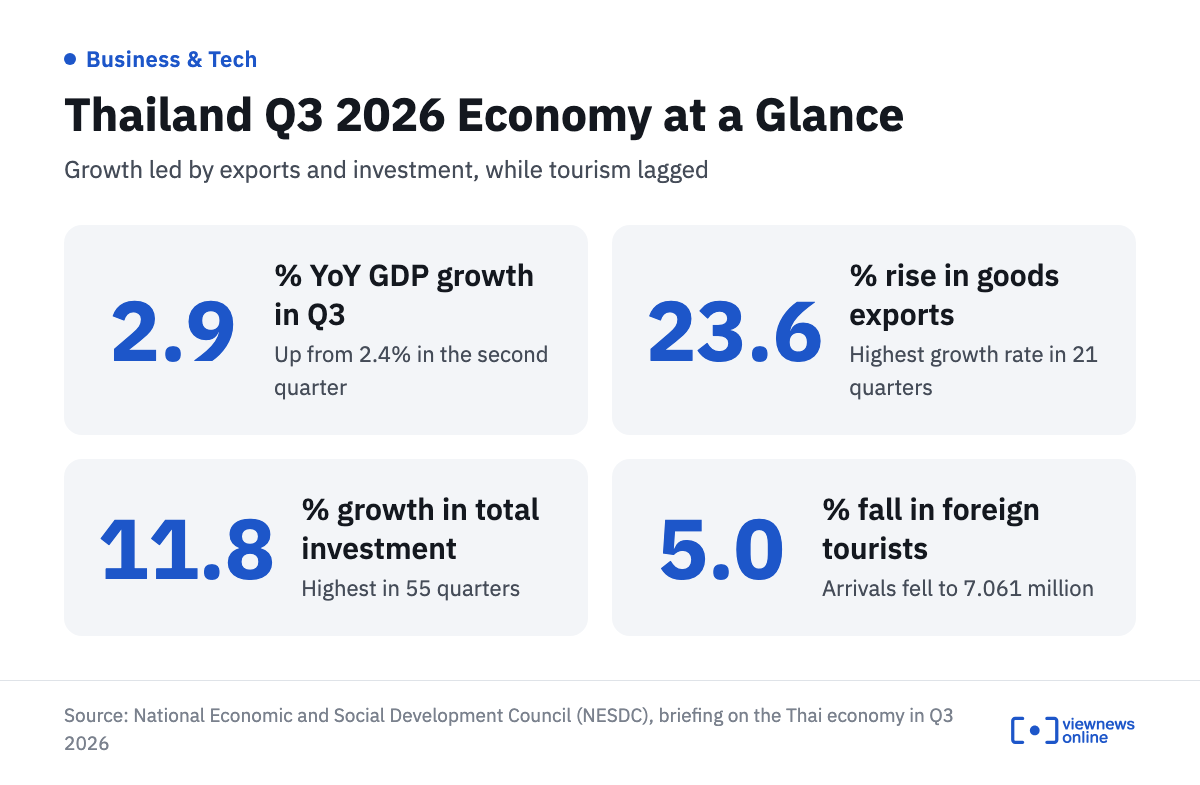
Thailand's economy grew 2.9% in the third quarter of 2026, up from 2.4% in the second quarter, according to the National Economic and Social Development Council (NESDC), the government planning agency. The NESDC announced the figure on 16 November 2026. Growth came mainly from goods exports and private investment. Government consumption spending fell, and foreign tourist arrivals dropped. A rising national total does not mean every business or household feels better off by the same amount.
The NESDC said exports of AI-related electronics and private investment drove this quarter's number, while foreign tourism remained weak. It raised its 2026 full-year growth forecast to 2.5% and sees 2.0-3.0% growth in 2027. That affects income, business and financial planning for residents, investors and business owners.
How to read the 2.9% figure
The 2.9% figure compares the quarter with the same quarter a year earlier, often called year-on-year (YoY). For the first nine months of 2026, the economy grew 2.8% on the same basis. This shows how much larger the economy is than a year ago.
The second figure to watch is quarter-on-quarter (QoQ), which compares with the previous quarter after adjusting for seasonal effects. On that basis the economy grew 0.3% from the second quarter. This shows how far the economy moved forward in three months. The two numbers answer different questions. They should not be compared directly, and 2.9% does not mean the economy sped up by 2.9% in three months.
Government spending is another common source of confusion. The 1.6% decline refers to final government consumption spending. Public investment grew 1.7%. The NESDC reports the two separately, so the right reading is that government consumption spending fell while public investment turned positive. It is not true that the government stopped spending.
Who is driving growth, and who is lagging
The first driver was exports. The value of goods exports rose 23.6% to US$106,377 million, the highest growth rate in 21 quarters. The NESDC said industrial goods led the gain, especially communication equipment, computer parts and integrated circuits linked to artificial intelligence (AI) and data centers.
The second driver was investment. Total investment grew 11.8%, the highest in 55 quarters. Private investment rose 16.2%, and machinery and equipment grew 20.5%. On the production side, manufacturing grew 3.7%, up from 1.6% in the previous quarter and the highest in 16 quarters.
Private consumption grew 2.5%, up from 2.1% in the second quarter. Durable goods rose 12.6%, led by vehicles. The consumer confidence index rose to 52.4. Wholesale and retail trade grew 6.0%, and transport grew 3.1%. Household spending is still growing, but far more slowly than exports and investment.
Agriculture grew 1.3%, but the farm income index rose 14.3% because prices of rubber, paddy rice and cassava were higher. The index covers those crops as a group. Actual income for each household still depends on what it grows and how much it harvests.
Foreign tourism was the weak spot. Foreign tourist arrivals fell 5.0% to 7.061 million. Accommodation and food services grew only 1.9%, slower than 2.1% in the previous quarter. Tourism service receipts, however, grew 11.7%. Tourism therefore shows a weaker side, with fewer visitors, and a stronger side, with higher revenue.
The NESDC's latest forecasts and economic stability
The NESDC raised its 2026 GDP forecast to 2.5% from 2.2%. Growth in 2025 was 2.4%. It expects average inflation of 2.0% for the year and a current account surplus of 0.6% of GDP.
For 2027, the NESDC expects growth of 2.0-3.0%, with a midpoint of 2.5%. It lists four supporting factors: faster public investment, continued growth in private consumption and investment, a recovery in tourism and related services, and higher net exports.
The first risk the NESDC lists is the conflict in the Middle East. Business owners and anyone planning finances for next year may want to watch it alongside export and investment data.
On stability, the unemployment rate in the third quarter was 1.02%. Headline inflation averaged 2.4% and core inflation was 1.4%. The current account returned to a surplus of US$1.4 billion. Foreign reserves at the end of September 2026 stood at US$276.1 billion. Public debt at the end of September was 13.4 trillion baht, or 68.6% of GDP.
How different readers can use these numbers
For employees and salaried workers, GDP is a national total and does not show any one person's income. It is more useful to check the figures for your own industry: manufacturing +3.7%, wholesale and retail +6.0%, transport +3.1%, agriculture +1.3%, and accommodation and food services +1.9%. Read them alongside inflation at 2.4%, which bears directly on the cost of living.
For business owners, the figures show investment flowing mainly into machinery and AI- and data center-related electronics. Firms in that supply chain should follow export and investment data. Businesses that rely on foreign tourists should look at both the 5.0% drop in visitors and the 11.7% rise in tourism receipts, because the two paint different pictures.
For 2027 planning, the 2.0-3.0% range is a better frame than a single number, since the NESDC itself lists the Middle East as its first risk. All of these figures are government estimates, not final outcomes, and they do not say whether anyone's income will rise or fall.
Source: National Economic and Social Development Council (NESDC), briefing on the Thai economy in the third quarter of 2026 and the outlook for 2026-2027.
This article is adapted from ViewNews' Thai-language report.