Anyone buying a used car in Thailand who worries about odometer rollback should see a complete information label, a Thai-language contract and a proper receipt before paying anything. On 16 November 2026, Supamas Isarabhakdi, the minister in the Prime Minister's Office who oversees the Office of the Consumer Protection Board (OCPB), announced the result of a case involving a used-car buyer. The buyer found that the mileage was higher than stated and that the order of previous owners did not match what they were told before buying. OCPB officials mediated, and the dealer agreed to pay 230,000 baht (about US$7,000) in compensation.
That figure applies only to this one case. It is not a standard rate that other buyers can cite. What buyers can use are the rules already in force, from the label that must be shown before payment, to receipts and contracts, the right to cancel and the complaint channels.
What OCPB has ordered, and what is still only an idea
The minister told the OCPB secretary-general to inspect used-car dealers more strictly, covering labels, contracts and proof of payment. Dealers with repeated complaints are a priority. Violators are to be prosecuted. The minister also told the office to speed up handling of complaints and to analyse complaint data to strengthen measures in the used-car market.
One item is still only a proposal. OCPB is to study cooperation with carmakers and service centres on a free system for checking mileage and service history before purchase, in line with personal data protection law. That system has not started, so buyers still have to check for themselves and rely on the rights they already have.
According to OCPB in August 2026, the three most common used-car complaints are dealers keeping a booking fee or deposit without returning it, odometer rollback, and car details that do not match the registration book, so the car cannot be transferred. The checklist below is built around those three problems.
What the label must show and how to check it against the registration book
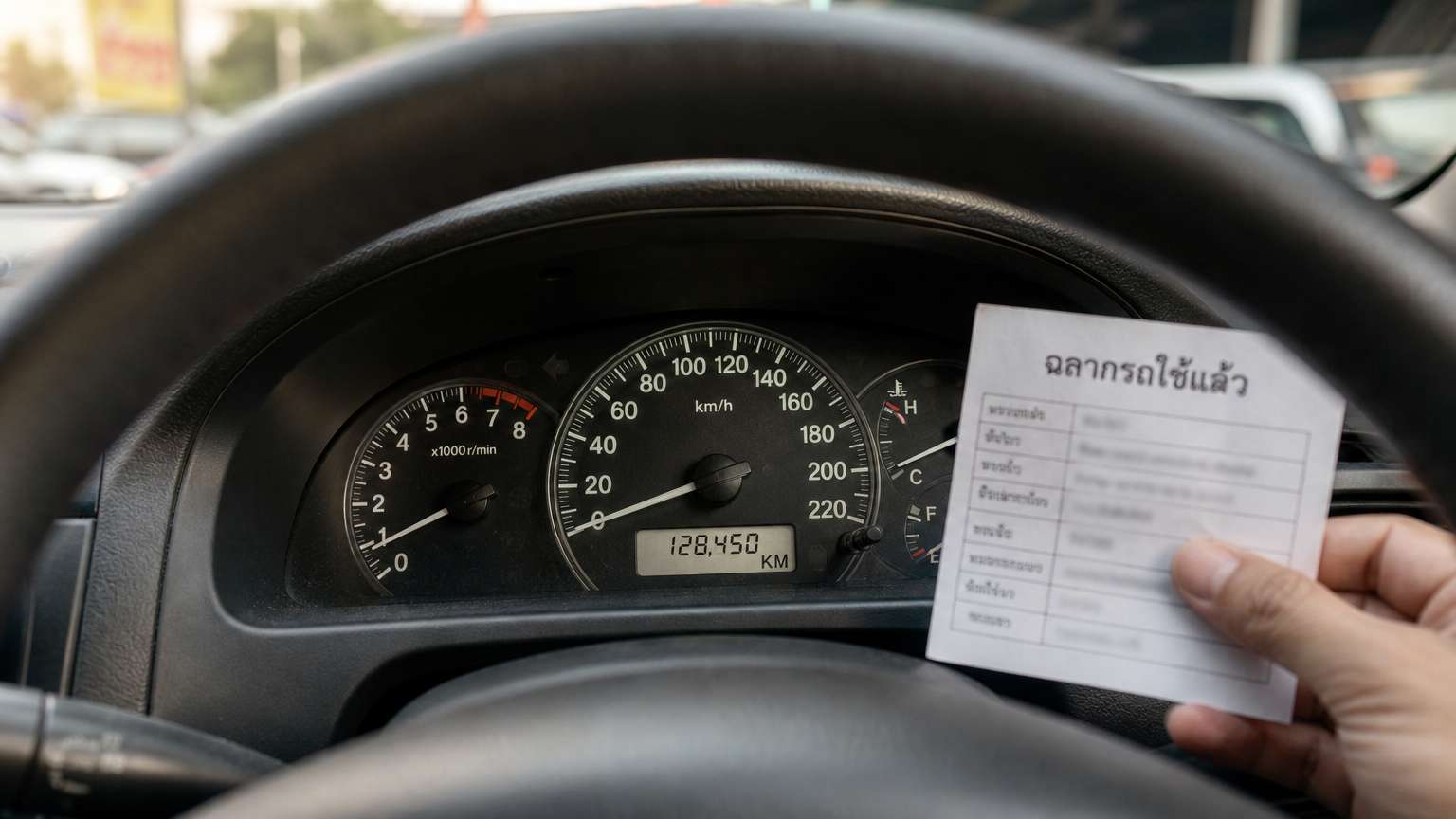
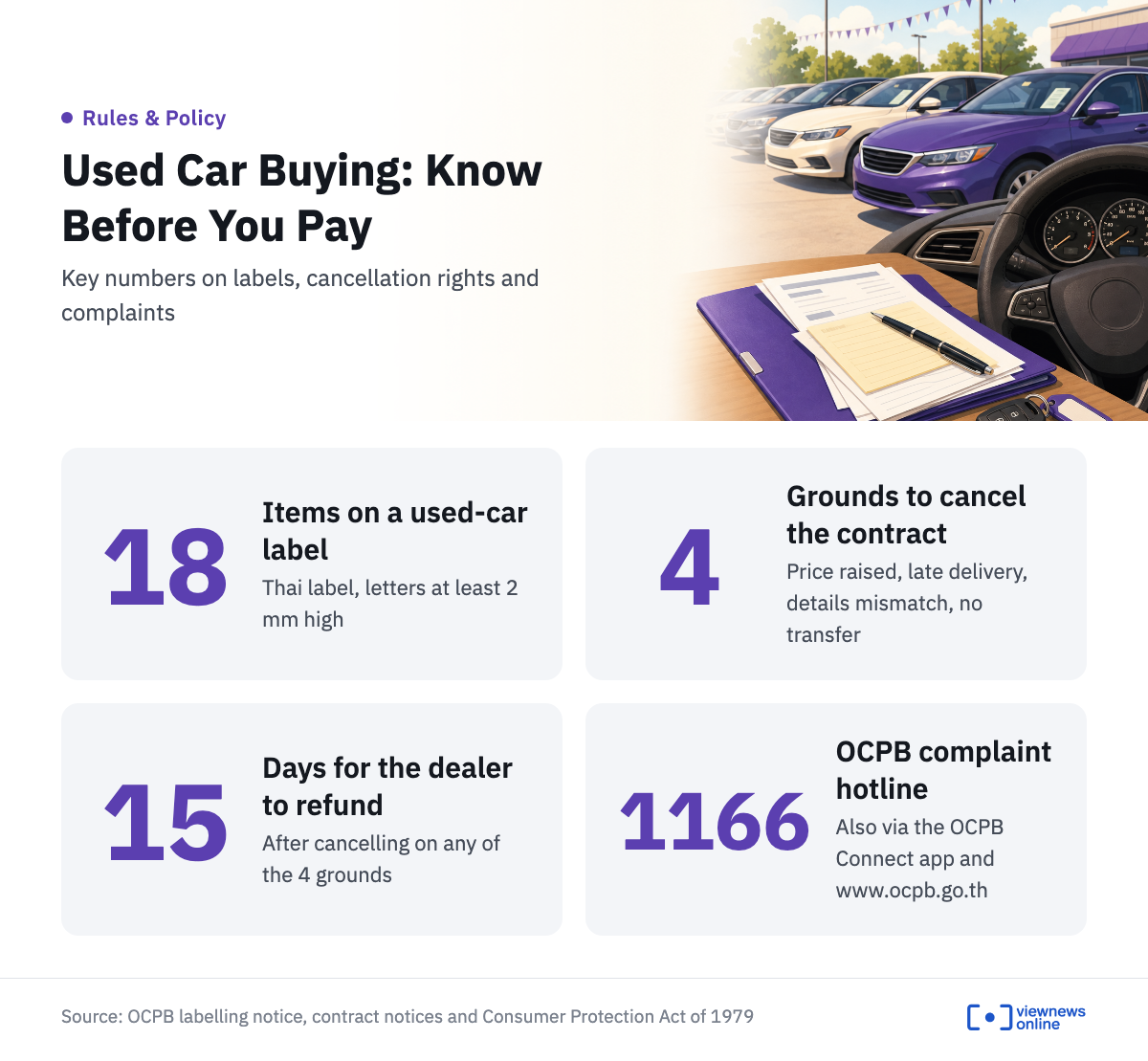
Under the OCPB labelling notice in force since 31 March 2026, used cars and used electric vehicles (EVs) must carry a Thai-language label with letters at least 2 millimetres high. The label has 18 items. They include make, model, year of manufacture, licence plate number, chassis number, engine number, distance driven, order of owners, accident history (collision, fire, flood), liens or encumbrances, warranty terms, the seller's name and address, and the price.
If an item does not apply, the dealer must write "none" rather than leave it blank. Used EVs must show 4 more items: the type of EV, electric motor output, battery type and battery warranty terms. If the label is missing any of these, ask the dealer straight away why it is incomplete.
A label is only useful if you compare it with the real car. Since a common complaint is data that does not match the registration book, check the label against the vehicle registration book, including the plate number, chassis number and engine number. Then photograph the label and the odometer on the dashboard. If a dispute comes up later, the photos show the condition and figures when the car was offered for sale.
- Check that the label is in Thai, clearly legible and complete.
- Compare the plate, chassis and engine numbers with the registration book.
- Photograph the label and the dashboard odometer before agreeing to buy.
- Ask about the order of owners and accident history, and see whether the label says the same.
- Ask for a receipt as soon as you pay, even for a booking fee.
- Ask for 2 copies of the contract in Thai, and read it before signing.
What the receipt and contract must contain
Under the 2007 OCPB contract notice, the dealer must issue proof of payment immediately, whether you pay in full or in part. It must include these details:
- Buyer and seller information
- Details of the car
- Distance driven
- Name of the title holder
- Date the car and registration book will be handed over
The receipt must also state that the dealer will refund everything if the registration cannot be transferred, the car cannot be delivered, or the contract is cancelled through no fault of the buyer. Look for this wording before you keep the receipt, because it is what obliges the dealer to refund your money.
A used-car sale contract under the 2019 contract notice must be written in Thai, in 2 copies with identical text, and handed to the buyer immediately after signing. If the dealer has you sign and then keeps both copies, or gives you a copy whose text differs, stop and do not pay more.
Four grounds for cancelling, and penalties for dealers
The law lets a buyer cancel the contract in 4 cases:
- The dealer raises the price above what was agreed.
- The dealer does not deliver the car within the agreed time.
- The delivered car does not match the contract, including a mileage that does not match.
- The registration cannot be transferred into the buyer's name.
When a buyer cancels for these reasons, the dealer must return all money and anything else received within 15 days. The contract may not include a clause allowing the dealer to keep your money, unless the buyer is the one who breached the contract. If a dealer hands you a contract with a forfeiture clause when you have done nothing wrong, refuse it and report it to OCPB.
Under Section 52 of the Consumer Protection Act of 1979, a dealer who fails to display a label, or displays it incorrectly, faces up to 6 months in prison, a fine of up to 100,000 baht, or both. A dealer who fails to prepare or hand over the receipt and contract faces up to 1 year in prison, a fine of up to 200,000 baht, or both.
How to complain
Buyers who find that the odometer or other car details do not match what the dealer said can complain to OCPB through 3 channels: the hotline 1166, the OCPB Connect app, and the website www.ocpb.go.th.
Attach the documents you kept: the receipt, the contract, photos of the label and photos of the odometer. The case OCPB mediated on 16 November 2026 involved a buyer who noticed the discrepancy after a visit to a service centre and had information to compare with what the dealer stated before the sale.
The Thai report does not say whether OCPB offers English-language help. Foreign buyers should check with OCPB before filing, and may want a Thai-speaking friend or translator to help read the label and contract.
Source: Office of the Consumer Protection Board (OCPB), including its labelling notice, its contract notices of 2007 and 2019, and the Consumer Protection Act of 1979.
This article is adapted from ViewNews' Thai-language report.