Women who use Mounjaro and take the oral contraceptive pill should know that the European Medicines Agency (EMA) says the pill may be less reliable while on the drug. The agency advises adding a barrier method of contraception for 4 weeks after starting Mounjaro and for 4 weeks after each dose increase. The other option is to switch to a contraceptive method that is not taken by mouth. This is not a ban on the drug. Talk to a doctor or pharmacist before changing anything yourself.
The EMA's Committee for Medicinal Products for Human Use (CHMP) endorsed a letter to healthcare professionals on the issue at its meeting on 9-12 November 2026. The EMA published its meeting summary on 13 November 2026. The advice applies to women who can become pregnant and use Mounjaro. For the right length of time in your own case, ask your doctor or pharmacist and check the package leaflet.
What the EMA said about Mounjaro and the pill
The EMA describes Mounjaro (tirzepatide) as a medicine used together with diet and exercise to treat adults with type 2 diabetes. The new advice on contraception applies to anyone using Mounjaro who can become pregnant and takes the pill.
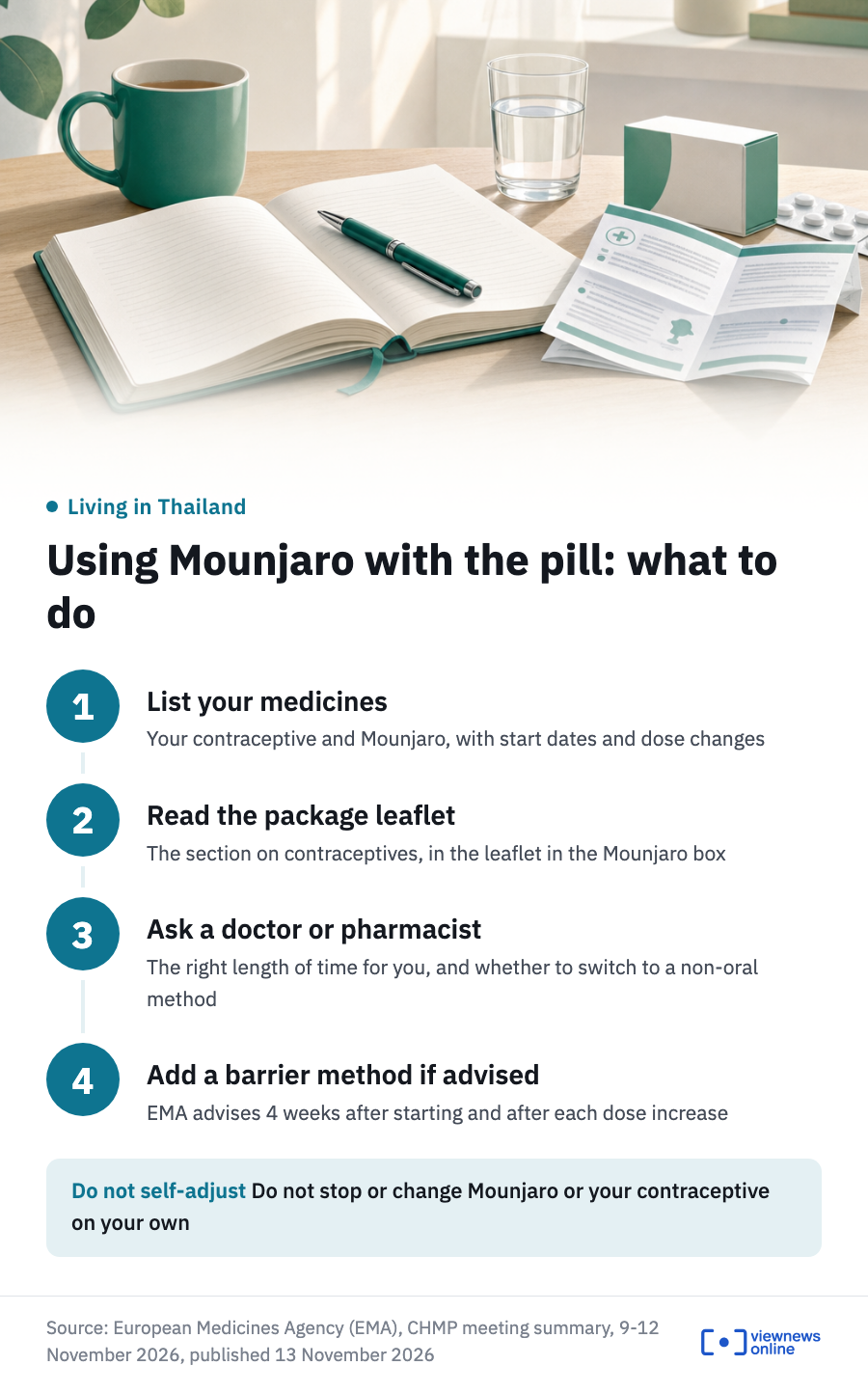
What the CHMP endorsed is a Direct Healthcare Professional Communication (DHPC), a letter sent to medical staff. It covers the possible effect of Mounjaro on how reliable oral contraceptives are. In plain terms, a woman who takes the pill alongside Mounjaro may not want to rely on the pill alone. The EMA therefore advises extra protection for 4 weeks after starting and after each dose increase, or choosing a non-oral method instead.
According to the EMA's meeting summary, the companies that hold the marketing authorisation for the drug will distribute the DHPC to healthcare professionals. It is a letter to medical staff. It is not a ban on the drug and not a withdrawal from the market.
What are barrier methods and non-oral methods?
A barrier method uses a physical barrier to keep sperm from reaching an egg. The most familiar example is the condom. The EMA's advice is to use a barrier method in addition to the pill you already take, for 4 weeks after starting tirzepatide and for 4 weeks after each dose increase.
This means two groups should raise the issue with a doctor: people starting Mounjaro for the first time, and people whose doctor is raising their dose. Ideally, do it before starting or before the increase.
The other option the EMA names is switching to a contraceptive method that is not taken by mouth. Which method suits which person is for a doctor to decide, because health history, existing conditions and other medicines differ. This article does not recommend a specific method.
There is one safe step you can take right away. Write down every medicine you use, including your contraceptive and Mounjaro, with the date you started and the dates of any dose changes. Take the list to your doctor or pharmacist. Ask how long you should use extra protection and whether you should switch to a non-oral method.
Data are limited, and this is not a recall
The EMA says the data on how tirzepatide affects the pharmacokinetics and effectiveness of oral contraceptives are limited. Pharmacokinetics means how the body absorbs, distributes and clears a drug. With limited data, the advice is a cautious approach. It does not say the pill will definitely fail.
The EMA's meeting summary does not give details on the mechanism or on figures. Readers should not draw their own conclusions about how much less effective the pill may be, or why, and should not compare with numbers from other sources.
To be clear, this is not a withdrawal of the drug's authorisation and not a ban. The DHPC is an information letter with advice for medical staff. Anyone using Mounjaro should not stop or change it on their own, because that could affect their treatment. Anyone taking the pill should not stop it on their own either, because that would leave them with no contraception at all.
Where does Thailand stand, and what should you do?
The conclusion comes from the EMA, which oversees medicines in the European Union. No announcement on this issue from Thailand's Food and Drug Administration (FDA) has been found so far. Mounjaro users in Thailand should not assume there is a new instruction from Thai authorities, but they also should not ignore the European advice.
The most sensible step is to open the package leaflet that comes in the Mounjaro box and read the section on contraceptives. Then ask the doctor or pharmacist who looks after you whether you should change your contraception plan. If you are not sure where to ask, check with your prescriber or the pharmacist who dispenses the drug.
It is worth watching whether the Thai FDA issues further information. Until then, talk to a doctor or pharmacist before starting or changing treatment, and never adjust medicines on your own.
Source: European Medicines Agency (EMA), summary of the Committee for Medicinal Products for Human Use (CHMP) meeting of 9-12 November 2026, published 13 November 2026.
This article is adapted from ViewNews' Thai-language report.