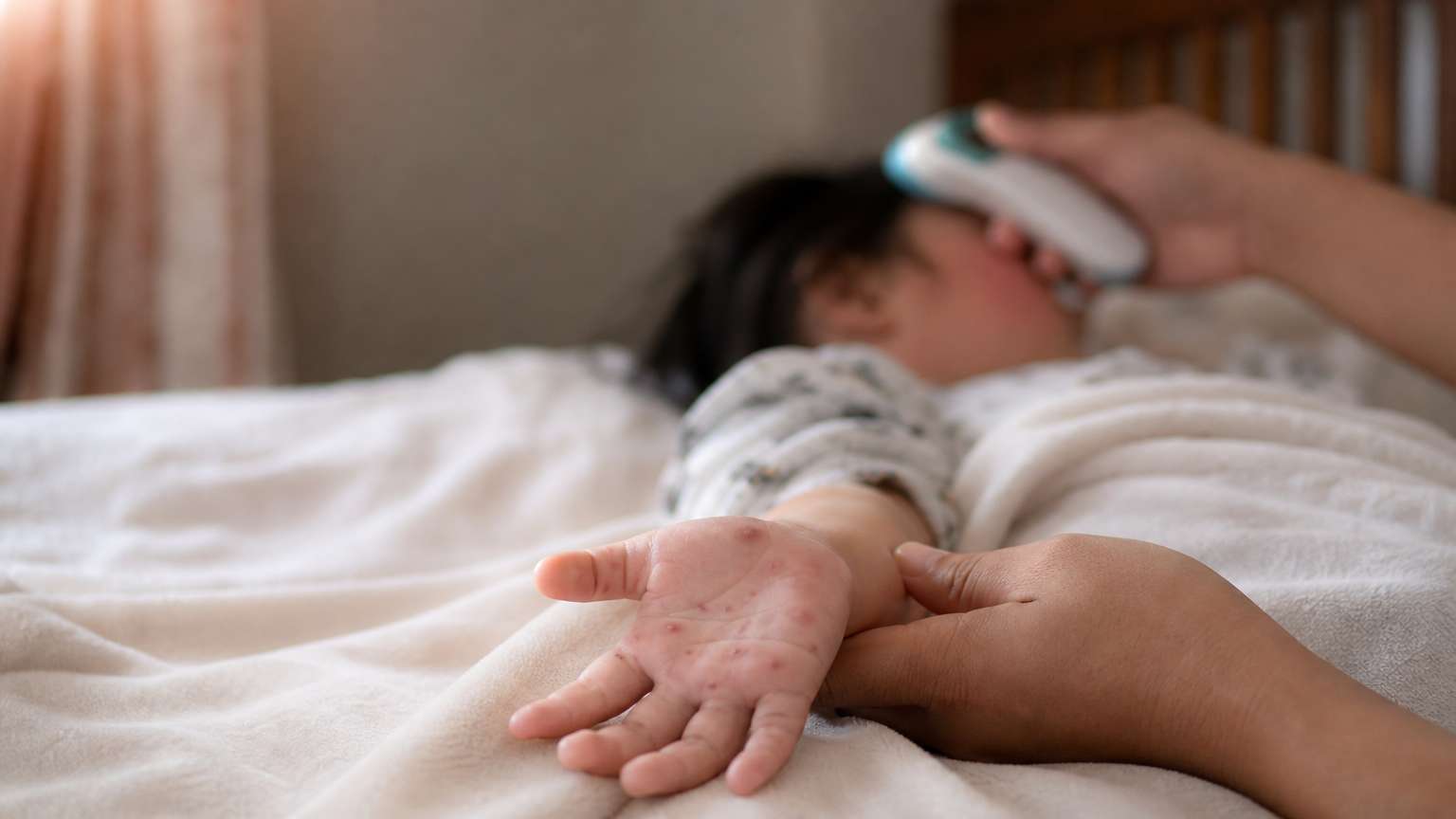
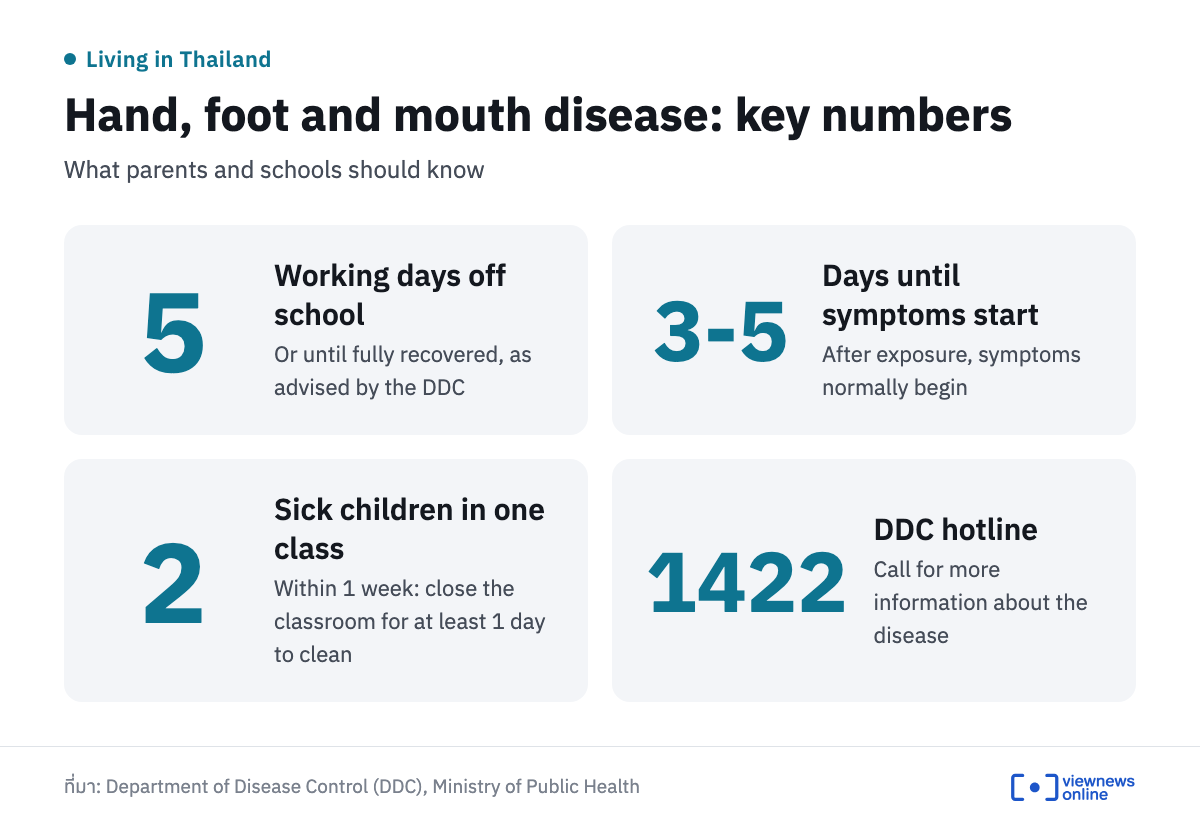
Hand, foot and mouth disease (โรคมือเท้าปาก) is a common childhood infection caused by enteroviruses. A child typically has a fever, painful mouth sores and blisters on the hands and feet. Most children recover in about a week with care at home. Parents should take a child to a doctor immediately if the child is drowsy, has convulsions or stiffening, vomits a lot, breathes rapidly or with difficulty, or eats and drinks very little. Thailand's Department of Disease Control (DDC, กรมควบคุมโรค), under the Ministry of Public Health, advises that a sick child stay out of school for 5 working days, or until fully recovered.
What causes it and how it spreads
The disease is caused by enteroviruses. The most common type is Coxsackievirus A16. Other Coxsackie viruses or enterovirus 71 (EV71) can also cause it.
The virus spreads in several ways: hands contaminated with the virus that touch the mouth, droplets from coughs and sneezes, nasal mucus, saliva, stool and fluid from the blisters. Small children who share toys, cups or spoons can pass it to each other easily. After exposure, symptoms normally start within 3-5 days.
The DDC says patients are most contagious in the first week of illness, but they can remain infectious for several weeks. Handwashing and cleaning a child's belongings therefore stay important even after the child looks better.
Some parents worry that the disease spreads through insects, water, food or garbage. The DDC's disease fact sheet says there is no reliable evidence that it spreads this way. Prevention should focus on close contact with patients and on items they share with other children.
Symptoms and how long the illness lasts
A child usually starts with a high fever for about 2 days. The fever then drops to a low-grade fever for another 3-5 days. During this time, painful sores appear in the mouth, and blisters appear on the hands, feet, palms and soles.
Because the mouth sores hurt, a child may drool and refuse food or milk. The symptoms usually clear up in about 1 week.
Warning signs: go to a hospital immediately
Most patients do not need to be admitted to hospital, but some become seriously ill. The DDC advises taking a child to a doctor immediately if the child has any of these signs:
- High fever
- Eating or drinking very little
- Drowsiness
- Convulsions or stiffening
- Heavy vomiting
- Rapid or labored breathing
According to DDC documents, complications can include inflammation of the brain, inflammation of the membranes around the brain, fluid in the lungs, inflammation of the heart muscle and polio-like weakness. EV71 infection can sometimes be fatal. Patients with serious complications need hospital care, so parents should not wait and watch if they see these signs.
A child who cannot take any food or milk is also a concern, because such patients need close monitoring in hospital.
Care at home, school absence and prevention
Treatment is only for symptoms, such as medicine to bring down fever and ease the pain of mouth sores. A doctor or pharmacist should decide the type and dose based on the child's age and weight. Parents should not choose medicine on their own. While caring for a child at home, watch whether the child is drinking enough and whether any of the warning signs above appear.
DDC documents say the disease does not require quarantine, and contacts are not given immunization. A sick child should still stay home for 5 working days, or until fully recovered, so the virus does not spread in classrooms or nurseries.
For schools, if 2 or more children in the same classroom fall ill within 1 week, the classroom should be closed for at least 1 day for cleaning. Children are then screened strictly for another week. Parents of children in a closed classroom should be ready for a temporary closure notice from the school.
The DDC's recommended prevention steps are simple daily habits:
- Wash hands with soap and water
- Do not share cups, spoons or straws
- Clean children's toys and belongings
- Keep small children away from crowded places
- Schools should screen children every morning
On handwashing, the department advises washing before preparing food, before eating and after using the toilet. It also advises using serving spoons when sharing meals and covering the nose and mouth when coughing or sneezing. The DDC says a patient's mucus, saliva and stool should be disposed of quickly and safely. Parents who change diapers or handle a sick child's stool should be careful and wash their hands thoroughly each time.
Schools should screen children every morning before class for fever, rash, blisters or mouth sores. A sick child should be separated from others and the parents asked to pick the child up. The school should also tell local public health officials. If several children are ill or cases cluster together, schools should ask public health authorities to assess the situation. Classrooms, toilets, toys and shared items should be cleaned regularly with suitable products, such as detergent, soap or diluted sodium hypochlorite as directed on the label. Schools should also provide enough sinks and soap.
For more information about the disease, call the DDC hotline on 1422. Always consult a doctor or pharmacist before starting or changing any treatment.
Source: Department of Disease Control, Ministry of Public Health, disease fact sheet and news release (4 September 2026). This article is adapted from ViewNews' Thai-language report.