Data center operators and businesses that rent AI computing power in Thailand need to know about a new US export rule for AI chips. The Bureau of Industry and Security (BIS), part of the US Department of Commerce, issued the rule on 16 November 2026. It requires a license before advanced AI processing chips are exported, re-exported or transferred within a country to Thailand, Malaysia, Indonesia, Singapore and Brazil.
License applications involving Thailand will be reviewed case by case. This is not an outright ban. The parties affected directly are chip exporters and data center operators, along with customers who use AI cloud services in Thailand.
What the US rule says
The measure is an Interim Final Rule, a provisional final rule, with the reference number RIN 0694-AK50. BIS requires advance approval in 3 situations for advanced AI chips going to the 5 countries: export, re-export (Reexport) and in-country transfer.
Covered items include those under Export Control Classification Numbers (ECCN) 3A090 and 4A090, as well as items with a .z suffix. Companies unsure whether their products fall into this group should check the product's ECCN directly. The code determines whether a license is needed.
The rule still allows chips to go to Thailand. Exporters must apply and wait for a case-by-case decision, so buyers should build license processing time into their purchasing and delivery plans.
Why Washington is worried about remote access
The rule aims to stop Chinese companies from reaching chips remotely through data centers in third countries. Cloud services make it possible to use computing power without owning the chips.
The rule therefore sets due diligence measures for overseas data centers. The thresholds are explained below. As for why Thailand is among the 5 countries, the US assesses that they risk becoming transit routes for advanced technology bound for restricted end users.
Exemptions, reporting and the overseas data center threshold
The rule includes an exemption for items whose ultimate end user, or ultimate parent company, is headquartered in the United States. Exporters who use it must file monthly reports under 15 CFR § 743.10. Getting the exemption therefore does not remove all obligations, because exporters must keep reporting.
The rule also bars providers from delivering total computing power above 12,000,000 Total Processing Performance (TPP) to companies headquartered in Country Group D:5 without advance approval. The threshold applies to the combined computing power delivered. Providers must track the total they supply to these customers rather than look at each contract separately.
What AI cloud providers and users in Thailand should check
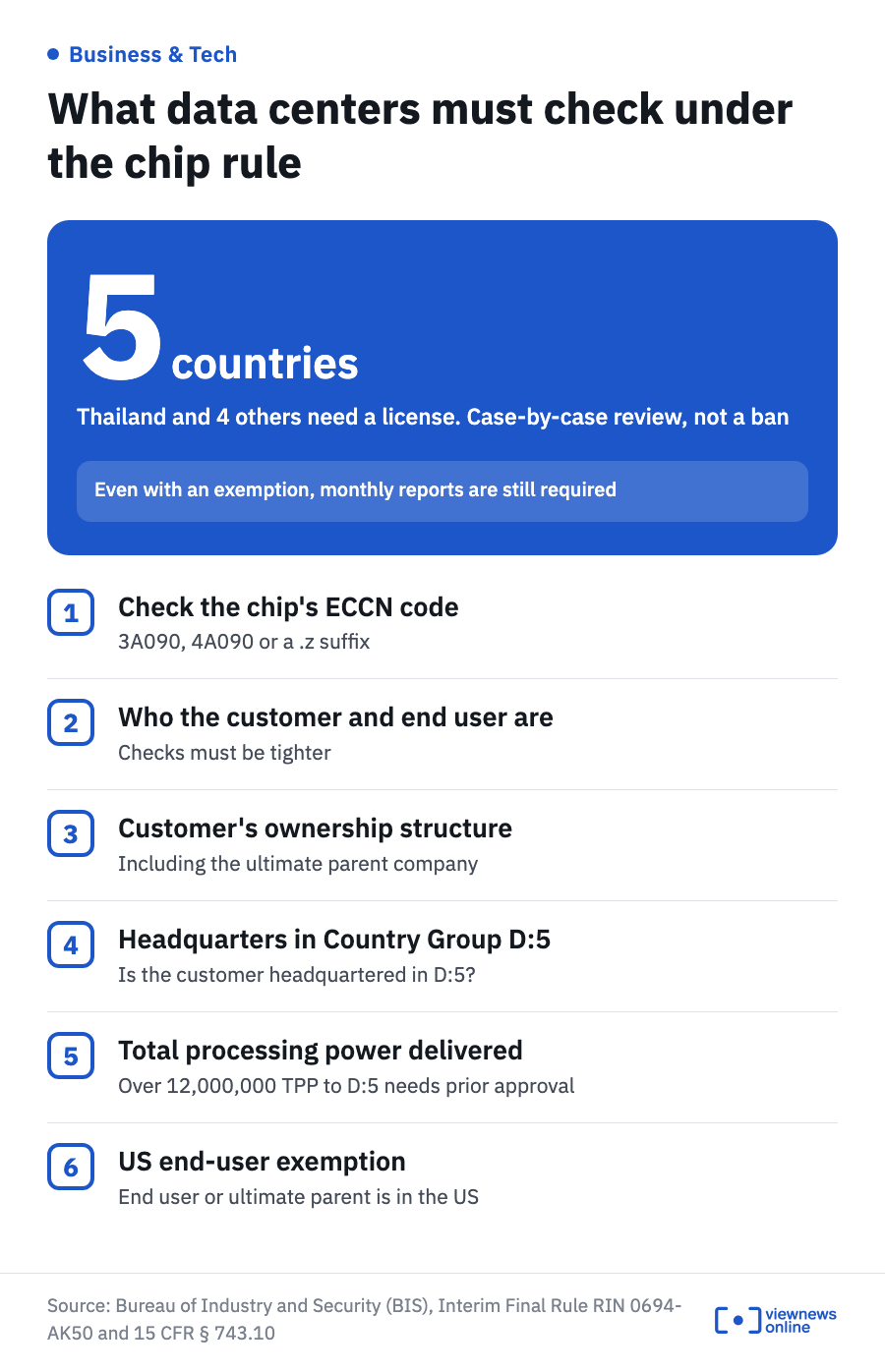
Chip exporters and the data center operators involved must scrutinize customer information, ownership structures and end users more closely. Based on the rule's text, operators should work through this list:
- Are the chips they import or offer under ECCN 3A090, 4A090 or a .z suffix?
- Who are the customer and the end user?
- What are the customer's shareholding structure and ultimate parent company?
- Is the customer headquartered in Country Group D:5?
- Does the combined computing power delivered to D:5 customers exceed 12,000,000 TPP?
- Does the exemption for US-based end users or ultimate parents apply, and does it trigger monthly reporting?
The license requirement and user checks may mean more time and higher compliance costs for some operators. This is most likely for projects that import high-performance AI chips or sell computing power to customers abroad. The actual impact depends on the type of chip, shareholding structure, business model and customer base of each data center. It is too early to conclude that data center investment in Thailand will slow across the board.
For businesses that rent AI cloud capacity in Thailand, the provider is mainly the party that must run these checks. Customers can ask their provider whether the checks are complete, especially on the ownership structure and headquarters of other customers that share the same systems.
What to watch next
The full text of the rule still needs to be checked for the effective date and any adjustment period. Affected companies must complete licensing steps within the timeframe the rule sets. Because the rule is provisional, details may change later. Companies should compare against the latest BIS text before making any decision.
Source: Bureau of Industry and Security (BIS), US Department of Commerce, Interim Final Rule RIN 0694-AK50 and 15 CFR § 743.10.
This article is adapted from ViewNews' Thai-language report.