The Thai Cabinet has approved in principle a draft ministerial regulation that would let private companies bid to invest in and run ports, ferries and roadside rest stops on rural highway land. A deputy government spokesperson said the Cabinet made the decision on 17 November 2026, on a proposal from the Ministry of Transport. Licences would run for no more than 50 years, but that figure is a ceiling, not a guaranteed term.
The draft is not yet in force. It must first go to the Office of the Council of State, the government's legal advisory body, for review. The information released so far does not say which projects will go to tender, where they are, or what users would pay. Ferry and port users, and communities along rural highways, will not see any practical effect for now.
What private firms could run
A winning bidder would be allowed to invest in, provide or manage ports, boats or other vehicles used for ferry crossings, and roadside rest stops. Other structures in rural highway areas are also covered. The licence would be issued by the head of the Rural Roads Department. The draft regulation would set the rules, the fees payable to the state, the licence period and the conditions.
The scope is limited to rural highway areas under Section 63 of the Highway Act B.E. 2535 (1992), as amended by the Highway Act (No. 2) B.E. 2549 (2006).
The deputy spokesperson said the aim is to bring in private firms to provide public services, to improve facilities in rural highway areas so they meet public needs, and to give private firms an equal and fair chance in the selection process.
50 years is a ceiling, not a guarantee
The licence period would be no more than 50 years from the date the department head issues the licence. The Ministry of Transport said the figure follows a similar 2020 regulation covering special highways, national highways and concession highways. That regulation draws on Section 3 of the Leasing of Immovable Property for Commercial and Industrial Purposes Act B.E. 2542 (1999), which allows leases of more than 30 years and up to 50 years.
The ministry said the limit is a maximum and does not entitle every private operator to 50 years. It said it would consider the size of the investment, value for money and the benefit to the state. Those factors would be judged from income, returns from the business, the time the operator needs to recover its investment, and the period over which the investment generates returns.
The words "no more than" mean the actual term for a given project could be shorter. There is no information yet on how many years any project would get, because no projects or detailed bidding terms have been made public.
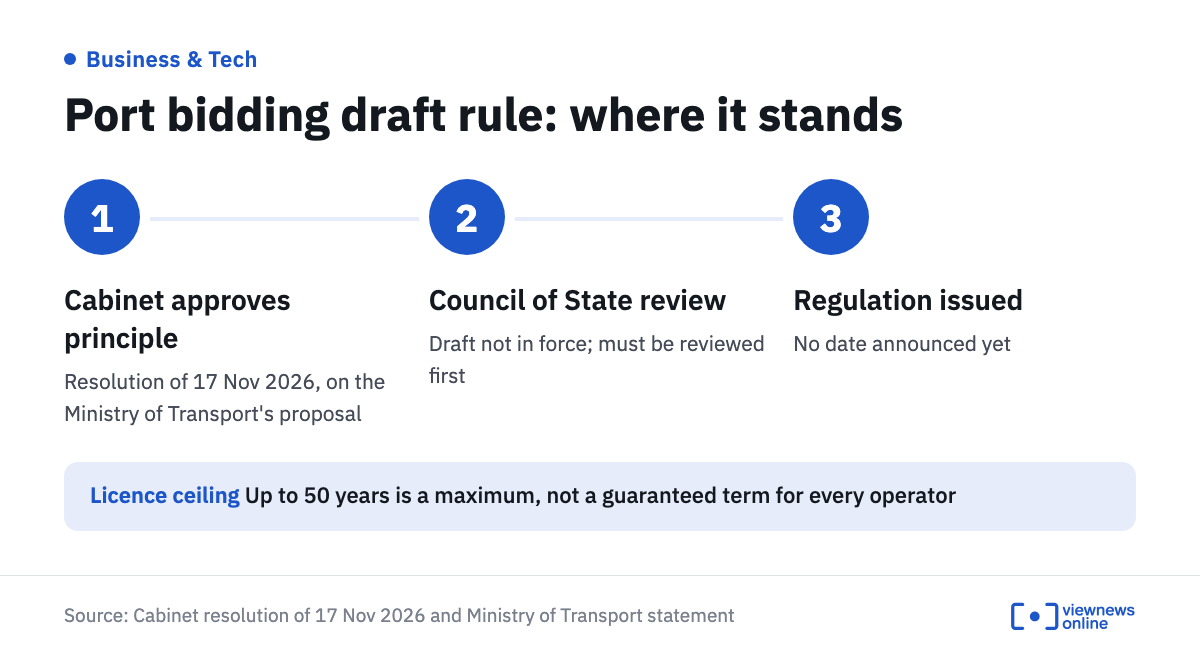
Draft still awaits Council of State review
The Cabinet has approved the principle only. The draft must go to the Council of State before it moves any further. It is not in force, and there is no timeline for when it might be.
The Cabinet also told the Ministry of Transport to take on board the views of the Ministry of Natural Resources and Environment, the Bureau of the Budget and the National Economic and Social Development Council (NESDC). Approval in principle is not the same as the rule being issued.
What has not been disclosed
The draft's title says it will set fees payable to the state, but no figures have been released. The same goes for detailed bidding terms, a list of projects, locations, and the fares or fees that port and ferry users would pay. All of that depends on the full text of the draft and on details that will emerge once actual projects are announced.
There are three things to watch:
- The Council of State's review of the draft, and the date the regulation takes effect.
- Which projects are put out to bid, where they are, and on what terms.
- The effect on fares and fees, and on use of land in rural highway areas.
The process is still at an early stage. Anyone who uses ports or ferries, or runs a business beside a rural highway, should follow announcements from the Ministry of Transport and related agencies.
Source: statement by the deputy spokesperson of the Prime Minister's Office summarising the Cabinet resolution of 17 November 2026, and clarifications from the Ministry of Transport.
This article is adapted from ViewNews' Thai-language report.