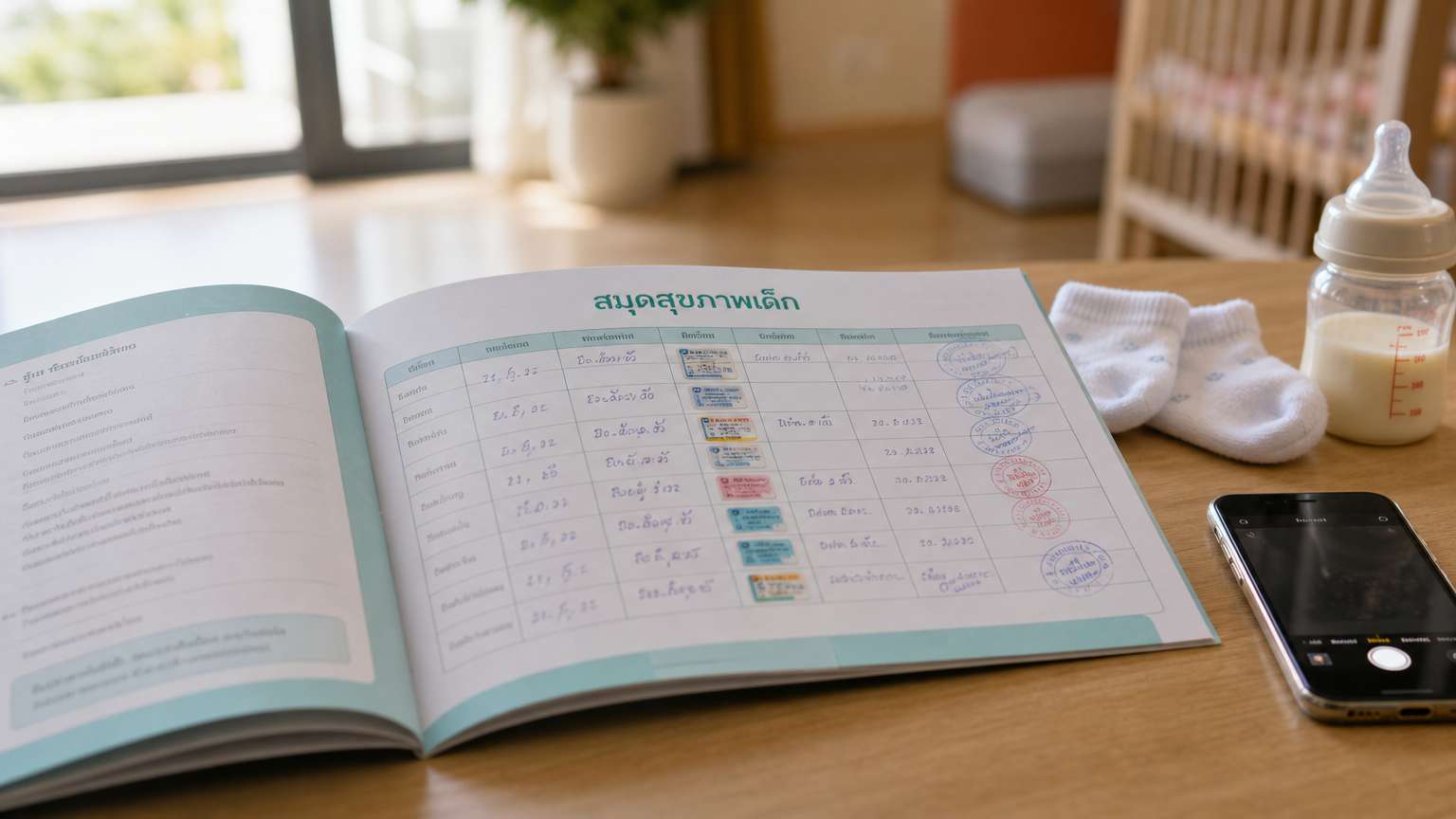
Thailand's national disease committee has approved the name and key symptoms of polio for listing as a dangerous communicable disease. Parents of young children in Thailand should check their child's health record to see whether polio vaccinations are complete. The National Communicable Disease Committee (meeting No. 6/2026) made the decision on 18 November 2026 under the Communicable Disease Act of 2015. The same meeting assigned government agencies to tackle rabies, after the Ministry of Public Health reported 13 deaths in 2026.
Where things stand
The meeting was chaired by Dr Somruek Chungsaman, Permanent Secretary for Public Health. The decision sets the name and key symptoms of the disease. Further details on what hospitals, clinics and the public must do will have to wait for a notice from the Ministry of Public Health.
The meeting also approved a draft ministry notice to set up 2 more international communicable disease control checkpoints, at Trat Airport and Nakhon Si Thammarat Airport. This is only a draft and is not yet in force. The two checkpoints are not yet operating.
Polio symptoms listed in the decision
The ministry says Thailand has been free of wild poliovirus (WPV) since 1997. However, it says the risk remains high of imported cases of vaccine-derived poliovirus (cVDPV) from neighboring countries such as Laos and Myanmar.
The symptoms listed in the decision are:
- Fever, fatigue, headache and vomiting
- Stiff neck or muscle pain
- In some patients, sudden muscle weakness or limp paralysis
Paralysis can lead to permanent disability. In severe cases, the respiratory system can fail and the patient can die.
Some infected people have no symptoms at all, so symptoms alone cannot show who is infected. The decision also requires a laboratory test confirming either naturally occurring poliovirus or vaccine-derived poliovirus. Diagnosis is a job for doctors and laboratories, not for guessing from symptoms.
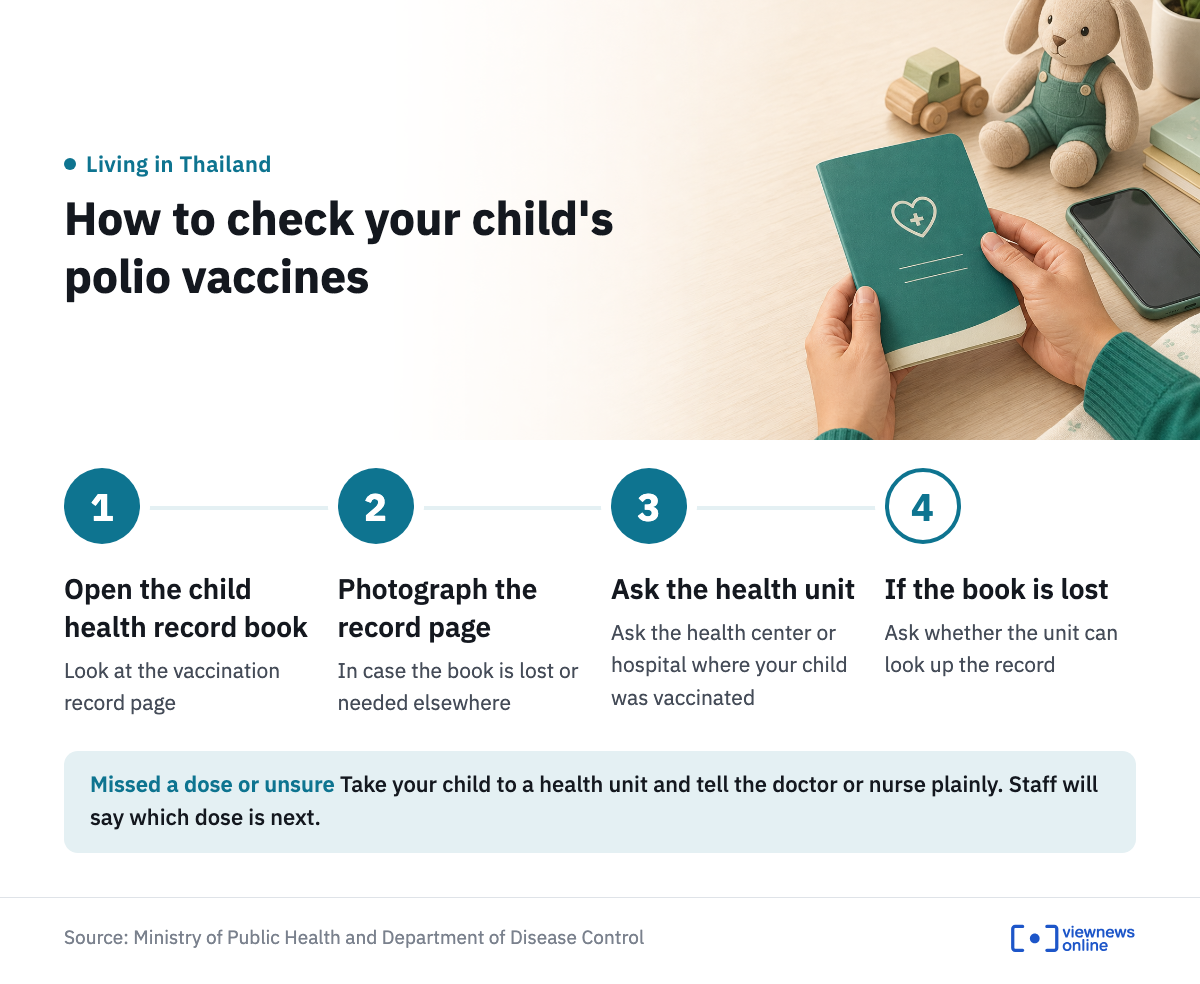
How to check your child's polio vaccinations
The number of doses and the ages at which they are due should follow the latest vaccine schedule from the Department of Disease Control or the Ministry of Public Health. Do not count doses from memory. The simplest check is the child health record book (สมุดสุขภาพเด็ก) and a question to the health unit where your child was vaccinated.
- Open the child health record book and look at the vaccination page.
- Take a photo of the page, in case the book is lost or needed at another facility.
- Ask the public health service center, sub-district health promotion hospital or hospital where your child was vaccinated.
- If the book is lost, ask the health unit whether it can look up the record.
If you missed an appointment or are not sure the vaccinations are complete, take your child to a health unit and tell the doctor or nurse plainly. Staff can say which dose is next and when to give it. Parents do not need to decide this themselves.
Families who cross borders often, or migrant workers with young children, should ask the local health unit whether the child's vaccine history is in the system. The ministry named Laos and Myanmar as the source of the risk from vaccine-derived virus. Foreign residents can ask the clinic or hospital directly about vaccine access and which documents to bring.
Rabies: 13 deaths in 2026
The ministry reported 13 deaths from rabies in 2026. The meeting found that the people who died had been bitten or scratched by an animal and did not receive a vaccine after exposure. Most of the animals responsible were puppies or stray dogs with no owner and no vaccination record.
The meeting assigned tasks by agency:
- Provincial public health offices and hospitals must provide channels for people exposed to risky animals to get diagnosis, treatment and a first rabies vaccine dose quickly.
- The Department of Livestock Development will step up disease surveillance in animals.
- The Department of Local Administration will survey animal populations, vaccinate animals and handle stray animals.
- The Department of National Parks, Wildlife and Plant Conservation will watch for disease where forest meets communities.
- The Public Relations Department will communicate the risks to the public.
For readers, a bite or scratch from an animal should not be treated as minor, even if the wound looks small. Go to a hospital so a doctor can assess the risk and consider a vaccine after exposure as soon as possible. The problem the meeting found was that the people who died did not get that vaccine. Treatment and vaccination must be assessed by a doctor for each person. Consult a doctor or pharmacist before starting or changing any treatment.
Source: Ministry of Public Health and the Department of Disease Control, on the decision of the National Communicable Disease Committee meeting No. 6/2026.
This article is adapted from ViewNews' Thai-language report.