A three-colour map showing which farmland in the Kok and Sai river basins is affected by heavy metals cannot be drawn until new test results come back. On 18 November 2026, the Deputy Spokesperson of the Prime Minister's Office said the Ministry of Agriculture and Cooperatives has ordered its agencies to collect samples at 333 sites between 23 and 25 November 2026. The results will be turned into a watch-list map with three colours: green, yellow and red. There are no results from this round of sampling yet.
The map is meant to guide targeted help for farmers in the two river basins. If any area is rated red, the government says it has prepared a three-stage response. Officials have not yet said what level of contamination will count as green, yellow or red.
Five agencies will sample soil, water, fish and livestock
The Ministry of Agriculture and Cooperatives has ordered its agencies to check for heavy metal contamination from the upper to the lower reaches of the Kok and Sai river basins. The statement did not name specific districts or provinces.
Five main agencies share the 333 sampling points. The Rice Department, the Department of Agriculture and the Land Development Department will jointly collect 250 soil and water samples from farmers' fields. The Royal Irrigation Department will take water samples at 83 points on irrigation water sources.
Two more agencies will test animals. The Department of Fisheries will check aquaculture areas. The Department of Livestock Development will test livestock raised in at-risk areas for heavy metals. The statement refers only to "heavy metals" and does not say which metals will be tested.
How the three-colour map will be made, and when results are due
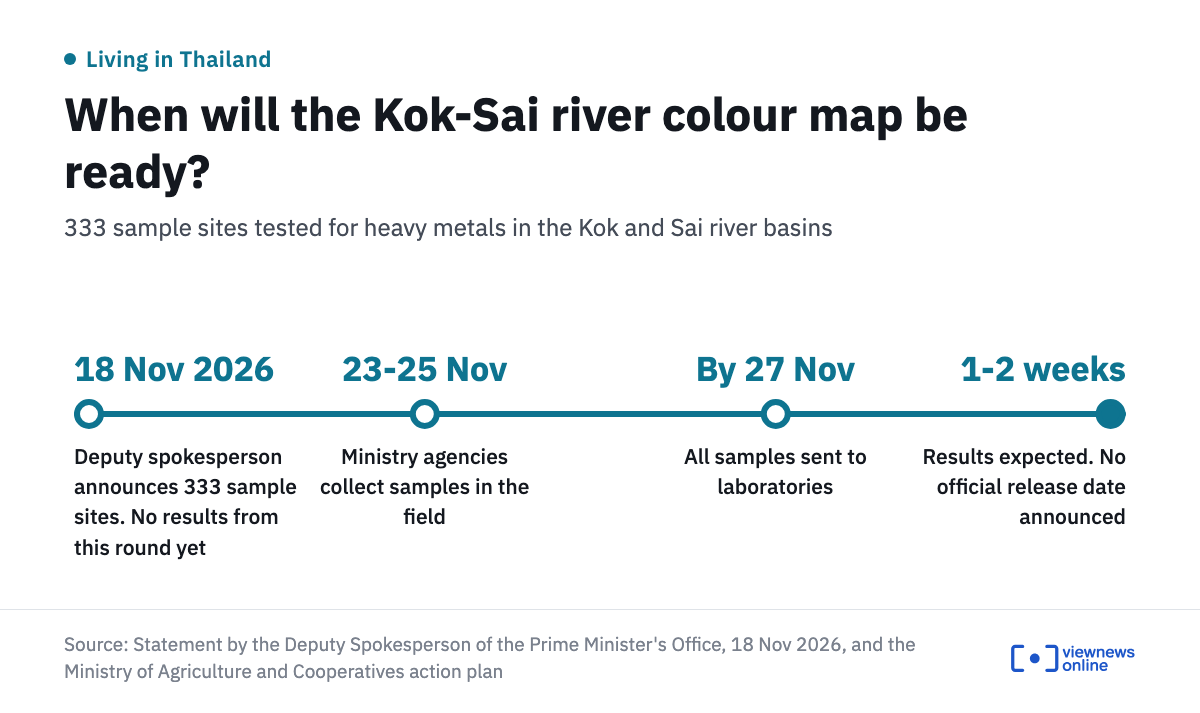
All samples are to reach the laboratories of the Land Development Department, the Department of Agriculture and the Rice Department by 27 November 2026. The deputy spokesperson said results are expected within 1-2 weeks. Counting from the lab submission date, that suggests results could appear gradually from early to mid-December 2026. The government has not announced an official date for releasing them.
For the map itself, the Land Development Department will set a standard for collecting data with GPS coordinates. It will load the data into a geographic information system (GIS) through an application called Agri-Map. The department will use it to produce a watch-list map that grades severity in three colours: green, yellow and red. With coordinates for every sampling point, each result can be placed on the map.
Two questions remain open. The government has not said what heavy metal levels will count as green, yellow or red. It has also not said where the public will be able to view the map. Until then, nobody can tell which colour a particular plot will receive, and the colour of a neighbouring area should not be used as a guide.
Three-stage plan if an area is rated red
The ministry says that if any area is found to be in a critical, red-level condition, it has a response in three stages.
The urgent stage focuses on tight control of produce. Officials will issue certificates for produce that meets safety standards and publish the information openly.
The medium-term stage deals with water sources. If a farmer cannot use their existing water source, the Land Development Department says it is ready to provide funds and machinery to dig small on-farm reserve ponds, called "mini ponds." No registration method, budget cap or eligibility conditions have been announced, so farmers cannot apply yet and must wait for an announcement.
The long-term stage encourages farmers to switch to alternative cash crops suited to the area and to safety needs. Examples given are rubber, flowers and ornamental plants, and other economic tree crops. This would come with technology transfer on restoring and improving soil.
These three stages are a plan for red areas only. The statement does not say what measures yellow areas would receive.
What is known and what to watch for
As of 18 November 2026, there are no new results from this round of sampling, because collection has not yet begun. The three-colour map has not been made, and no farmer has been placed in any zone. Contamination figures released earlier are not results from this round.
While waiting, the government has not said whether produce from any particular area is safe or unsafe. Buyers and farmers should wait for officially released laboratory results rather than rely on rumours or word of mouth.
Three things are still to be announced: the date results will be released, the thresholds that separate green, yellow and red, and the details of how to apply for the medium-term support.
Source: Statement by the Deputy Spokesperson of the Prime Minister's Office on the response to water quality in the Kok and Sai river basins, and the action plan of the Ministry of Agriculture and Cooperatives. This article is adapted from ViewNews' Thai-language report.