A Thai health committee on 18 November 2026 approved two draft Public Health Ministry notices that would add heavy-metal illnesses to the country's legal lists of occupational and environmental diseases. The drafts add cadmium and mercury to the occupational list, and cadmium, mercury and arsenic to the environmental list. Both are still drafts and have not been announced for use. Adding a disease name to a legal list does not mean more people are ill, and it does not mean any area is safe or unsafe.
Two drafts, five new disease entries
The decision came at the first meeting of 2026 of the Committee for the Control of Occupational Diseases and Environmental Diseases, held online and chaired by the ministry's Permanent Secretary. The committee approved two draft notices.
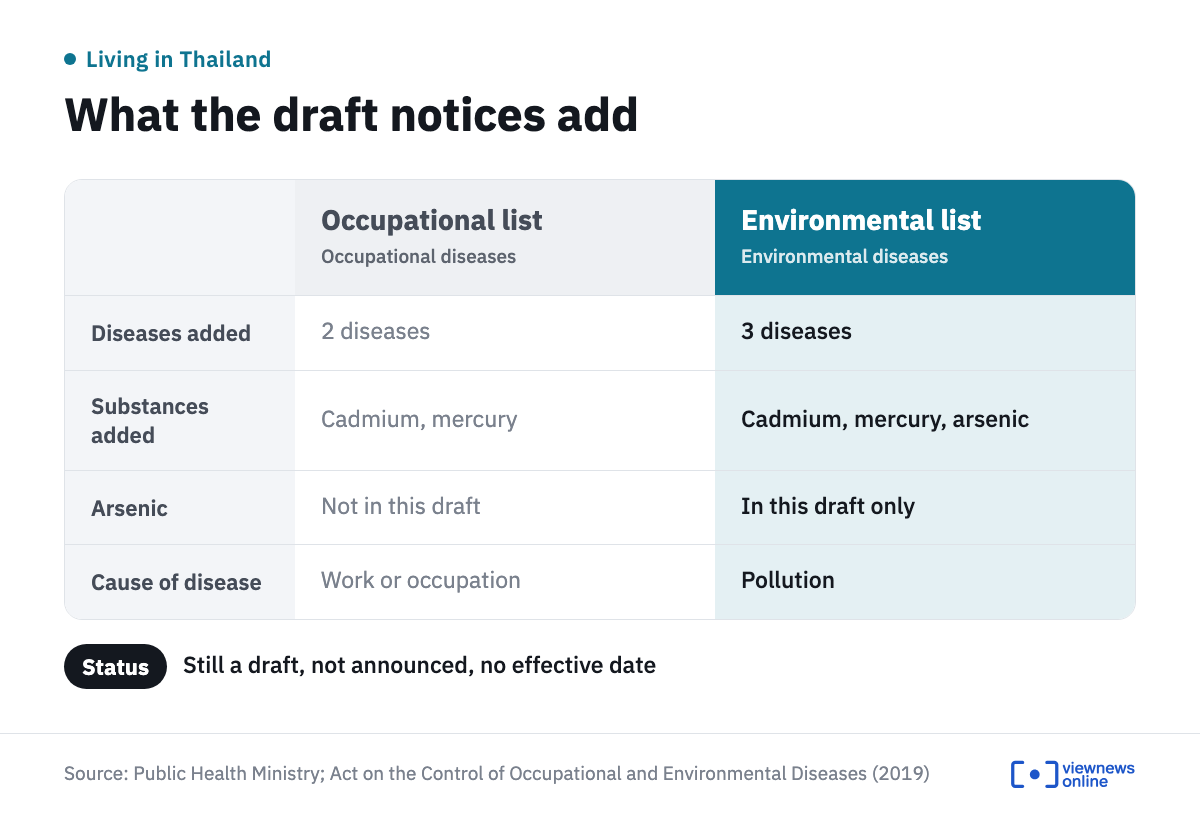
The first draft covers "names or key symptoms of occupational diseases". It adds 2 diseases: illness or symptoms caused by cadmium or its compounds, and illness or symptoms caused by mercury or its compounds.
The second draft covers "names or key symptoms of environmental diseases". It adds 3 diseases: illness or symptoms caused by cadmium, mercury and arsenic, including the compounds of each metal. Arsenic appears only in the environmental draft.
The Public Health Ministry says both drafts must still go through the required procedures. There is no notice in force and no confirmed effective date. Updates will have to come from the ministry.
Occupational disease versus environmental disease
Both lists fall under the Act on the Control of Occupational Diseases and Environmental Diseases, enacted in 2019. The Act defines an occupational disease as an illness or abnormal condition arising from work or an occupation. It defines an environmental disease as one arising from pollution.
The Act defines pollution broadly. It covers waste, hazardous substances, contaminants and other pollutants that affect environmental quality or endanger public health. In simple terms, the first list is about harm from work, and the second is about harm from pollution in the surroundings. Cadmium and mercury can sit on both lists. Arsenic is only on the environmental list in this round.
The ministry says the listings support disease surveillance, prevention and control. It says the aim is to cover the risks that hazardous substances pose to employees, workers and people affected by environmental pollution, and to reduce exposure at the source. The detailed key symptoms and diagnostic criteria will be in the text of the draft notices.
Arsenic screening results are not patient counts
At the same meeting, the Department of Disease Control (DDC) director-general reported on arsenic contamination in surface water. The department is monitoring it because it may pose a health risk to local people, especially those more likely to be exposed.
In 2026, the DDC screened 10,711 people in at-risk groups. Of these, 1,269 needed a health check with a urine sample. Arsenic above the reference level was found in 94 people.
- Mae Hong Son: 17 cases were investigated. Arsenic in 2 of them was above the reference level. None of the 17 showed abnormal symptoms.
- Chiang Rai: 31 cases are awaiting laboratory results.
- Five other provinces: 46 cases are under investigation.
"Above the reference level" is a screening result used to decide who gets investigated and followed up. It does not mean a person is sick. The Mae Hong Son cases show this: some readings were above the level, yet no abnormal symptoms were found in the 17 people investigated. The reference level is a DDC criterion.
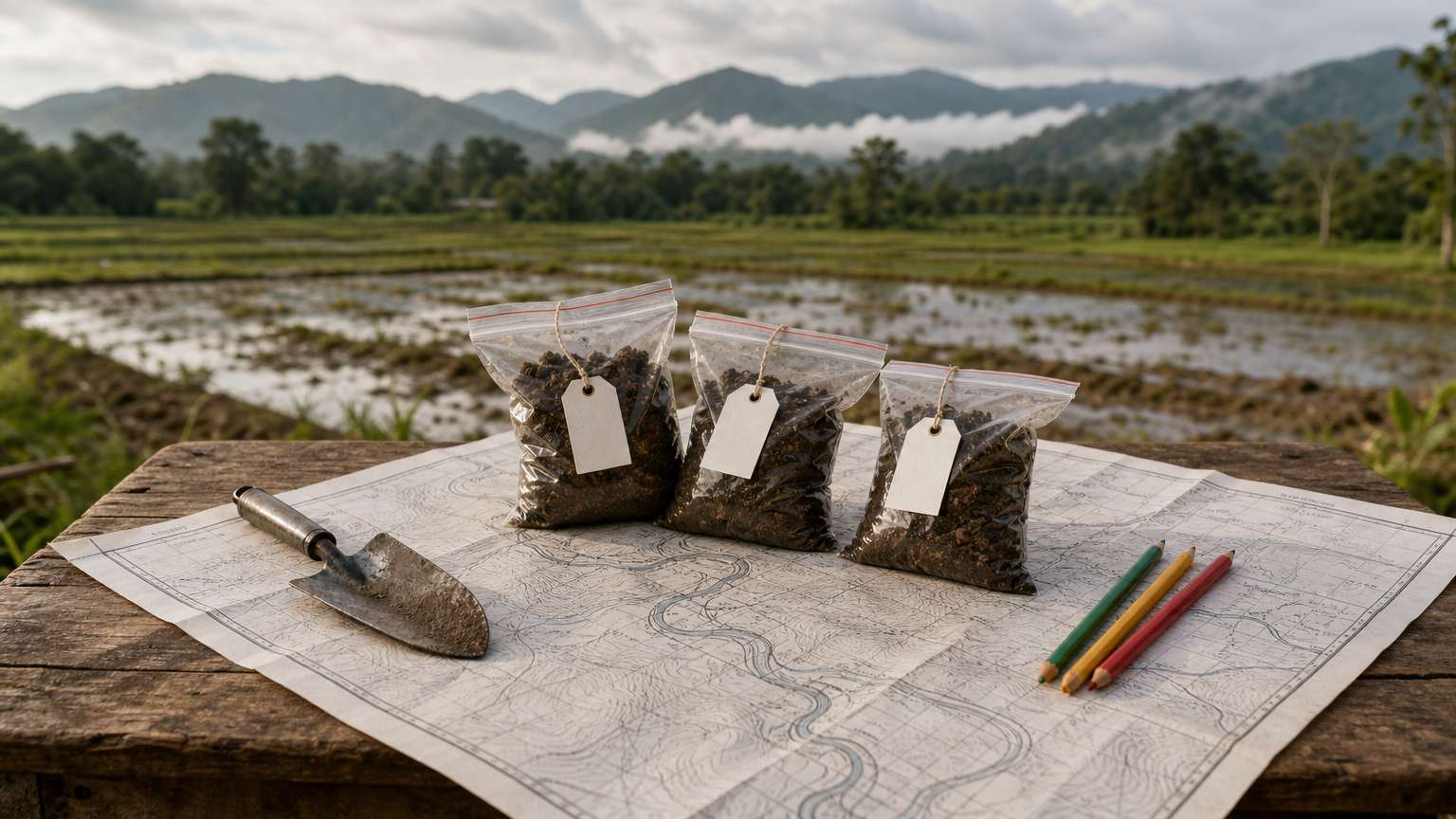
This is separate from a plan by the Ministry of Agriculture and Cooperatives to collect soil and water samples at 333 points in farmland and water sources from 23 to 25 November 2026. That plan will produce a green, yellow and red watch map for the Kok and Sai river areas. The health committee's decision concerns disease names in draft notices. It is not a sampling plan and not a tap-water plan.
What to watch next
The DDC deputy director-general said the department is preparing to declare the Kok, Salween and Mekong river basins special surveillance areas, starting with Chiang Rai. The aim is to monitor arsenic poisoning closely. This is still a plan, and no declaration has been issued.
There are four things to follow:
- When the two draft notices are signed and announced.
- The laboratory results for the 31 cases in Chiang Rai.
- The investigation results for the 46 cases in 5 provinces.
- The special surveillance area declaration for the three river basins.
These details change quickly, so check the official channels of the Public Health Ministry and the DDC.
People who live near water where arsenic has been found, or who work with heavy metals, and who are worried about their health, can ask local public health officers about screening. In this round, urine samples were collected for testing. If you are concerned about symptoms or exposure to arsenic or other heavy metals, see a doctor.
Source: Public Health Ministry and the Department of Disease Control, first 2026 meeting of the Committee for the Control of Occupational Diseases and Environmental Diseases, and the Act on the Control of Occupational Diseases and Environmental Diseases (2019).
This article is adapted from ViewNews' Thai-language report.