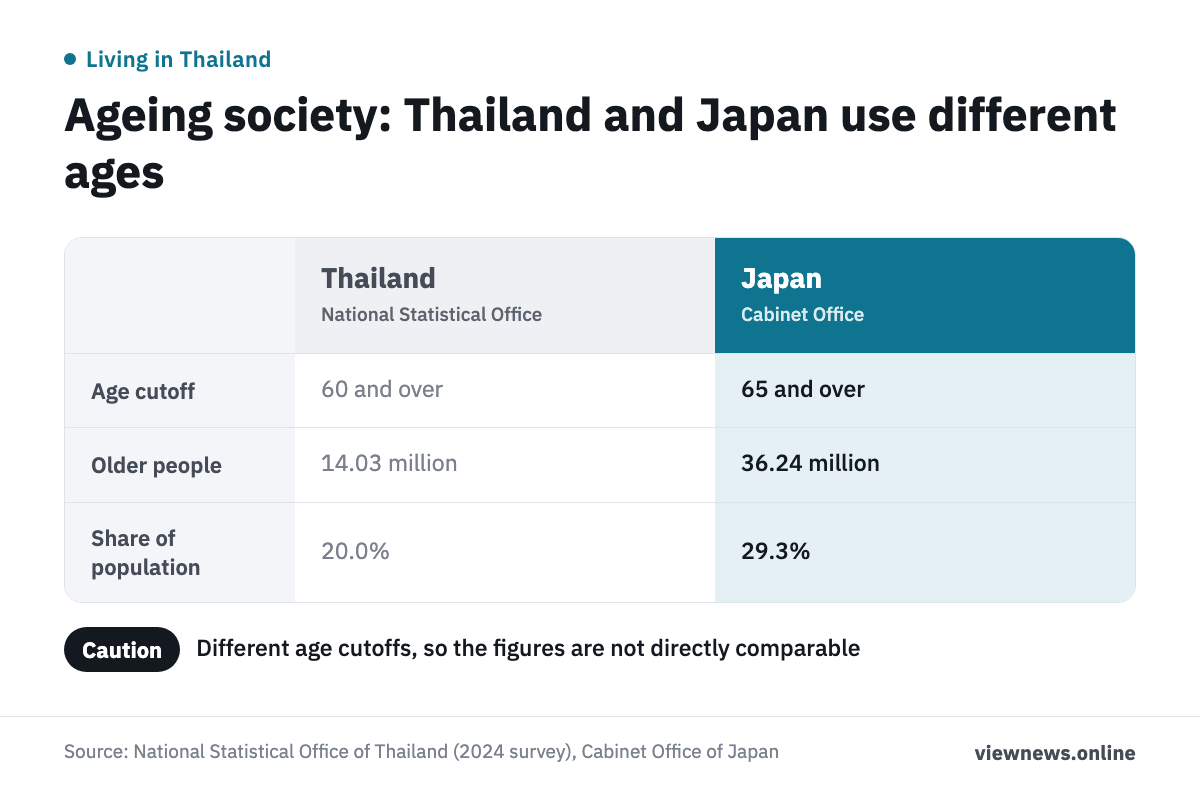
Thailand now counts one in five people as a senior citizen. A survey by the National Statistical Office (NSO), carried out from April to June 2024, found 14.03 million people aged 60 and over, or 20.0% of the population. In Japan, the Cabinet Office reports 36.24 million people aged 65 and over as of 1 October 2024. That is 29.3% of a population of 123.80 million. The two countries count different age groups, so the percentages cannot be compared directly. The direction of travel and the effects on households can be.
Where Thailand's ageing stands
The NSO has surveyed the older population eight times since 1994. The 2024 survey drew on 86,880 sample households nationwide. It shows the share of older people rising steadily, from 6.8% in 1994 (4.01 million people) to 14.9% in 2014 and 20.0% in 2024. The NSO says Thailand has entered a "Complete Aged Society", which is defined as more than 20% of the population aged 60 or over.
The next stage is a "Super Aged Society", where older people make up more than 28% of the population. The NSO expects Thailand to reach it before long.
Within the older group, about 59.3% are in the early stage (60 to 69), 29.8% in the middle stage (70 to 79) and 10.9% in the late stage (80 and over). Women outnumber men in every age band and make up 57.9% of all older people.
How far ahead Japan is
Japan's Annual Report on the Ageing Society, published by the Cabinet Office in June 2025, counts 36.24 million people aged 65 and over. Of these, 15.47 million are aged 65 to 74 (12.5% of the population). Another 20.78 million are aged 75 and over (16.8%), a group now larger than the 65 to 74 group. The report projects that by 2070, one in every 2.6 Japanese will be 65 or older.
The two countries cannot be compared directly because Japan reports the share aged 65 and over, while the NSO reports the share aged 60 and over. Japan's 29.3% and Thailand's 20.0% are therefore not like-for-like. What can be said safely is that both countries have high and rising shares of older people, and that Japan is further along.
Japan itself no longer treats 65 as a fixed dividing line. Ageing-policy guidelines approved by the Japanese Cabinet on 13 September 2024 say Japanese people have among the longest life expectancies in the world. They add that it is not appropriate to treat everyone aged 65 and over in the same way.
Effects on households and the job market
The NSO survey shows the burden of care falling more heavily on people of working age. The old-age dependency ratio rose from 10.7 in 1994 to 31.1 in 2024. In other words, every 100 working-age people (15 to 59) are responsible for about 31 older people. The support ratio fell from 9.3 to 3.2, which is roughly three working-age people for each older person. The ageing index stands at 127.4, meaning 127.4 older people for every 100 children under 15.
Living arrangements are changing too. Some 64.5% of older people live with others, 22.6% live with only a spouse and 12.9% live alone. The share living alone has nearly quadrupled from 3.6% in 1994. Only 8.6% of older people have a caregiver. That share is 32.8% among the late-stage group but just 3.4% among the early-stage group. Japan shows a similar trend. The Cabinet Office report says that in 2020, 15.0% of men and 22.1% of women aged 65 and over lived alone. It projects 26.1% and 29.3% in 2050.
On income, 34.0% of older people in Thailand are still working: 44.7% of men and 26.2% of women. The main reason is that they are healthy and able to work (51.5%), followed by the need to support themselves or their families (43.5%). The main income sources for older Thais are their children (35.7%), work (33.9%), government living allowances (13.3%) and pensions or lump-sum retirement payments (6.8%). In Japan in 2024, 53.6% of people aged 65 to 69 were employed, as were 35.1% of those aged 70 to 74 and 12.0% of those aged 75 and over. The number of working older people has risen for 21 years in a row.
What the agency recommends
- Strengthen financial and health welfare systems, so older people do not have to rely on work more and more.
- Develop jobs and work settings that suit older people, such as working from home or flexible hours.
- Run campaigns to raise awareness of, and respect for, older people in society.
The NSO's reasoning is that older people who keep working, especially healthy ones, can ease pressure on their households. But working in later life may also reduce their health and quality of life.
The NSO also reports on technology use. A paper from its Economic Statistics Division, citing a 2024 survey of older people's use of information and communication technology, says more than 80.0% of older Thais use a mobile phone and nearly 60.0% use the internet regularly. The agency sees this as a base to build on. If older people cannot get online, they may miss out on health information and services that are increasingly moving online.
Japan's figures show that living longer does not always mean living in good health. In 2022, healthy life expectancy, meaning years without health-related limits on daily life, was 72.57 years for Japanese men and 75.45 years for women. That is almost unchanged from 2019. For working-age readers, the data suggests that planning retirement income and care for parents is a closer concern than many assume. Children remain the largest single income source for older Thais.
Source: National Statistical Office of Thailand, Report on the 2024 Survey of the Older Persons in Thailand, and an NSO Economic Statistics Division paper on older people in the digital world; Cabinet Office of Japan, Annual Report on the Ageing Society FY2025.
This article is adapted from ViewNews' Thai-language report.