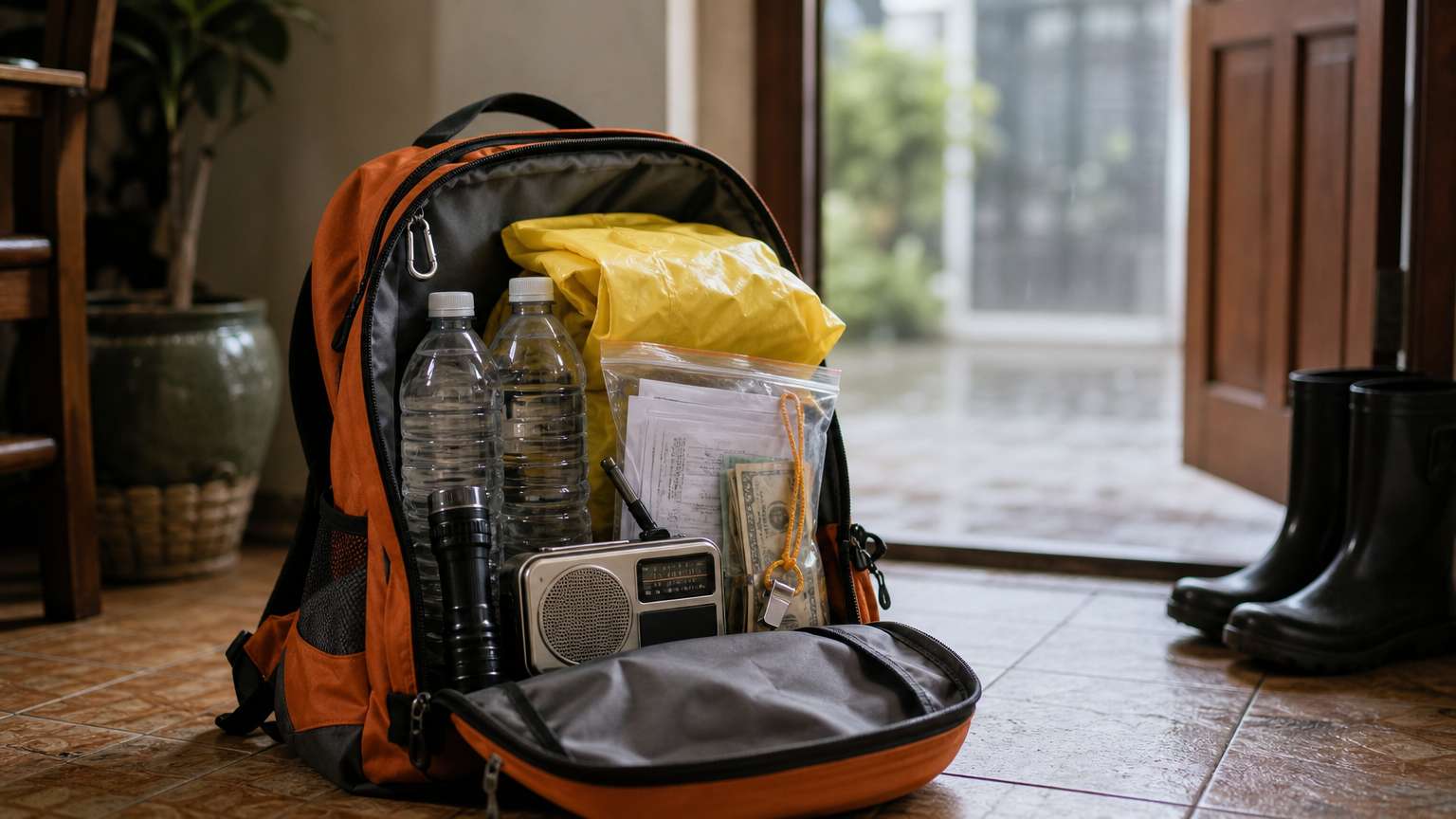
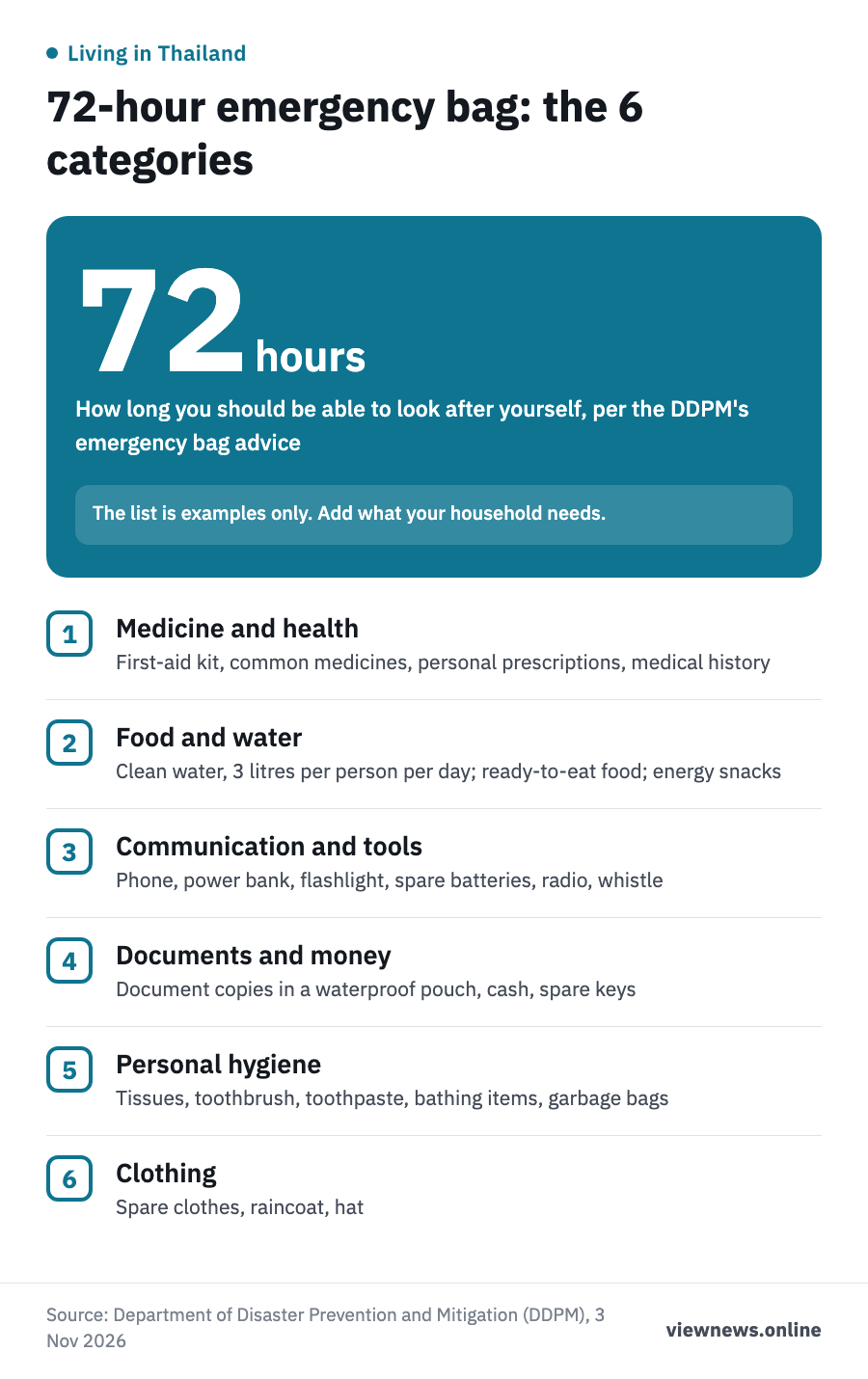
Thailand's Department of Disaster Prevention and Mitigation (DDPM) says a bag that lets you look after yourself for 72 hours, or three days, should cover six categories: medicine and health, food and water, communication devices and tools, documents and cash, personal hygiene, and clothing. DDPM Director-General Nirat Phongsittaworn told the public on 3 November 2026 to prepare an emergency bag at home.
The announcement followed warnings from several countries urging residents to stock 72 hours of supplies because of the conflict in the Middle East. The DDPM said Thailand is not on the list of countries that need to prepare for this. It said the emergency bag is a basic measure the agency has promoted for years. It is not a reason to panic, only a way to have basic supplies ready.
Why the DDPM says 72 hours
The director-general said 72 hours is the international standard for disaster and emergency preparedness. In the first three days after a disaster, people have to cope on their own while the government is still sending help to each affected area. Having enough water, food and equipment matters most in that window.
The DDPM says the bag covers natural hazards such as flash floods, runoff from the hills, mudslides, earthquakes and epidemics. It also covers man-made hazards such as fires, riots and sabotage. In other words, one kit works for many kinds of emergencies, and you do not need to prepare separately for each.
What to pack: the six categories
The DDPM groups the essentials into six categories. You can use them as a checklist and go through them one by one to see whether your home has everything.
- Medicine and health: a first-aid kit, common household medicines, your personal prescription medicines, and documents on your medical history.
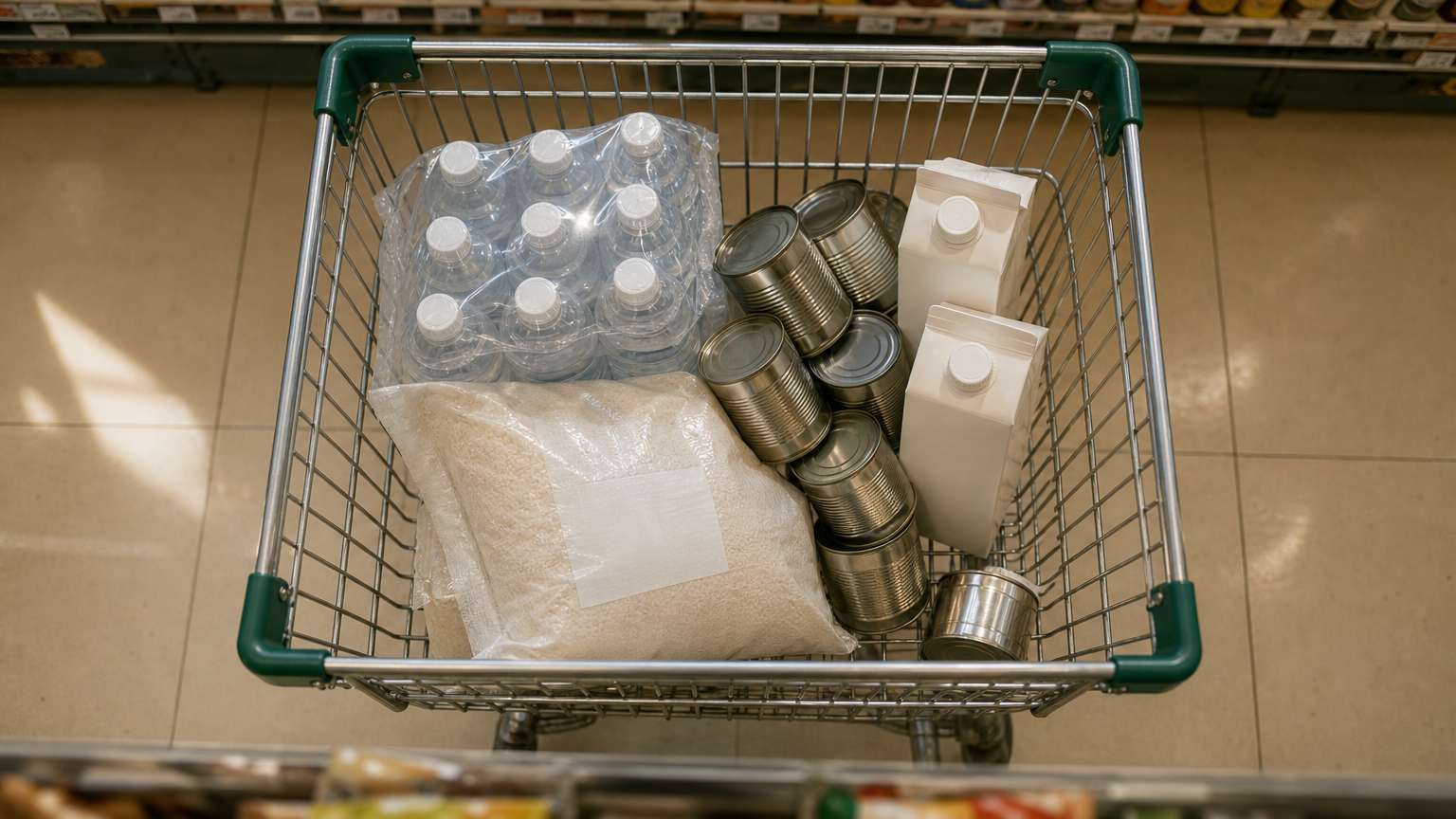
- Food and water: clean drinking water at 3 litres per person per day, ready-to-eat food, energy snacks, and food for young children, older people or patients if you have them at home.
- Communication devices and tools: a phone, a power bank, a flashlight, spare batteries, a transistor radio, a whistle and similar items.
- Documents and money: copies of important documents in a waterproof envelope or zip-lock bag, cash, and spare keys.
- Personal hygiene: tissues, a toothbrush, toothpaste, bathing items and garbage bags.
- Clothing: spare clothes, a raincoat, a hat and similar items.
Several of the DDPM's categories end with phrases meaning "and so on", so the list is a set of examples, not a fixed inventory. Each household can add what its own members need.
This is our own observation, not DDPM advice. The medicine and the food-and-water categories deserve extra care, because items in both expire and are needed in larger quantities than the rest.
How much drinking water to store
The DDPM says to prepare clean drinking water at 3 litres per person per day. Over three days, our calculation comes to about 9 litres per person. The 9-litre figure is ours, not a number announced by the DDPM.
For a household of four, our calculation puts the need at about 36 litres. It is worth knowing before you shop, because water is the heaviest and bulkiest item in the bag. One suggestion of ours, not the DDPM's: a household with several people could keep the water as a separate set outside the backpack. That makes it easier to grab and avoids carrying everything at once.
Extra items for children, older people or patients
The DDPM says that if vulnerable people live in the home, you should also prepare food for young children, older people or patients. If someone is ill or takes medicine regularly, put their personal medicines and medical history documents in the bag under the medicine and health category.
The rest is our own suggestion, not DDPM advice. Ask each household member to check what they cannot do without, and write it all on one list. Review the bag every 6 months and replace food, medicine and medical supplies that are close to expiry. Keep the bag somewhere everyone at home can reach easily.
If you take regular medication, ask a doctor or pharmacist how much to keep in reserve and how to store it, before you change how you use it.
For people in southern Thailand: the Thai Meteorological Department issued its Announcement No. 9 warning of heavy to very heavy rain in the South from 5 to 9 November 2026. People in areas at risk of flash floods or runoff from the hills should check their emergency bags when a warning like this is issued.
Source: the Department of Disaster Prevention and Mitigation (DDPM), statement of 3 November 2026, and the Thai Meteorological Department.
This article is adapted from ViewNews' Thai-language report.