Residents of Chiang Rai province, especially along the Sai and Kok rivers, have new government instructions on tap water and drinking water. The Cabinet met on 17 November 2026 and acknowledged a 3-level plan to deal with arsenic in the Sai River. The Prime Minister ordered agencies to step up monitoring of tap water quality, provide clean drinking water to affected communities, and keep the public informed about test results.
The Deputy Spokesperson of the Office of the Prime Minister said the Prime Minister relayed the instructions through Deputy Prime Minister Phiphat Ratchakitprakarn, who chaired the meeting. The news has two main parts: what the government has ordered for tap water, and how far along the backup water sources in the plan are. Contact channels for the relevant agencies are listed at the end.
Three orders on Chiang Rai tap water
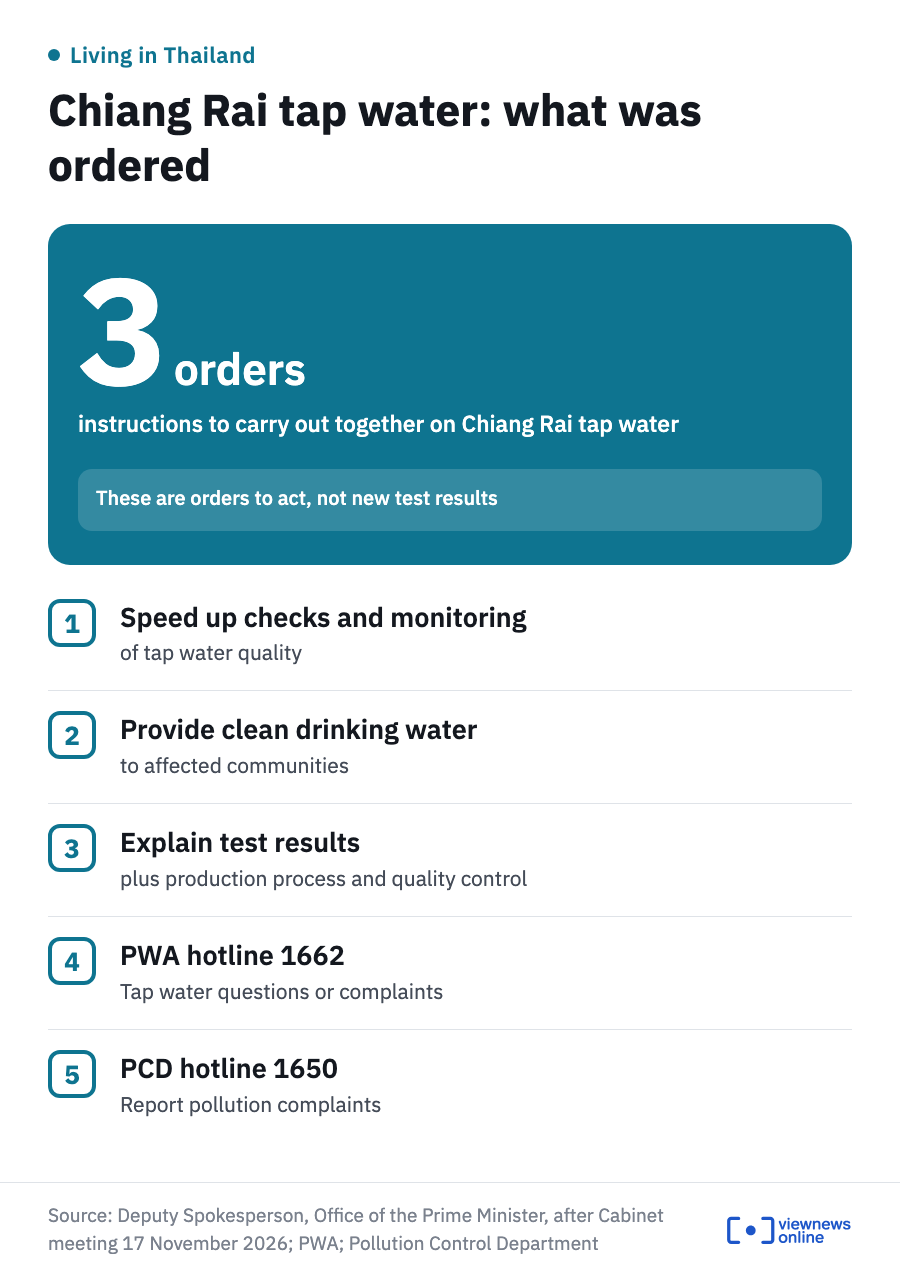
The Deputy Spokesperson said the Prime Minister told the Interior Ministry, the Ministry of Natural Resources and Environment, and other related agencies to do three things at the same time. First, speed up checks and monitoring of tap water quality. Second, provide clean drinking water to affected communities. Third, keep explaining test results, the production process and quality control of tap water to the public.
These are instructions to agencies to act. They are not new test results. The briefing did not give the latest arsenic levels in the river or in tap water, and it did not say whether Chiang Rai tap water is safe. Figures and conclusions still have to come from the agencies that test the water directly.
The 3-level plan for arsenic in the Sai River
The same briefing said the government is tackling water quality problems in Chiang Rai, especially in the Kok and Sai rivers, on three levels at once. The first level is finding replacement water sources and improving monitoring systems. The second is preparing to help people in the area. The third is international coordination. The plan includes cooperation among Thailand, Myanmar and China to address cross-border pollution.
On replacement sources, the plan for Chiang Rai city is to use water from the Lao River. For Mae Sai district, the approach is to extend the water supply system, study drawing water from the Mekong near Chiang Saen district, and survey nearby sources such as Khun Nam Nang Non.
The briefing said each project is at a different stage. In its wording, the Lao River option for Chiang Rai city is a plan, the Mae Sai supply system is an approach, the Mekong option at Chiang Saen is a study, and Khun Nam Nang Non is a survey.
There is no timetable for when any backup source will be ready. There is also no date for when cooperation with Myanmar and China will produce results. The second level, helping residents, fits with the order to provide clean drinking water to affected communities.
Where to follow water test results
These official channels are open to the public. The Pollution Control Department (PCD) has a page on the situation in the Kok, Sai and Mekong rivers at pcd.go.th/kok, a surface water quality database at iwis.pcd.go.th, and a pollution complaint system with a hotline on 1650. These systems cover surface water. Tap water is the job of the Provincial Waterworks Authority (PWA).
The home pages of the PCD, the PWA and Chiang Rai province had not yet published the latest arsenic readings for the Kok or Sai rivers. They had also not published numerical test results for tap water.
The PWA has a hotline on 1662 and an online complaint system. Its website carried a news item on 11 November 2026 with a headline that translates roughly as: PWA tightens production controls to handle the raw water quality crisis, PWA Mae Sai branch. The PWA's tap water standards are available as a document. That document sets the criteria. It is not a test result.
The Chiang Rai provincial website has posted news on contamination in the Sai River and help for affected people. If agencies begin explaining results as ordered, readers can look for announcements on the channels above.
What communities can do now
The most concrete confirmed help is drinking water. On 17 November 2026, Chiang Rai province announced that a mobile drinking water production truck from the Disaster Prevention and Mitigation Region 15 Chiang Rai office would produce and give out free clean drinking water at the Mae Sai District Office from 09.00 to 15.00. This matches the order to provide clean drinking water to communities.
For tap water questions, the PWA hotline on 1662 is available for inquiries and complaints. For pollution, the PCD complaint system (hotline 1650) is the channel. On backup sources, the briefing gave no details or timetable for water from the Lao River or the Mekong, because those projects are still at the plan, approach, study or survey stage.
Source: Deputy Spokesperson of the Office of the Prime Minister, briefing on instructions after the Cabinet meeting of 17 November 2026; websites of the Pollution Control Department, the Provincial Waterworks Authority and Chiang Rai province.
This article is adapted from ViewNews' Thai-language report.