People in seven Thai provinces along the Cambodian border will be able to deduct up to 100,000 baht (about US$3,000) for home repairs and up to 30,000 baht (about US$900) for vehicle repairs on their income tax return for tax year 2026, if two draft laws clear every step. The Cabinet approved the draft laws in principle on 17 November 2026, on a proposal from the Finance Ministry, the deputy government spokesperson said. Because this is approval in principle only, nobody can claim the deduction yet.
The package has three parts: an income tax exemption for compensation payments, a deduction for home repairs, and a deduction for vehicle repairs. This article explains who is covered, the caps, the timing and what to keep on file.
Who is covered and which provinces
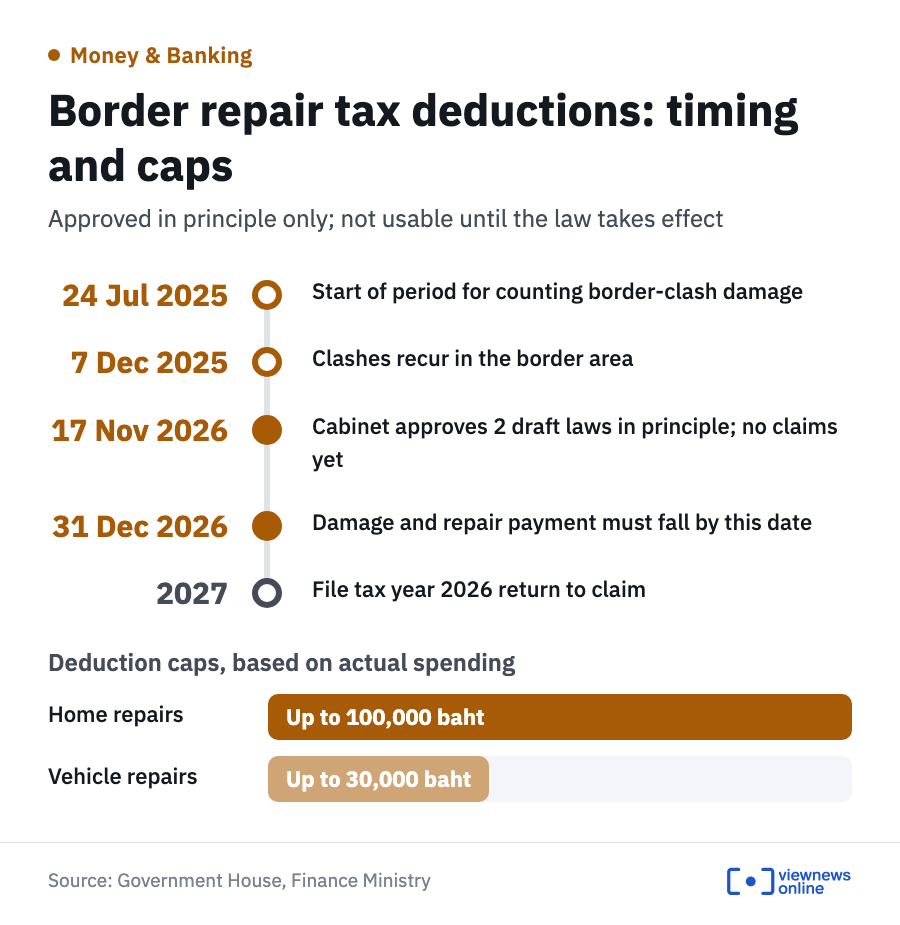
The seven provinces are Ubon Ratchathani, Si Sa Ket, Surin, Buri Ram, Sa Kaeo, Chanthaburi and Trat. The government says these areas were affected by clashes along the Thai-Cambodian border from 24 July 2025, and by renewed incidents from 7 December 2025.
The home repair deduction is for owners, tenants or users of a house under conditions still to be set. The vehicle repair deduction is for owners or hire-purchase buyers of cars or motorcycles. In both cases the property must have been damaged by events in an area that the authorities have officially declared a disaster zone or an emergency disaster-relief zone.
The Thai report does not say whether foreign residents, foreign homeowners or foreign-owned companies are treated differently. If you fall into one of these groups, check with the Revenue Department or a tax adviser before relying on the measure.
How much can be deducted
Home repairs can be deducted at the amount actually paid, up to 100,000 baht in total. Vehicle repairs can be deducted at the amount actually paid, up to 30,000 baht in total. Both figures are ceilings, not payouts. The government stresses that this is a deduction based on real spending, not full compensation for everyone affected.
Some examples:
- If you paid 60,000 baht to repair a home, you can deduct 60,000 baht.
- If you paid 150,000 baht for home repairs, you can deduct 100,000 baht.
- If you paid 20,000 baht to repair a vehicle, you can deduct 20,000 baht.
- If you paid 45,000 baht for vehicle repairs, you can deduct 30,000 baht.
The home and vehicle caps are separate and are not combined into one amount. The measure covers only damage from the border clashes in the seven provinces. It is separate from the existing deduction for flood victims.
Key conditions:
- The damage must occur, and the repair be paid for, between 24 July 2025 and 31 December 2026.
- The deduction is claimed for tax year 2026, with the return filed in 2027.
- The property must be in an area officially declared a disaster or emergency relief zone.
Documents to keep
No official list of required documents has been issued. The list below is general advice, not an official requirement, but keeping these items costs nothing because the main conditions depend on actual payments and on the declared disaster areas.
- Receipts or proof of payment for all repair work and materials
- Photos of the damage before and after repairs
- Proof that the property is in an officially declared area
- Proof of ownership, a lease, or a hire-purchase contract for the vehicle
- Records of any compensation or insurance payout received, to compare with the damage
Keep home and vehicle paperwork in separate sets, since the caps differ. If you paid for repairs in several instalments or at several shops, keep every receipt together so the total can be added up when you file.
Compensation and insurance payouts
The first measure exempts income tax, for both individuals and juristic persons (companies and similar entities), on government compensation. It also covers money or assets received from other sources to make up for the damage, up to the value of the damage. Anyone who has already received compensation should keep records to compare against the actual loss.
For insurance payouts, the government said corporate income tax will be waived on the portion that meets the conditions. The statement gave no details for individuals who receive insurance payouts.
Separately, the Cabinet acknowledged two Finance Ministry notifications that extend the deadlines for filing returns and paying tax for affected people in the border area. They cover corporate income tax, withholding tax, value-added tax, certain specific business taxes and stamp duty. These are notifications, not draft laws awaiting approval.
Where the bills stand
The Cabinet has approved only the principle of the two draft laws. No date has been given for when they will take effect. Anyone who has already repaired a home or vehicle cannot claim yet, and must wait for the laws to take effect and for details on how to claim.
The Finance Ministry estimates the home and vehicle deductions will cost the state about 360 million baht in lost tax revenue: 280 million baht for homes and 80 million baht for vehicles.
Two things to watch: the date the laws take effect, and the full conditions for claiming. If you plan repairs, remember that payment must fall within the period the measure sets, and keep all records until the 2027 filing season.
Source: Government House, the deputy spokesperson of the Prime Minister's Office (Cabinet resolution briefing), and the Finance Ministry.
This article is adapted from ViewNews' Thai-language report.