The Bank of Thailand (BOT) and the central banks of Indonesia, Malaysia and the Philippines signed a memorandum of understanding (MOU) on 13 November 2026 to promote payments in local currencies. It falls under the Local Currency Transaction (LCT) Framework. Exporters, importers and small businesses that trade with those 3 countries are directly affected. No start date has been announced, and no list of participating banks has been published.
One MOU for 4 central banks, replacing the 2023 version
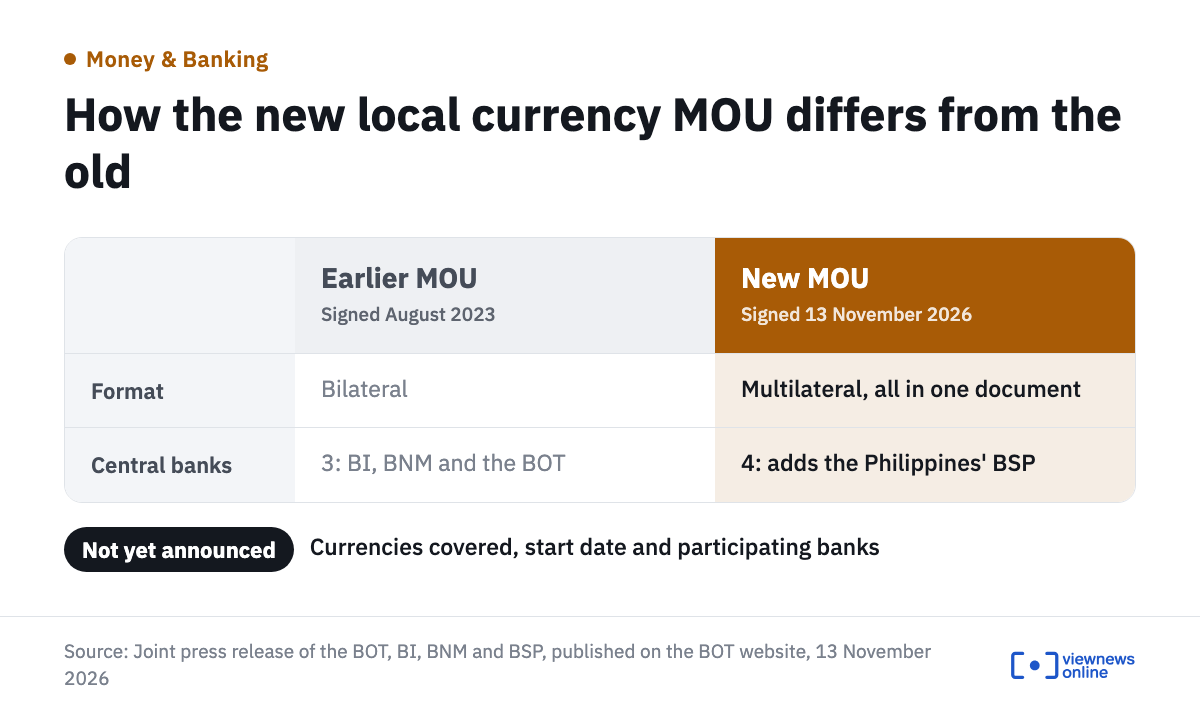
The signatories are Bank Indonesia (BI), Bank Negara Malaysia (BNM), the Bank of Thailand and the Bangko Sentral ng Pilipinas (BSP). The governors signed for their institutions: Destry Damayanti for BI, Abdul Rasheed Ghaffour for BNM, Vitai Ratanakorn for the BOT and Eli M. Remolona, Jr. for the BSP. This is according to a joint press release published on the BOT website.
The MOU sets out cooperation to promote and facilitate the use of local currencies in cross-border transactions among the participating countries. It covers trade, investment and other transactions specified under the framework.
Two things have changed. The Philippines joins as the fourth country. The MOU is also multilateral, meaning all parties sign one document. It replaces the bilateral MOU that BI, BNM and the BOT signed in August 2023, when only 3 central banks were involved.
The central banks listed 3 objectives: to make cross-border payments more efficient, to reduce the cost of exchanging money through multiple currencies, and to give businesses and financial market players more options for managing exchange rate risk. The press release says the 4 central banks will keep developing and operating the framework together. It expects use of local currencies to grow gradually.
How local currency payment differs from going through a third currency
The idea is that trading partners settle in their own currencies, or in each other's, instead of converting through a third currency first. The press release refers to the cost of exchanging money through multiple currencies. That means the cost that arises when money is converted more than once between buyer and seller.
Here is a hypothetical example. It illustrates the concept only and is not how the actual system works. A Thai food manufacturer sells to an importer in Malaysia. If payment goes through a third currency, the buyer's ringgit are first converted into that currency and then converted into baht. Each conversion is a point where costs arise. The LCT idea is to shorten the chain, for example by exchanging ringgit and baht directly.
The central banks say the framework adds options for managing exchange rate risk. The word used is "options". It does not say the risk disappears. The press release also gives no figure for how much cost could be saved, so businesses cannot yet estimate the difference. They will need to compare prices and terms once banks offer the service.
What the announcement does not say
The joint press release does not state which currencies are covered. It gives no start date and does not name participating banks. What exists is a cooperation framework between central banks. It is not an announcement that commercial banks are ready to offer the service. Businesses should not assume they can switch payment methods immediately at every bank.
The release also gives no figure for the share of trade settled in local currencies. Clearer details would emerge if the central banks announce the currencies, the participating banks or a start date.
What is clear is the direction. The 4 central banks agreed to keep developing the framework and see wider use as a gradual process. Anyone who sends or receives money with partners in Indonesia, Malaysia or the Philippines should watch for announcements from the BOT and from their own bank.
What exporters, importers and small businesses should ask their bank
With no operating details yet, the practical step is to ask your current bank. Do not change how you pay until the bank confirms clear terms. Useful questions include:
- Does the bank already offer local currency payments with Indonesia, Malaysia or the Philippines?
- If so, which currency pairs are covered?
- Which transaction types qualify, such as payment for goods, services or investment?
- How do fees and exchange rates differ from the usual payment method?
- Does the overseas partner need an additional account or meet other conditions?
- If not yet available, when does the bank plan to offer it?
Asking these questions commits you to nothing and will help you compare options when the service launches. Small businesses with ongoing supply contracts in the region should also talk to their partners about which currency to use for pricing and payment, because local currency settlement needs the other side to agree.
Source: Joint press release of the Bank of Thailand, Bank Indonesia, Bank Negara Malaysia and the Bangko Sentral ng Pilipinas, published on the BOT website on 13 November 2026.
This article is adapted from ViewNews' Thai-language report.