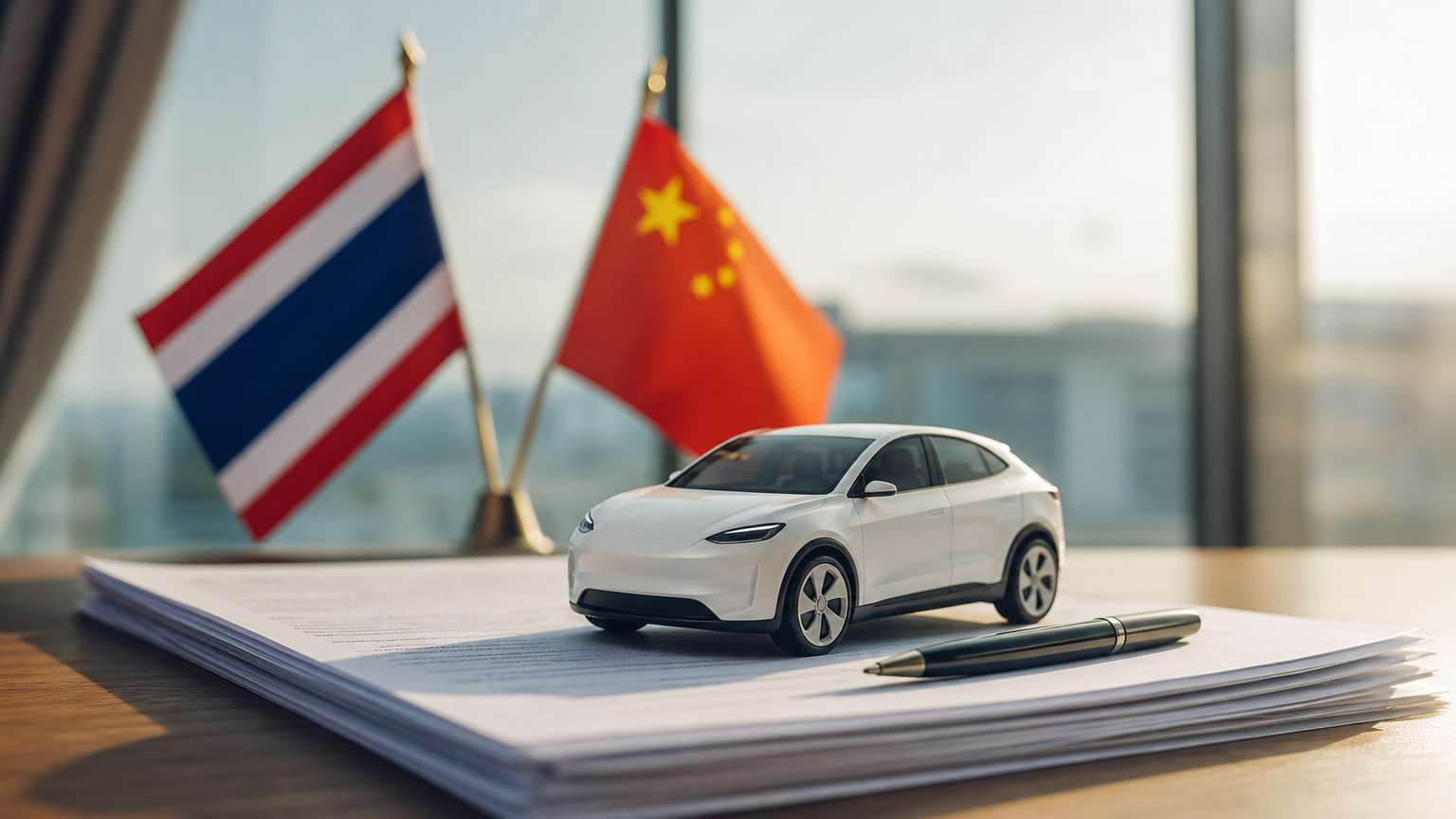
The Thai Cabinet approved on 10 November 2026 a draft memorandum of understanding (MOU) on the automotive industry with China. The MOU is between Thailand's Ministry of Industry and China's Ministry of Industry and Information Technology (MIIT). It runs for 5 years and covers investment, trade, standards and other areas. The deputy spokesperson of the Prime Minister's Office said it is a cooperation document, not an agreement that legally binds Thailand or China.
The topic matters to electric vehicle (EV) buyers, parts makers and workers in the auto sector. For now, though, it sets a framework. It is not a measure that changes car prices or creates jobs straight away.
The five areas of cooperation
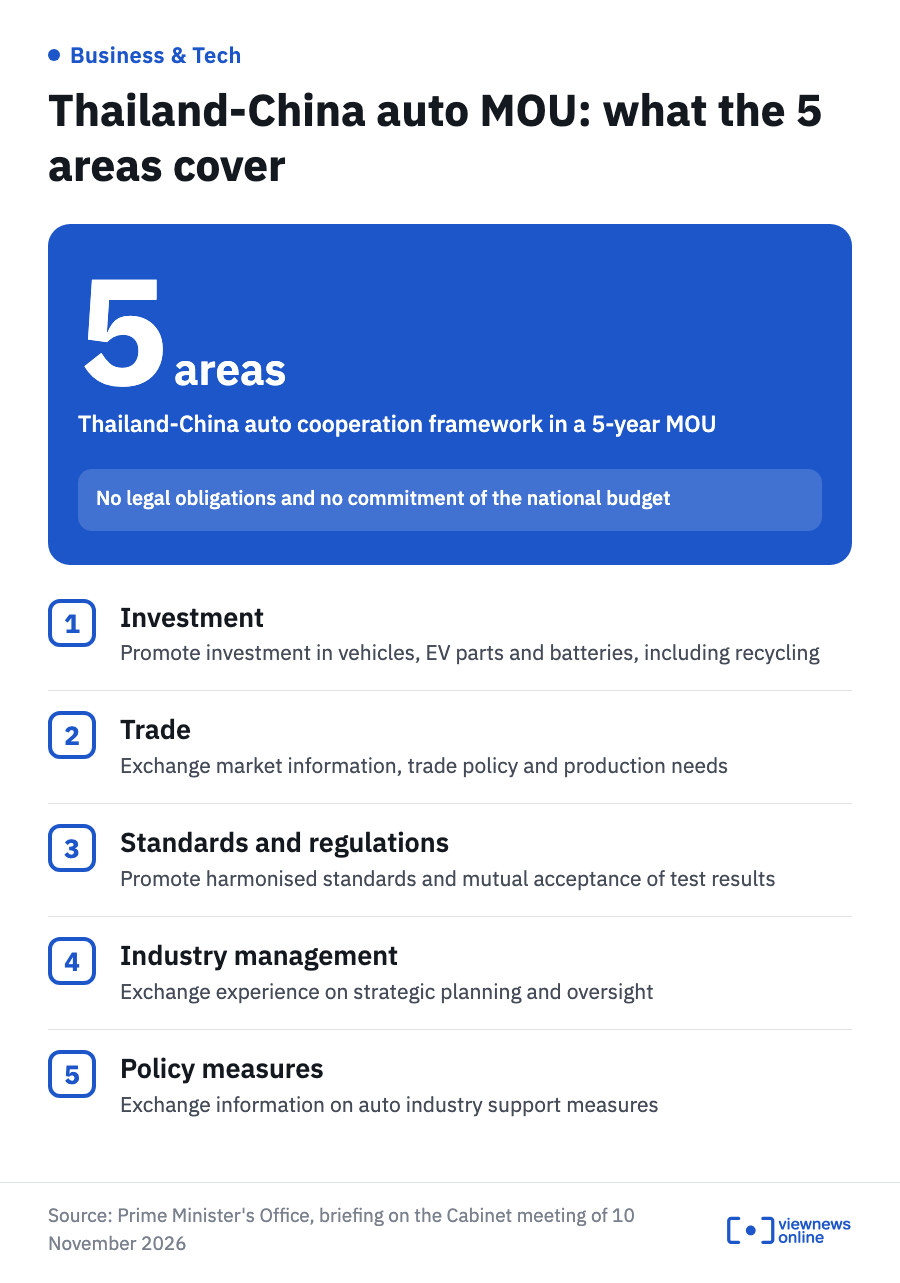
According to the deputy spokesperson, the MOU sets out cooperation in 5 areas.
- Investment: promote investment between Thai and Chinese companies in vehicle production, auto parts, EVs, and battery production and recycling. It also covers facilitating investment projects of companies in both countries.
- Trade: exchange information on market conditions, trade policy and production needs, to increase trade opportunities for vehicles and parts.
- Standards and regulations: exchange information on vehicle standards through seminars, training and joint activities, and promote harmonised standards and mutual acceptance of test results.
- Industry management: exchange experience on strategic planning, industry oversight and analysis of obstacles.
- Policy measures: exchange information and experience on measures that support the auto industry, so that policy keeps pace with technological change.
Most of this is exchange of information, experience and joint activities. It does not set specific numbers or commitments. The government statement gave no investment value, no number of factories and no number of jobs.
The key word on standards is "promote". The statement does not say which products mutual acceptance of test results would cover, or when it would begin.
Not legally binding, unlike a trade agreement
The MOU does not create obligations that are binding under international law. A trade agreement that is in force is different. The statement also says activities and budgets under the framework will be considered jointly case by case, and that the MOU does not commit the national budget.
In plain terms, the MOU agrees a general direction. It does not require either side to invest, buy, sell or accept any standard by a set date.
Real outcomes will depend on what work plans a joint working group draws up, and on whether companies in the two countries decide to run joint projects. The statement also does not mention import tariffs on EVs. Car buyers should not assume the MOU will make imported EVs cheaper or more expensive.
The working group and what to watch
A China-Thailand Automotive Industry Cooperation Working Group will be set up to coordinate work, track progress and draw up annual work plans. On the Thai side, the lead contact is the Office of Industrial Economics under the Ministry of Industry. On the Chinese side, it is the Equipment Industry Department I of MIIT. The annual plans, and the topics the group takes up first, will be the clearest guide to direction.
Parts makers should look at the investment and standards areas, since the framework covers auto parts, batteries and battery recycling, as well as harmonising standards. EV buyers can watch for progress on standards and testing once work plans appear.
For workers, the government statement says only that the framework includes knowledge exchange among industry, universities and research institutes in both countries. No figures were given on jobs created or affected.
Signing expected in November 2026
What the Cabinet approved on 10 November 2026 is a draft. Thailand plans to sign in November 2026, during a visit to Thailand by China's prime minister. The Cabinet authorised the Minister of Industry, or a delegate, to sign for Thailand.
The 5-year term will run from the actual signing date. The full text of the MOU has not appeared in the information the government released. Still to watch are the actual signing date, the full text and the working group's first annual plan.
Source: Prime Minister's Office, briefing on the Cabinet meeting of 10 November 2026.
This article is adapted from ViewNews' Thai-language report.