The ASEAN Digital Economy Framework Agreement (DEFA) could give online sellers, app providers and digital service users in Thailand a common set of regional rules for the first time, if it is signed and takes effect. Negotiations concluded in late May 2026. The Association of Southeast Asian Nations (ASEAN) is aiming to sign the deal at its 49th summit in November 2026. Signing is still a target and has not yet happened.
Thailand has chaired the DEFA Negotiating Committee (DEFA NC) from the start of talks in 2023 to their conclusion in 2026.
What DEFA is and Thailand's role
DEFA is the world's first regional digital economy agreement, drawn up among ASEAN member states, according to Thailand's Commerce Ministry. It focuses on making members' digital systems work together, a goal known as interoperability.
The talks concluded at the 2/57 meeting of the ASEAN Senior Economic Officials (SEOM) in Manila, the Philippines, in late May 2026. Singapore's Ministry of Trade and Industry (MTI) announced the outcome on 31 May 2026.
As chair of the DEFA NC, Thailand has had an overview of the whole negotiation, from the start in 2023 to the point where members reached agreement. For business readers, that is a reason to follow the deal closely: the rules that emerge concern a market Thailand helped shape.
More than trade in goods
A typical trade agreement is mainly about the cross-border trade of goods. DEFA is different. It deals with the rules for doing business and making transactions on digital systems.
The Commerce Ministry says DEFA covers cooperation on cybersecurity, consumer protection, action against online scams, and preparation for technologies such as artificial intelligence (AI).
Singapore's MTI gives more detail. It says DEFA sets common rules to make digital trade easier, supports trusted cross-border data flows, improves digital payments and electronic transactions, and strengthens online consumer protection. It also covers newer issues such as AI, financial technology and source code protection.
The agencies have not released the text of individual provisions. That includes conditions on data flows and country-specific exceptions. As a result, DEFA cannot yet be compared clause by clause with other agreements.
What the agencies expect, and what is unclear
The Commerce Ministry and Singapore's MTI list the topics the agreement covers: linking digital systems, cybersecurity, consumer protection, action against online scams, cross-border data flows and digital payments. These are areas where the agencies expect common rules. They are not results that have already happened. The agencies have not said how the benefits would reach Thai sellers or consumers.
The headline figures are projections from studies cited by the agencies. According to those studies, the ASEAN digital economy could grow to US$2 trillion by 2030, and the value of digital trade could rise by as much as 30% by 2030. Both are estimates. Whether they come true depends on the agreement being signed, entering into force and being put into practice by member states.
Online sellers and app providers may want to do the following:
- Watch for a Commerce Ministry announcement on whether the agreement has been signed.
- Watch for the full text when it is published, especially on digital payments and data flows.
- Check whether your business sends customer data across borders or accepts digital payments from abroad, since both topics fall within the agreement's scope.
- Watch for any announced timetable for ratification.
For consumers, the consumer protection and online scam provisions are worth watching once the full text is out. For now, the agencies have described only the broad scope.
Awaiting signing and the steps after
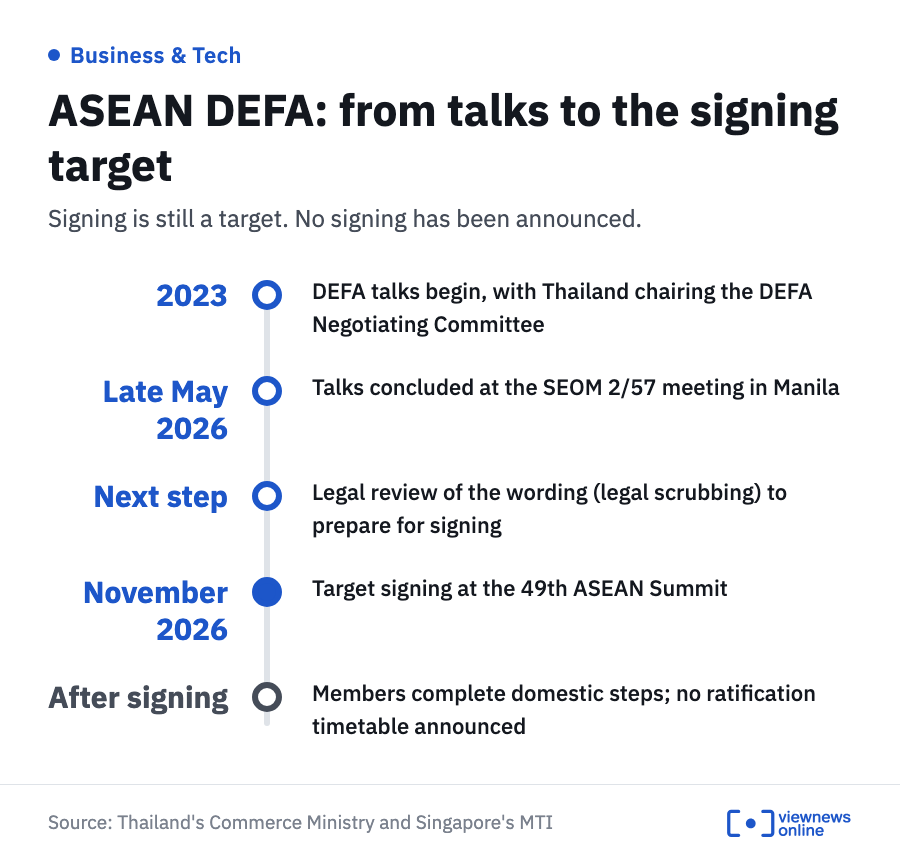
No agency has announced that DEFA has been signed. The negotiations are finished, and the next step is a legal review of the wording, known as legal scrubbing, to prepare for formal signing. The Commerce Ministry and Singapore's MTI both say the target is to sign at the 49th ASEAN Summit in November 2026.
After signing, member states still need to complete their own domestic procedures before the agreement can be used in practice. The source agencies have not announced a ratification timetable or an entry-into-force date. It has also not been disclosed whether Thailand would need to amend any laws to implement DEFA. Online sellers and app providers should wait for details from the Commerce Ministry before changing their systems or business processes.
Source: Thailand's Commerce Ministry and Singapore's Ministry of Trade and Industry (MTI), based on their reports on the DEFA negotiations.
This article is adapted from ViewNews' Thai-language report.