The US tariff rate that Thailand expects, about 19%, will not take effect when the Thailand-US joint statement is signed, because the statement is not the main trade agreement. The Cabinet approved the draft statement on 10 November 2026. It authorised the Prime Minister to announce and/or sign it during the ASEAN summit in Manila on 15-17 November 2026. For now Thailand still applies its existing normal tariff rates. When the new rate starts depends on steps that have not yet happened.
The joint statement is a political document, not a binding one
The draft Joint Statement on the Thailand-US Reciprocal Trade Agreement was proposed by the Ministry of Commerce and approved by the Cabinet. It is a statement of political intent. It has no binding force under international law, and it does not set out the details of the negotiated outcome. Readers should not expect to find tariff figures or product lists in it.
The purpose of announcing or signing it in Manila is to confirm that the negotiations have reached a substantial conclusion. The document therefore reports the status of the talks. It does not say what the conclusion contains.
The Cabinet also allowed the signatories to change non-substantive wording without returning to the Cabinet for fresh approval. The final text may therefore differ from the approved draft in minor points that do not affect the substance.
Joint statement versus the main agreement
The two documents do different jobs. The comparison below covers only what Thai agencies have disclosed. Where nothing has been disclosed, it says so.
- Legal force: the joint statement is not legally binding under international law. Thai agencies have not yet released information on the main agreement's legal status.
- When tariffs take effect: not immediately after the statement, and Thailand keeps its existing normal rates for now. For the main agreement, the existing rates continue until it is signed. Its effective date has not been disclosed by Thai agencies.
- Remaining steps: after the announcement and/or signing in Manila, both sides begin their domestic processes. The main agreement then needs a legal review of the draft by both countries, followed by signing and entry into force. Thai agencies have not disclosed a signing date.
In short, the statement confirms that the talks reached a substantial conclusion. The tariff rate and the start date depend on the main agreement.
Why the US tariff is not immediate
According to the Prime Minister's interview, Thailand will keep its existing normal tariff rates while lawyers from both countries review the draft of the main agreement. This continues until the main agreement is formally signed. The existing normal rate is the one Thailand applies today, so even after the statement is signed, a new rate does not start at once.
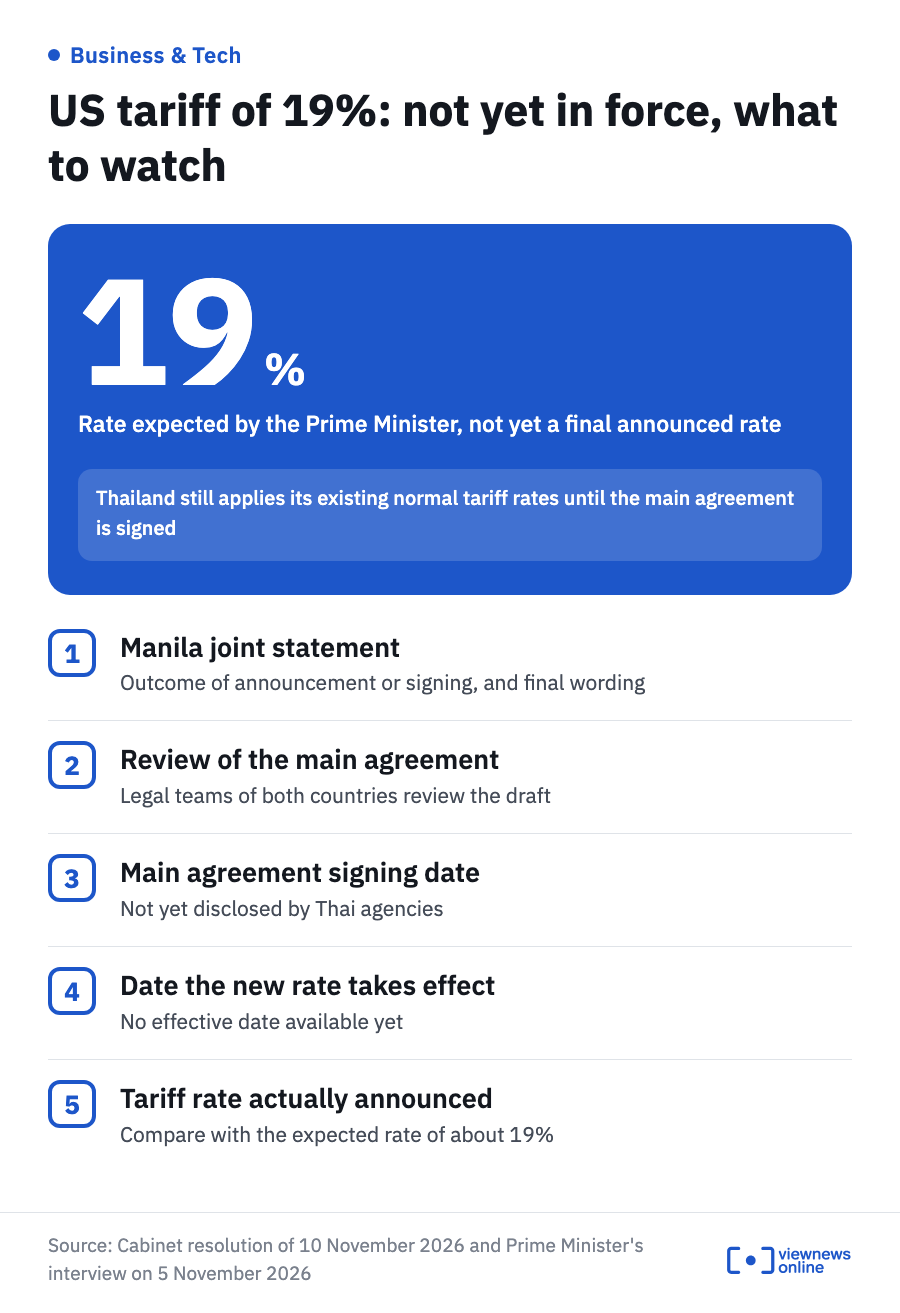
The figure of about 19% is the rate the Prime Minister expects while the main agreement is under review. It is not a final announced rate. The actual rate will become clear when the main agreement is finished and signed.
On the origin of the number: the rate Thailand had risked facing was 36%, and an earlier framework fixed a rate of 19% to avoid it. The expected 19% is therefore not a cut from the 19% framework agreed earlier. It is also a separate matter from the normal rates Thailand applies today.
After the statement is announced, both sides will start domestic processes to prepare for signing and for the agreement to take effect. Thai agencies have not said what these processes involve or how long they will take.
What exporters and importers should watch
For businesses that ship goods to the US or import goods from the US, the tariff rates in use now remain the existing normal rates. That will continue until the main agreement is signed and an effective date is announced. The joint statement is a political signal that the talks are progressing, but it is not a figure you can use for calculations. The points to follow are:
- The outcome of the announcement or signing in Manila, and the final wording of the document
- Progress of the legal review of the main agreement by both countries
- The signing date of the main agreement
- The date the new tariff rate takes effect
- The tariff rate actually announced, compared with the expected figure of about 19%
Thai agencies have not yet disclosed three things: the details of the substantial conclusion, the signing date of the main agreement, and the effective date. These determine when the new rate starts.
There are also no figures from Thai agencies on the effect on import prices or export-sector jobs, so it is too early to say how far prices might move or how many jobs could be affected. What can be said now is the status of the documents and what remains to be done. That should become clearer once the main agreement passes its legal review and a signing date is set.
Source: Cabinet resolution of 10 November 2026, as proposed by the Ministry of Commerce, and the Prime Minister's interview on 5 November 2026. This article is adapted from ViewNews' Thai-language report.