
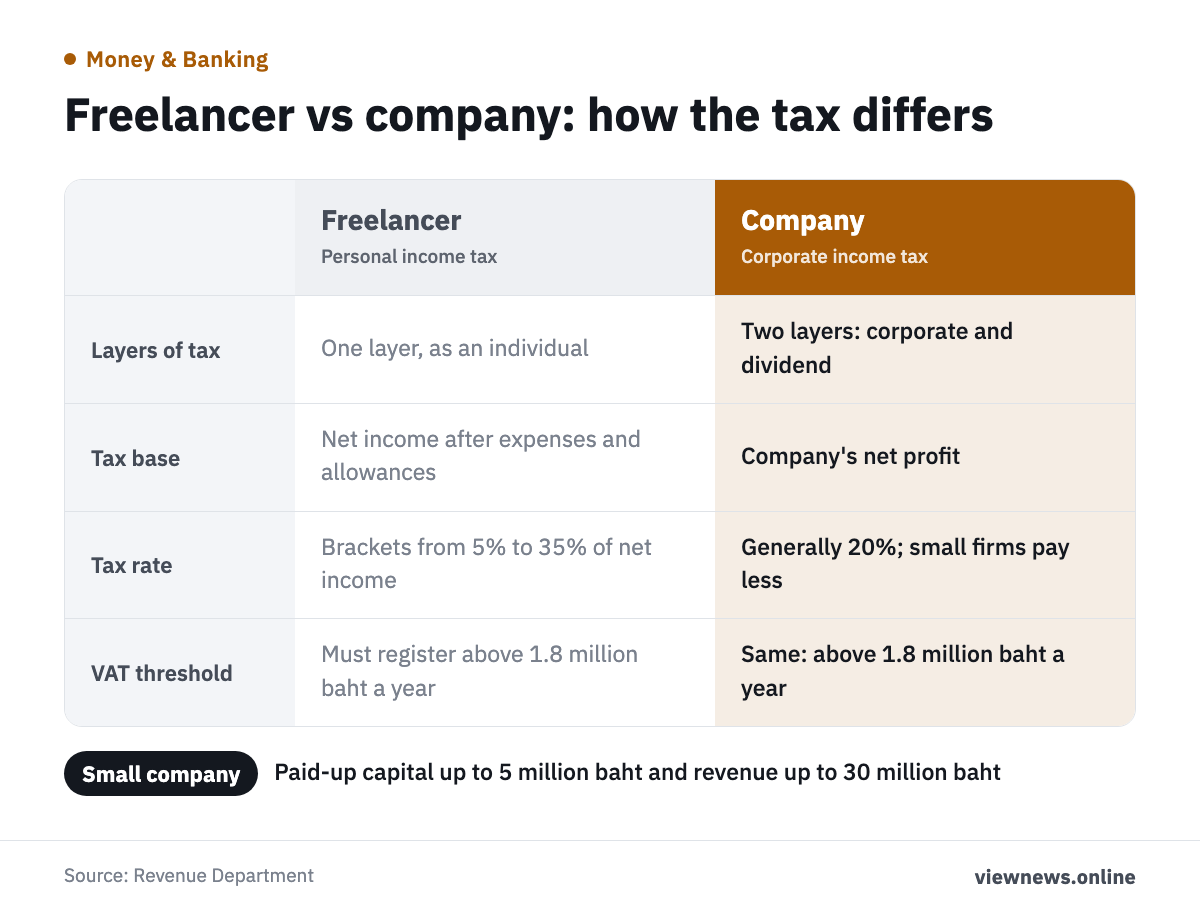
Freelancers in Thailand pay personal income tax on a sliding scale based on net income. A company pays corporate income tax first, and if it distributes profit as dividends, shareholders can face a second layer of tax. Anyone taking on work independently, including foreign professionals, often asks whether to stay a freelancer or register a company. Neither option is always better. The answer depends on income level, the cost of doing the work and whether the business is meant to grow.
The rates and thresholds below follow Revenue Department information in effect in 2026. If the department announces changes, check with it again before deciding.
Freelancers pay personal income tax in brackets
Freelancers must add their income to their personal income tax calculation and file Form PND 90 (ภ.ง.ด.90), according to the type of income. General freelance work is classed as income under Section 40(2). If the work involves buying materials or equipment, or carries high costs, it may fall under Section 40(8), which covers business and other activities.
Tax is calculated on net income, which is income after expenses and allowances. The first 150,000 baht of net income is exempt. The next bands are taxed as follows:
- 150,001 to 300,000 baht: 5%
- 300,001 to 500,000 baht: 10%
- 500,001 to 750,000 baht: 15%
- 750,001 to 1,000,000 baht: 20%
- 1,000,001 to 2,000,000 baht: 25%
- 2,000,001 to 5,000,000 baht: 30%
- Above 5,000,000 baht: 35%
The brackets are progressive. Each higher rate applies only to the portion of income above that band, not to the whole amount.
There is a second calculation for people whose income under Sections 40(2) to 40(8) totals 120,000 baht or more. The department takes the starting income and multiplies it by 0.5%, then compares the result with the bracket-based tax. The taxpayer must pay whichever is higher. This method does not apply if the tax it produces is 5,000 baht or less.
How much can you deduct? It depends on the income type
Freelancers with Section 40(2) income can deduct a flat 50% of income as expenses. If they also have salary income under Section 40(1), the combined deduction is capped at 100,000 baht. They can instead deduct actual expenses if they have evidence that real costs were higher.
For Section 40(8) income there are two options. The first is to deduct actual expenses that are necessary and reasonable. The second is a flat 60% deduction, available only for 43 types of business set by law. Businesses not on that list must use actual expenses. Freelancers with low costs often benefit from the flat deduction because they do not have to keep every receipt. Those with high real costs should compare it with the actual-expense method before choosing.
Companies pay tax twice, but small firms get lower rates
A company pays corporate income tax on net profit. The general rate is 20% of net profit. Small companies get lower rates if they meet two conditions: paid-up registered capital of no more than 5 million baht, and revenue from sales of goods and services of no more than 30 million baht in the accounting period. For those companies, net profit up to 300,000 baht is exempt. Profit above 300,000 baht and up to 3,000,000 baht is taxed at 15%. Profit above 3,000,000 baht is taxed at 20%.
The second layer is the dividend. When a company pays a dividend to an individual shareholder, the payer must withhold 10% tax under Section 50(2) of the Revenue Code. Under Section 48(3), the recipient may choose not to include the dividend in their year-end tax calculation. A company owner who takes dividends therefore pays tax twice: first as the company, then when the dividend is received.
Here is a hypothetical example. A small company has net profit of 2,000,000 baht. The first 300,000 baht is not taxed. The remaining 1,700,000 baht is taxed at 15%, which comes to 255,000 baht, leaving profit of 1,745,000 baht. If all of it is paid out as dividends, 10% withholding tax applies, or 174,500 baht. The example does not include accounting fees or other company costs.
The VAT registration threshold applies to both
A business with revenue from goods or services above 1.8 million baht a year must register for value added tax (VAT). Those below the threshold are treated as small operators and are exempt. The threshold is the same whether you work as a freelancer or through a company.
The temporarily reduced VAT rate is 7%, including local tax. The Revenue Department has published Royal Decree No. 807 of 2026, which extends the reduction to 30 September 2027. The higher rate therefore does not need to be charged in that period. Anyone whose income is close to 1.8 million baht should plan ahead. Once registered, a business must charge VAT to customers and file returns on a continuing basis.
Source: the Revenue Department (personal income tax rates and deductions, corporate income tax rates, VAT, Royal Decree No. 807 of 2026, and its guidance on dividends paid to individuals).
This article is adapted from ViewNews' Thai-language report.