People hurt in accidents involving public buses and other public passenger vehicles in Thailand may get help from a road safety fund more widely in future. The Cabinet met on 10 November 2026 and approved in principle a draft ministerial regulation from the Transport Ministry. It is still only a draft. It has no payment rates and no start date, and nobody can apply for help under it yet.
The draft amends a 2004 ministerial regulation covering how the fund's board members serve and how fund money is spent. Only the principle has been approved. Payment rates, conditions for receiving money and the date the rule takes effect are not part of this stage.
Cabinet approves the principle and sends it for legal review
The deputy spokesperson of the Prime Minister's Office said the Cabinet approved the principle of a draft regulation on the rules, methods and conditions for board members of the fund for road safety, and for spending the fund's money. The Transport Ministry proposed it.
Approval in principle means the Cabinet agrees with the direction of the draft. The regulation itself is not finished. The Cabinet ordered the draft sent to the Office of the Council of State, the government's legal drafting body, for review. The Public Health Ministry's views go with it. The Transport Ministry must then consider the Council of State's comments.
Before the Cabinet meeting, the Department of Land Transport (DLT) held two public comment periods of 30 days each. They ran from 24 April to 23 May and from 25 May to 23 June 2026. Comments were collected on the government's central legal portal (law.go.th) and on the DLT website. Most people who commented supported the draft. The DLT prepared the impact assessment and a summary of the comments and published them on the portal.
What the draft would change
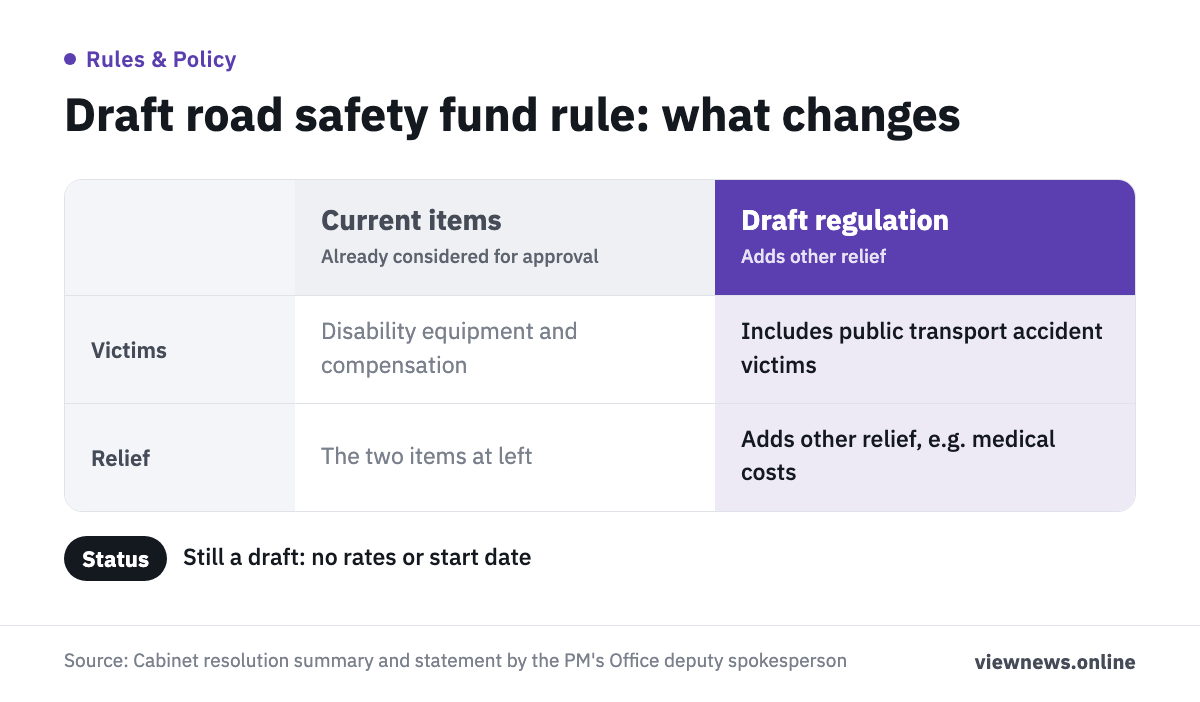
The biggest change is the scope of what the fund can approve. The draft would include help for victims of accidents involving public passenger vehicles. It would also cover other kinds of relief beyond the two items the fund already considers: equipment for people with disabilities and compensation under the 1992 law protecting motor vehicle accident victims.
The examples given are medical costs and the cost of repairing or installing safety equipment in public vehicles. In other words, the fund could pay for safety equipment in public vehicles as well as for victims.
The draft would also let the fund be used to develop the road transport system. That would follow DLT projects or plans for scheduled buses, school transport vehicles and related matters.
It also changes how the fund handles money. The draft provides for government cheques and electronic payments (e-Payment). A DLT finance and revenue office would keep the fund's accounts in place of the former finance division.
Fund money versus the existing accident victims law
The fund already considers two kinds of items: equipment for people with disabilities, and compensation under the 1992 Motor Vehicle Accident Victims Protection Act. The draft adds other relief, such as medical costs, as items the fund could approve.
The two matters are separate. The first is the set of rights under the 1992 Act, which already exist. The second is this draft regulation for the fund, which is still going through legal steps. What can be claimed, and how much, will depend on the text of the final regulation once it is published.
The government said the change is meant to give people harmed in road accidents more suitable and wider help, and to let the fund support safety measures more flexibly. That is the stated goal, not a result that has happened.
What is still missing and what happens next
The draft does not yet set individual payment amounts, medical cost rates, conditions for receiving money, or the date the regulation will be published or take effect. Passengers on buses or school transport vehicles cannot apply for money under it yet. They should not assume extra compensation is available.
The Public Health Ministry's views and the Council of State's comments have not been made public. The next steps are legal review by the Council of State, consideration of its comments by the Transport Ministry, and then publication as a ministerial regulation.
Points to watch are the final text after legal review, the conditions and rates that are set, and the DLT projects on scheduled buses and school transport that would draw on the fund.
What this means for foreign residents and visitors
- Nothing changes today. The draft is not in force and no claims can be made under it.
- The Thai report does not say whether the draft treats foreign nationals differently from Thai nationals. If you are hurt in an accident on a bus or school van, ask the DLT or the relevant insurer about your options.
- Rights under the 1992 Act already exist and are separate from this draft.
Source: Cabinet resolution summary and statement by the deputy spokesperson of the Prime Minister's Office on the draft ministerial regulation for the fund for road safety.
This article is adapted from ViewNews' Thai-language report.