PromptPay, Thailand's instant transfer and payment system, had 83.60 million registered IDs at the end of September 2026, and shops can now accept QR payments from visitors from 9 countries and economies. NITMX, the operator of the national payment infrastructure, reported 2.45 billion transactions in September alone. This guide explains how PromptPay works, how shops use it, and which foreign visitors can pay with their home apps.
PromptPay is the base of everyday QR payments
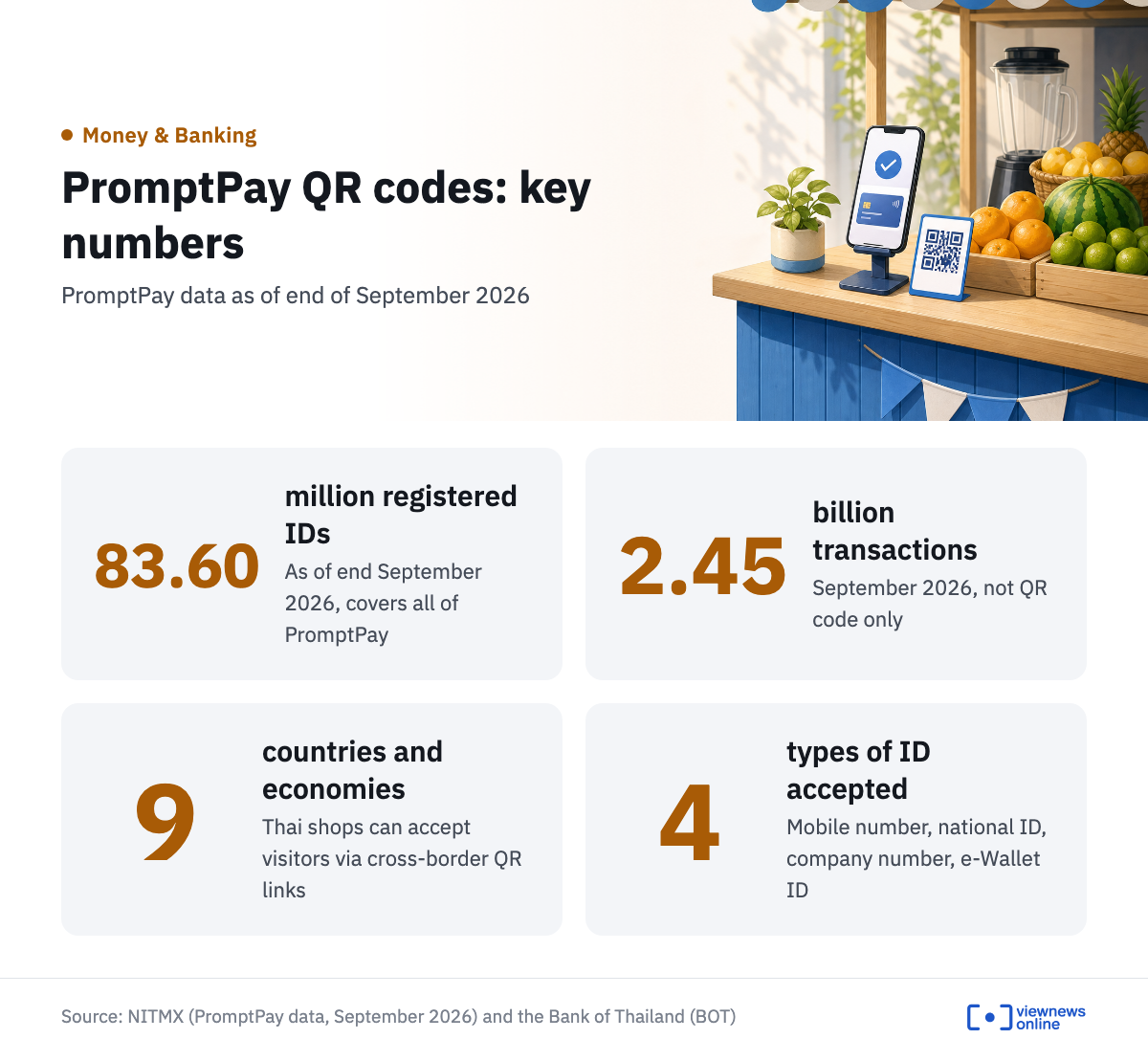
The Bank of Thailand (BOT), the central bank, describes PromptPay as an instant transfer and payment system. It uses a reference number instead of a bank account number, which is hard to remember. Four kinds of ID can be used: a mobile phone number, a national ID number, a juristic person (company) registration number, and an e-Wallet ID. The system links many payment providers, so users can send money between banks without knowing which bank the other person uses.
PromptPay grew out of the National e-Payment project, which began in 2015 as a joint effort of the government, private sector, financial institutions and the BOT. In 2020 the BOT reported 52.7 million registered IDs. NITMX data show the total reached 83.60 million in September 2026.
Shops of every size accept Thai QR Payment
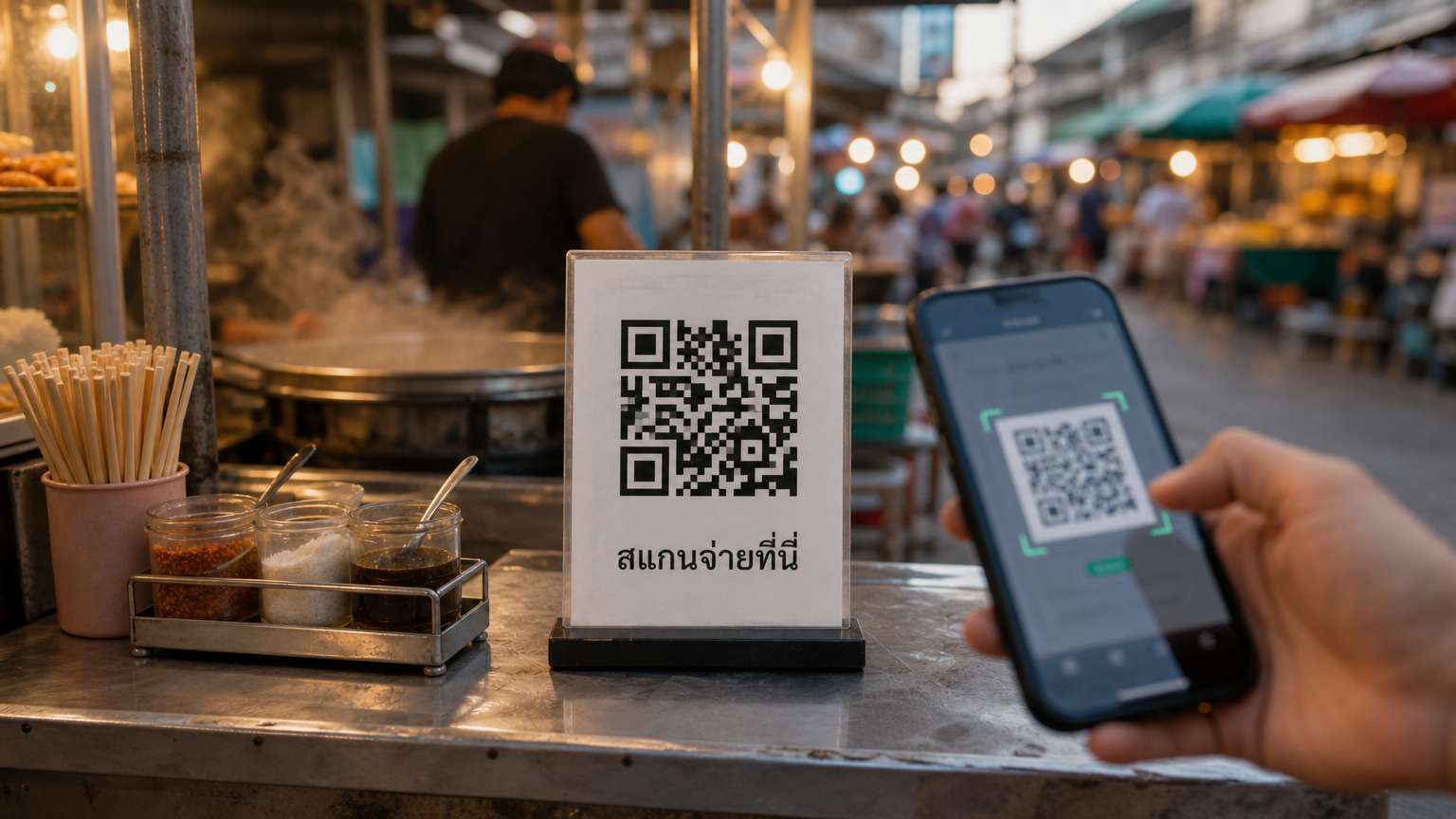
The BOT says Thai QR Payment gives shops a convenient, low-cost way to take payments, from small stalls and street carts to large department stores. Customers can pay from several sources, including bank accounts, debit cards, credit cards and e-Wallet accounts. The BOT also says PromptPay has a lower fee structure and that suitable fees encourage people to use it.
There are two types of QR code. A static code is a fixed code displayed at the shop. The customer scans it and types in the amount. A dynamic code is generated for each bill. The BOT says this reduces steps and payment errors. In 2020 the BOT counted about 6.1 million standard QR payment points across the country.
Tax refunds and donations
PromptPay is not only for buying goods. The BOT says the system supports government payments, including welfare payments and tax refunds sent through a person's national ID number. People who have linked their number to an account do not need to give the agency their account number each time.
Another service is e-Donation. A donor scans a charity's QR code, and the donation data is sent to the Revenue Department so the donor can claim a tax deduction. The Thai report does not say whether these two services are open to people without a Thai national ID. If you are a foreign resident, check with your bank or the Revenue Department before relying on them.
Latest figures and cross-border payments
NITMX reported that PromptPay handled 2.45 billion transactions in September 2026, up 13% from a year earlier. Their value was 4.26 trillion baht, up 1%. Of the 83.60 million registered IDs, 83.17 million belong to individuals and 0.43 million to businesses. The busiest day was 1 September 2026, with more than 106.28 million transactions. These figures cover all of PromptPay, not only QR codes.
For cross-border payments, NITMX reported the three largest inbound transaction values in September as China at 929.00 million baht, Malaysia at 333.93 million baht and Laos at 129.62 million baht.
- Visitors from Cambodia, Malaysia, Vietnam, Indonesia, Hong Kong and Laos can pay in Thailand with Thai QR.
- Korean visitors use the provider Paybooc. Chinese visitors use UnionPay, Alipay and WeChat Pay to scan Thai QR codes at Thai shops.
- Users in Thailand can pay in Cambodia, Malaysia, Vietnam, Indonesia and Hong Kong. In Japan they can pay by generating a QR code under the MyPromptQR standard through a Thai bank app.
- For Laos, the first phase lets Lao users scan Thai QR in Thailand. A plan would let Thai users scan LAO QR in Laos.
Singapore has two services. PromptPay-PayNow allows transfers by mobile number in both directions, with an initial limit of 1,000 Singapore dollars, or 25,000 baht, per day. PromptPay-NETS is used to pay for goods and services. The BOT says it plans to extend the service to more countries and add more providers, shops and banks. It also plans to raise transfer limits to support businesses.
On 2 November 2026 the BOT, the Tourism Authority of Thailand and commercial banks held their third event under the theme 'Scan Thailand - Pay Like A Local' in Yaowarat (Chinatown), Bangkok. The aim is to sign up shops in major tourist areas to take payments from foreign visitors through cross-border QR links with 9 countries and economies: China, South Korea, Hong Kong, Vietnam, Indonesia, Singapore, Malaysia, Cambodia and Laos.
What to check if you are not from these markets
The BOT's list does not include other countries. The Thai report does not say whether foreign cards or foreign-issued wallets can be used, or whether non-Thai residents can register a PromptPay ID. Check with your bank or payment provider before you rely on QR payment, and carry another way to pay.
Source: Bank of Thailand (PromptPay article, Cross-border Payment page and 2 November 2026 event news) and NITMX's September 2026 PromptPay usage data.
This article is adapted from ViewNews' Thai-language report.