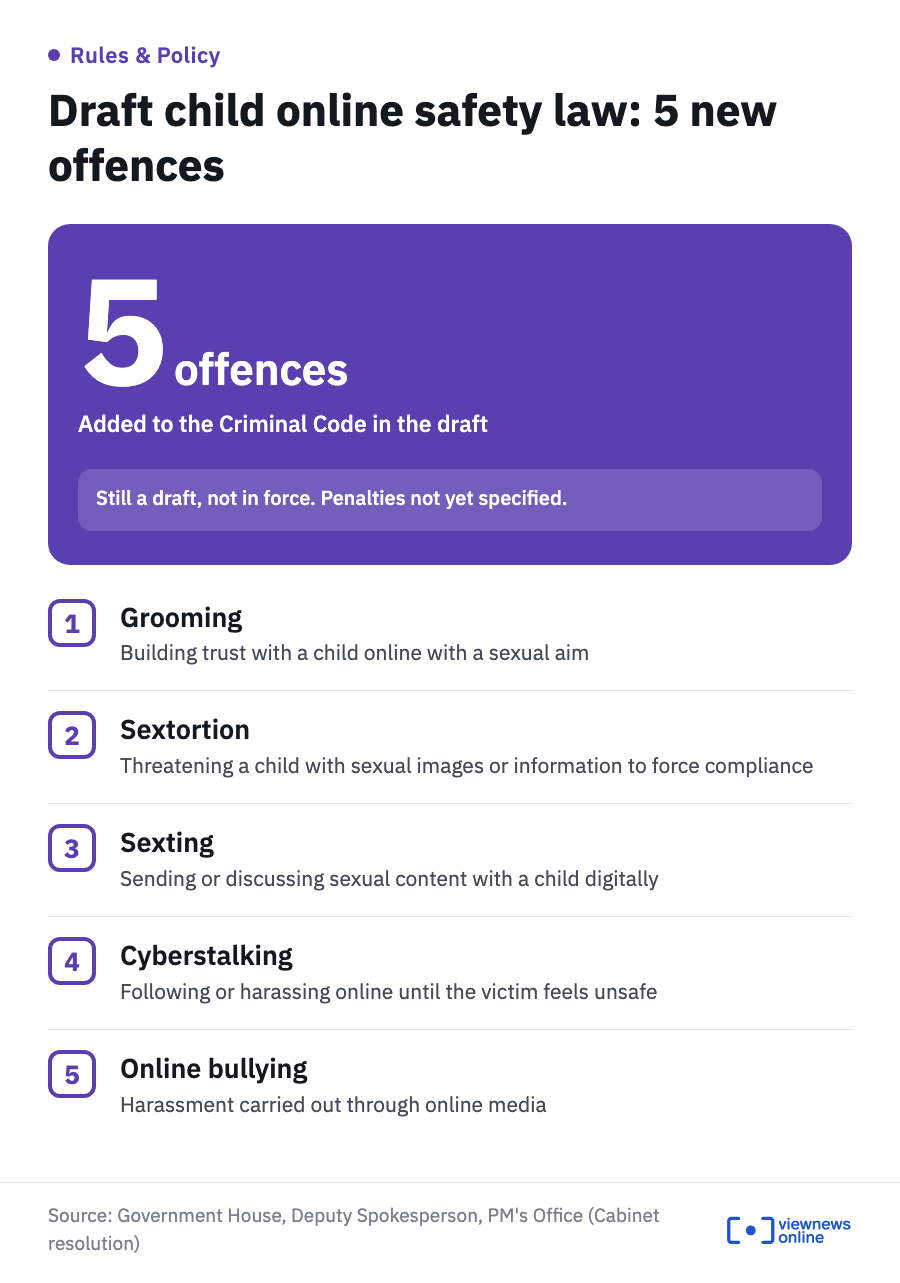
Thailand's Cabinet has approved a draft law to protect children online. It would add five offences to the Criminal Code: grooming children for sex, sexual blackmail, inappropriate sexual communication with children, cyberstalking and online bullying. A deputy spokesperson at the Prime Minister's Office said the Cabinet made the decision on 17 November 2026. The measure is still a draft and is not in force.
Until it moves through the remaining steps, parents and teachers in Thailand will have to rely on watching for warning signs and keeping evidence. This article explains what each offence means, why the government wants the change, and what families can do now.
The five offences in the draft
The draft is an amendment to the Criminal Code covering sexual offences and offences against liberty committed against children. The Office of the Council of State, the government's legal drafting body, has already reviewed it. The five offences are:
- Grooming: building closeness or trust with a child online with a sexual aim.
- Sextortion: threatening or coercing a child using sexual images, information or content.
- Sexting: sending or discussing sexual content with a child through digital channels.
- Stalking: following or harassing someone online until they feel uneasy or unsafe.
- Bullying: harassment carried out through online media.
These descriptions are general explanations to help readers, not the wording of the draft. The government's statement did not give penalties or the age range of children who would be protected. Readers should not treat any figure as part of the draft.
Why the government wants it
The deputy spokesperson said current law does not adequately cover some behaviour, especially the use of online channels to lure or exploit children and young people, who are at risk of becoming victims.
While preparing the draft, the Ministry of Justice gathered public opinion and produced a regulatory impact analysis under Section 77 of the Constitution.
What parents and teachers can do now
This section is general advice, not a legal requirement. Warning signs include a stranger or adult who becomes unusually close to a child online, requests for photos or private content, threats involving images or personal information, or a child who seems frightened, withdrawn or quickly closes the screen when a message arrives.
Parents can start by checking privacy settings on a child's accounts, so that only people the child really knows can see posts and send messages. It also helps to agree in advance that the child will not accept friend requests from strangers or send private photos to anyone. If someone asks for them or makes threats, the child should tell a trusted adult straight away and will not be blamed.
Teachers should let students know they can come to them with concerns. After hearing a report, they should tell the parents and school management following school procedures, without naming the child to others.
If a child describes an incident, listen calmly and do not blame them, so they keep talking. A teacher who receives a report should note who told them, when, and what the child said happened, without pressing the child with hard questions. Then preserve the evidence:
- Take screenshots of messages, the profile picture and the other person's account name.
- Save the link to the profile or chat room.
- Do not delete chats or the accounts involved.
- Write down the date and time of each incident.
- Do not send the other person more images or money.
Report incidents to the police or the local child protection agency. Check phone numbers and reporting channels on the agency's own website, and take the collected evidence with you. Foreign residents who are unsure how to report, or whether an English-language service is available, should check with the police or the agency directly.
Where the draft stands
The Cabinet approved the draft after the Council of State reviewed it, but it must still pass further steps, so it is not in force. An earlier version cleared the approval-in-principle stage on 18 March 2025. This round is approval of the draft after review.
The deputy spokesperson also said there is a proposal to speed up the process so the law could be promulgated before the Global Summit of Women, scheduled for June 2027. That is only a proposal, not a confirmed timetable. No date has been announced for the draft to go to Parliament or for it to take effect.
Source: Government House, the Deputy Spokesperson of the Prime Minister's Office (Cabinet resolution briefing), and the Ministry of Justice.
This article is adapted from ViewNews' Thai-language report.