The cost of street lighting, which has been built into household electricity bills at about 10 satang, may get a new payer. A draft amendment to Thailand's energy business law would have the Electricity Development Fund pay for public lighting instead. The Office of the Energy Regulatory Commission (ERC) is taking public comment on the draft until 20 November 2026.
The draft says the arrangement must not become a burden on the public or on the state budget. Questions remain over where the fund's money comes from. The fund is financed by licensed electricity operators, so the Office of the Council of State, the government's legal advisory body, is concerned that the cost could end up back with electricity users. JustPow, an outside organization that follows energy policy, sees it as possibly just a change in how the bill is paid.
What street lighting costs were in your bill, and the decision to separate them
Public lighting power covers lighting in public places and on public roads, such as street lamps, in areas run by government agencies and local administrations. Until now, this cost has been included in the electricity rates paid by all ordinary users, at about 10 satang.
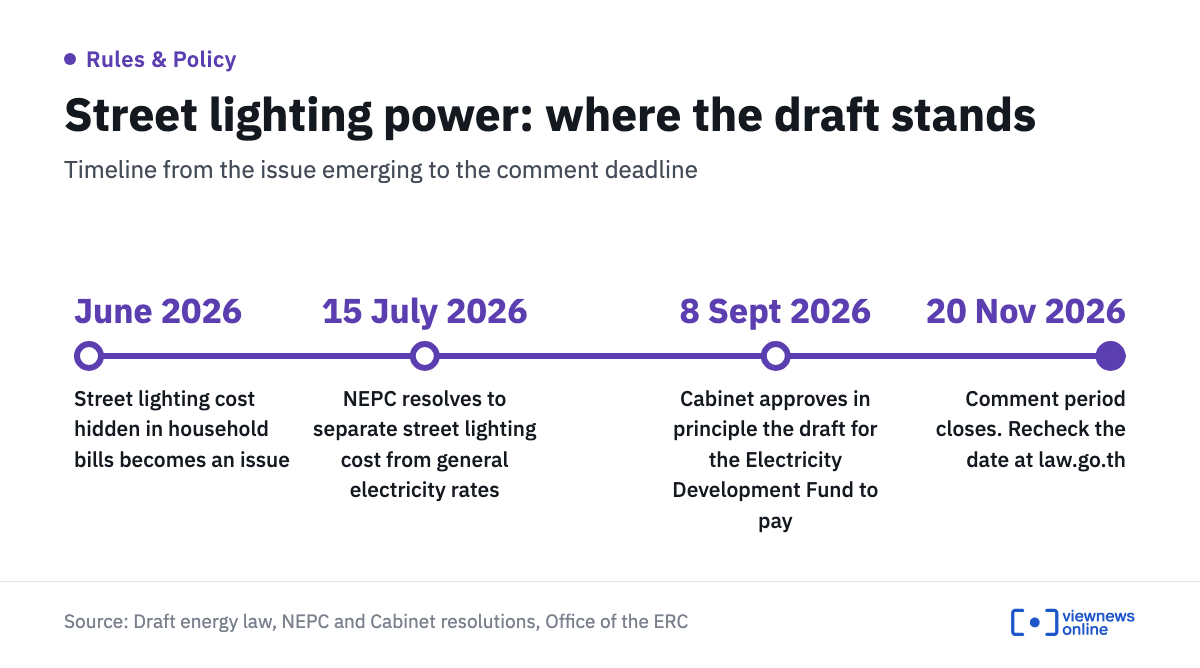
The issue came to the fore in June 2026. On 15 July 2026, the National Energy Policy Council (NEPC) resolved to separate the cost of public lighting, such as street lamps, from the electricity rates charged to general users.
How the draft would use the fund
The Cabinet approved the draft law in principle on 8 September 2026, on a proposal from a deputy prime minister. The main change is to amend the Energy Industry Act of 2007 so that the Electricity Development Fund can be used to pay for public lighting. The draft describes this as lighting that 'government agencies and local administrative organizations use to provide light for public safety in public places or on public roads under their care, without being a burden on the public or the budget.'
The same draft also changes other rules on the ERC. It links the commission's powers to national energy policy. It also lets the NEPC act in place of the ERC temporarily if fewer than 4 ERC commissioners remain in office.
The Electricity Development Fund (กองทุนพัฒนาไฟฟ้า) was set up under the Energy Industry Act of 2007. It receives money from licensed electricity operators.
The fund's financial report for the year ending 30 September 2024 shows total assets of 24,644.75 million baht and total revenue of 17,748.48 million baht. Most of that revenue, 17,167.76 million baht, came from licensed operators. The asset figure is the fund's overall position. It is not money earmarked for street lighting. There is no official figure yet on how much the fund would pay for public lighting each year.
Concerns from the Council of State and JustPow
The secretary-general of the Council of State sent the Cabinet a letter with its opinion. It said the Cabinet could approve the draft in principle, but it raised 3 points.
First, changing the fund's purpose to cover public lighting amends the purpose of a revolving fund under the Revolving Fund Management Act of 2015. The agencies involved must therefore first submit the draft to the revolving fund policy committee for review. The draft must then go back to the Cabinet.
Second, letting the NEPC step in for the ERC temporarily is meant to keep work running. But it may not fit the intent of the law, which separates energy policy, regulation and the running of energy businesses.
Third, and most directly relevant to electricity users, money in the fund under Section 97 is paid in by licensed electricity operators. If it must be used to pay public lighting costs on behalf of government agencies and local administrations, that affects the operators' costs. It could in turn feed through to electricity users.
JustPow reached a similar view. It noted that part of the fund's money is already embedded in people's bills through the base tariff and the Ft (fuel tariff adjustment). Changing the source of money therefore does not remove the cost from the public, it said. It only changes the channel of payment. This is JustPow's opinion and assessment, not a fact confirmed by a government agency.
What changes in the draft is who pays for street lighting under the law: the Electricity Development Fund, instead of ordinary electricity users through their bills. What remains unclear is whether, and by how much, the fund's money would come back indirectly to users' bills. No official document gives figures on this, so it cannot yet be said whether electricity bills would rise or fall.
Where the draft stands and how to comment
This is only a draft open for public comment. It has not been passed into law and is not in force. According to the consultation notice, interested people can submit comments until 20 November 2026. Check the latest closing date and submission channels on the government's central legal portal, law.go.th, because dates can change.
The next steps to watch are whether the draft goes through the revolving fund policy committee as the Council of State proposed, and when it returns to the Cabinet. Anyone who wants more clarity on the cost question, for example by asking the agency to publish the figure the fund would pay for public lighting, can raise it during this comment period.
Source: the draft Energy Industry Act amendment and the public consultation by the Office of the ERC, NEPC and Cabinet resolutions, the Office of the Council of State's opinion letter, the Electricity Development Fund's financial report for the year ending 30 September 2024, and observations from JustPow.
This article is adapted from ViewNews' Thai-language report.