
The Monetary Policy Committee (MPC) of the Bank of Thailand (BOT), the country's central bank, voted unanimously among the members present on 28 October 2026 to keep the policy rate at 1.00% a year. Earlier, the International Monetary Fund (IMF) said Thailand still had room to ease monetary policy further if economic data supported it.
The policy rate is the benchmark that guides borrowing and deposit costs across the economy. For people who hold baht savings, borrow in Thailand or run a business here, it is the number to watch.
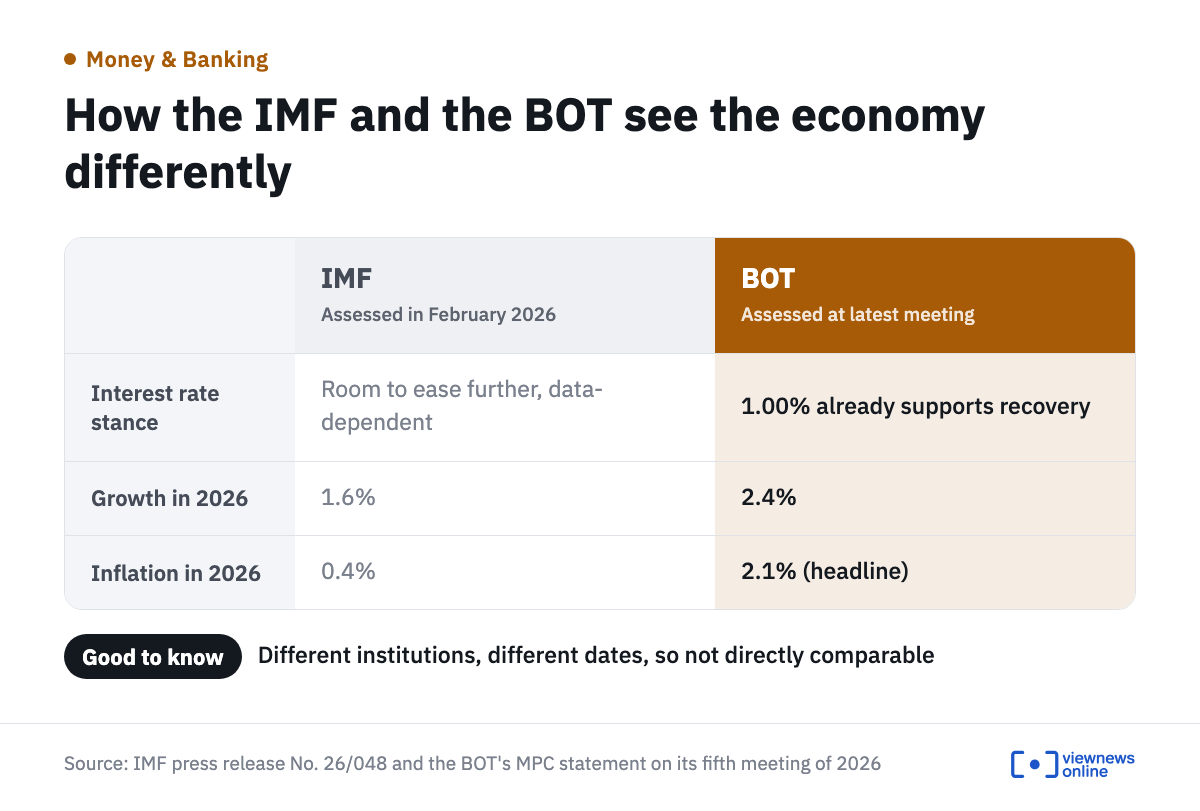
The IMF sees room to ease, depending on data
The IMF's Executive Board concluded its annual Article IV Consultation with Thailand in a press release dated 13 February 2026. Board directors welcomed the accommodative monetary policy stance that supports domestic demand. They said there is room for further easing, depending on incoming data, and stressed that the central bank's independence should be preserved.
The release does not say what level the policy rate should be at, and it does not set a date by which the BOT should cut. The IMF tied the issue to how well monetary policy passes through to the real economy. It also called for action on high household debt and for systematic household debt restructuring, with good governance and limits on moral hazard, meaning borrowers expecting too much help.
The IMF estimated that the Thai economy grew 2.5% in 2024, slowed to about 2.1% in 2025 and would grow 1.6% in 2026 as external pressures increase. It expected inflation of 0.4% in 2026. Low inflation in 2025 came mainly from lower energy and fresh food prices.
The BOT cut to 1.00%, then held
At its meeting on 25 February 2026, the MPC voted 4 to 2 to cut the policy rate by 0.25 percentage point, from 1.25% to 1.00%, effective immediately. According to the BOT's statement, the two members who dissented wanted to hold at 1.25%.
The committee then kept the rate at 1.00% at its meeting on 24 June and again at its latest meeting, the fifth of 2026. The latest statement said one member did not attend.
Why the BOT has not cut further
In the statement on its fifth meeting of 2026, the MPC said 1.00% is appropriate to support the economic recovery. It said the rate works alongside targeted financial measures, which help parts of the economy that are not growing evenly.
The committee said the economy is getting support from the technology and AI cycle, but growth is still below potential. The benefits are concentrated in large industrial and service businesses and their workers. Private consumption is held back by high household debt, a fragile labor market and the cost of living for low-income households. Tourist arrivals are expected to fall because of higher oil prices.
On inflation, the MPC expects headline inflation to rise temporarily until early next year because of energy prices and the El Nino weather pattern. It then expects inflation to fall as the higher price base and weak domestic demand take effect. The BOT estimates average headline inflation of 2.1% in 2026 and 1.3% in 2027. It puts average core inflation at 1.2% and 1.3% for the same years. Its growth forecasts are 2.4% for 2026 and 2.1% for 2027.
These are the BOT's estimates from its latest meeting. The IMF's 1.6% growth figure for 2026 comes from a different institution and was made in February, so the two cannot be compared directly.
Credit and business borrowing costs
The MPC said total credit is still growing, driven by large companies that need working capital and are making a new round of investment. Lending to small and medium-sized enterprises (SMEs) has kept shrinking in almost every sector, because lenders remain cautious about riskier borrowers. The BOT sees overall credit quality as stable but says the repayment ability of SMEs and vulnerable households needs close watching.
According to the same statement, private-sector borrowing costs are steady and in line with the policy rate. The MPC said it is using targeted financial measures alongside the policy rate. The IMF, as noted above, proposed tackling household debt and promoting debt restructuring.
The IMF also advised that fiscal support be well targeted and used sparingly, because fiscal space is narrowing. It projected public debt at 64.8% of GDP in 2025 and 66.8% in 2026. It suggested raising government revenue to build buffers and make room for growth-supporting spending.
What to watch next
The MPC listed three risks to monitor. Inflation could come in higher than expected because of uncertainty in the Middle East and limits to holding energy prices down. Core inflation could pick up if businesses pass on higher costs. And a long period of low interest rates could affect financial stability over the longer term.
According to the BOT's calendar, the next MPC meeting is on 23 December 2026. It is the last meeting of the year on the calendar the BOT has published.
If you have a loan or deposit in Thailand, check with your bank on how its own rates relate to the policy rate.
Source: the IMF Executive Board (press release No. 26/048) and the Bank of Thailand (MPC statements and meeting calendar). This article is adapted from ViewNews' Thai-language report.