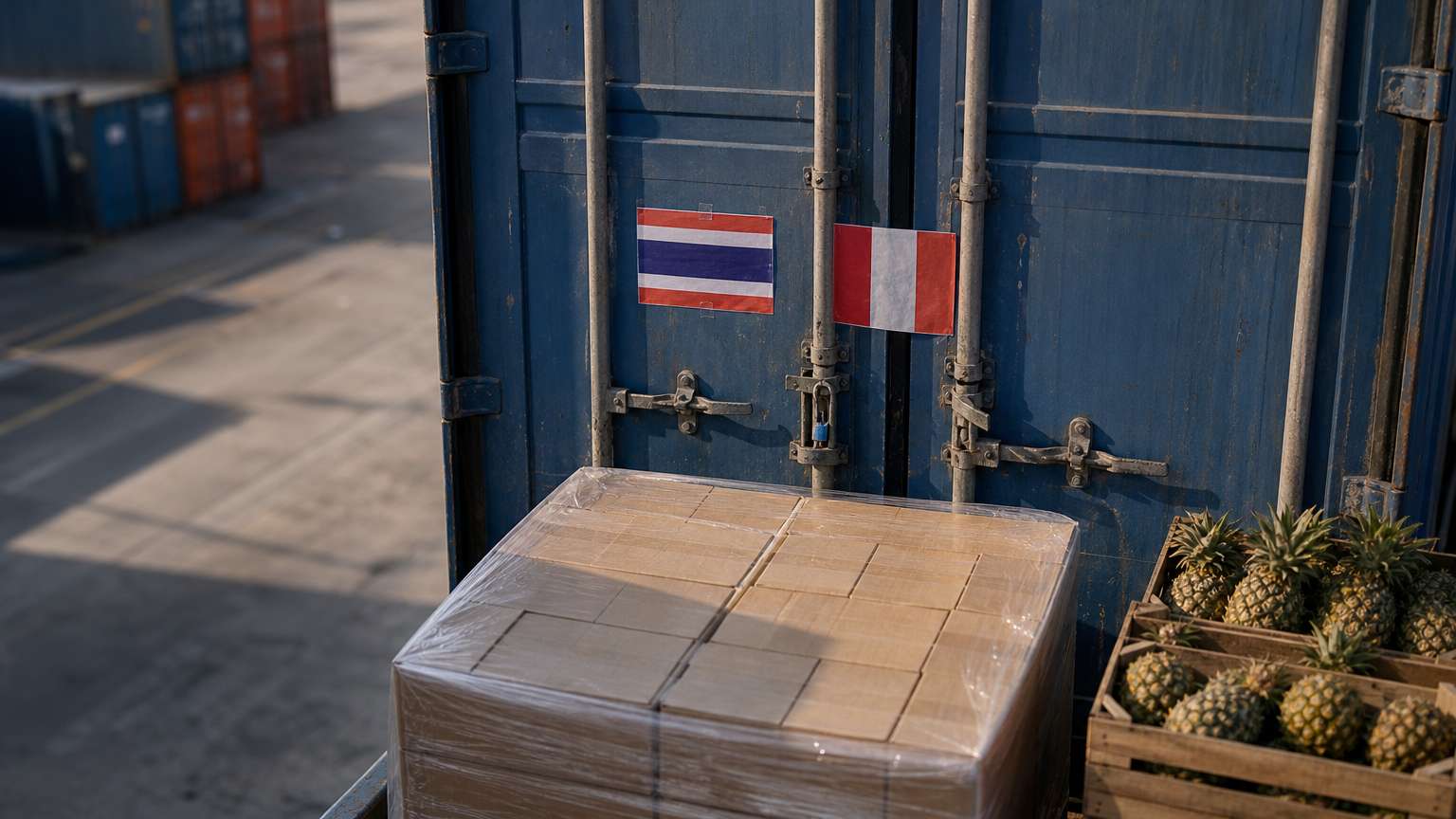
Thailand and Peru signed a free trade agreement (FTA) on 19 November 2026 at the 33rd Asia-Pacific Economic Cooperation (APEC) leaders' meeting in Shenzhen, China. The agreement is not yet in force, so exporters and manufacturers in Thailand cannot use its tariff cuts now. The Ministry of Commerce expects it to take effect in 2027, after it passes through parliament.
Suphajee Suthumpun, Deputy Prime Minister and Commerce Minister, signed for Thailand. Peru's Minister of Foreign Trade and Tourism signed for Peru. Prime Minister Anutin Charnvirakul and Peruvian President Keiko Sofia Fujimori Higuchi witnessed the signing.
The talks took a long time. The Ministry of Commerce said negotiations stalled in 2014, resumed in 2025 and were finally concluded. The ministry describes Peru as one of the markets in Latin America with the strongest potential for economic growth. The agreement is only the first step in a process that still has several stages to go.
Signed, but waiting for parliament
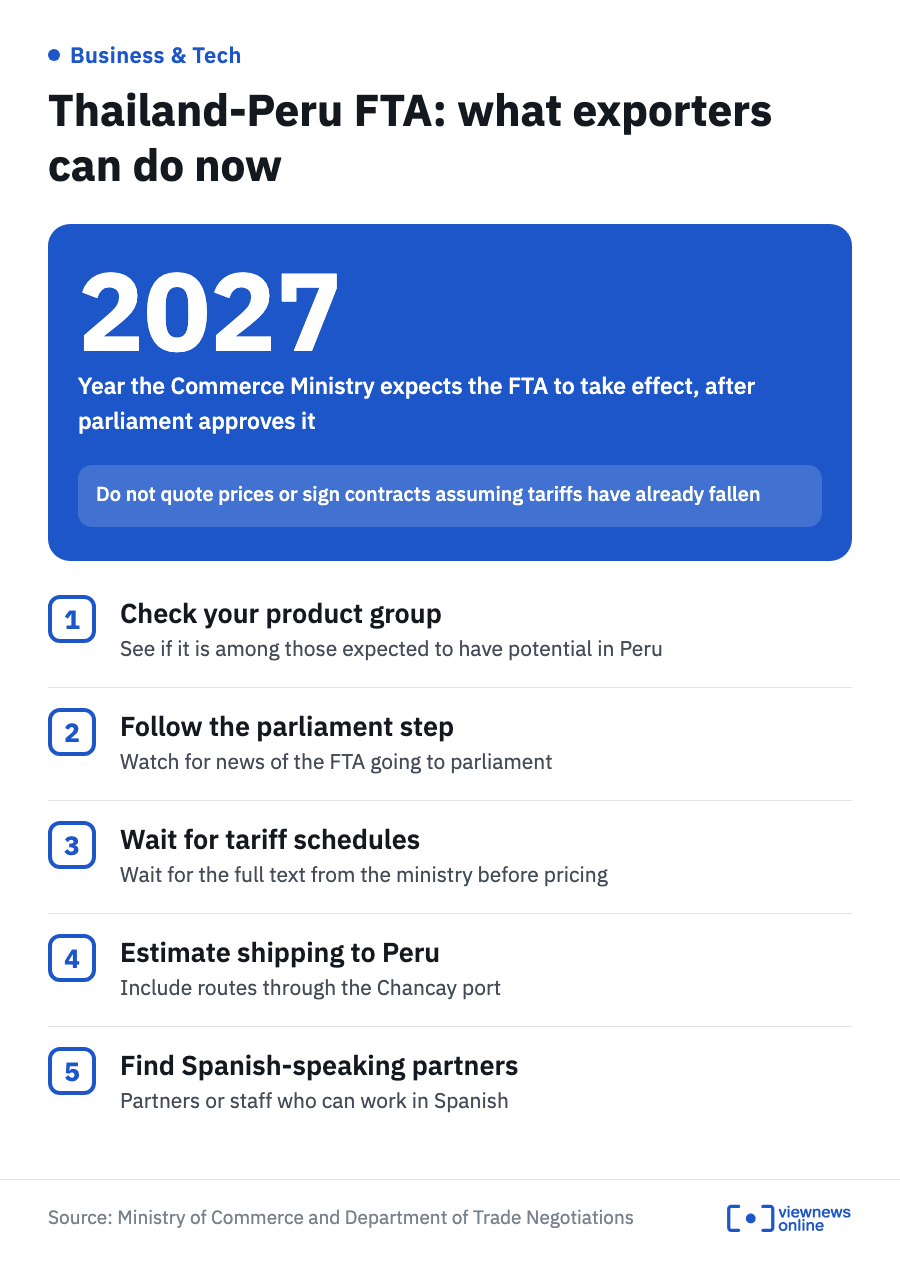
As of the signing date, the agreement is signed but not in force. The ministry expects it to take effect in 2027 after parliamentary procedures. The date the agreement will go to parliament, and the exact date it will take effect, have not been announced. Ms Suphajee said the ministry will speed up the relevant steps so the agreement can take effect as soon as possible.
It helps to separate two terms. Signing means government representatives endorse the text of a negotiated agreement. Entry into force is the date from which the reduced tariffs actually apply to goods crossing the border. In trade agreements generally, each country must complete its own domestic steps between the two, such as getting parliamentary approval, and then notify the other side. This is a general explanation, not the timetable for this agreement, which has not been disclosed.
In practice, businesses should not quote prices or sign contracts on the assumption that tariffs have already fallen. No one can yet guarantee that every product will get a tariff cut as soon as the agreement takes effect. The number of product lines each side opens up is also not settled, so no single figure should be used for planning. Businesses should wait for the full text and the product-by-product tariff schedules from the Ministry of Commerce.
Products and services with potential in Peru
The Ministry of Commerce says Peru has import demand for several product groups that Thailand can supply. They are:
- vehicles and parts
- car tyres
- dietary supplements
- fish fillets, such as catfish and tilapia
- pineapple, papaya and processed fruit
- machinery
- construction materials
- plastics
- veterinary medicines for pets
The ministry singles out machinery and construction materials, because demand in Peru is rising with the country's infrastructure development. Manufacturers in that supply chain have reason to start studying the Peruvian market early, even though they cannot yet claim tariff cuts.
On services, a deputy director-general of the ministry's Department of Trade Negotiations spoke at a seminar held before the signing. The official said Peru is opening the remaining roughly 30% of its market to Thai goods. Peru will also allow Thai companies to hold 100% ownership in almost all service sectors. That means Thai service businesses could invest directly in Peru. Details of the commitments for each service sector have not been released, so investors should wait for the full document before deciding.
The Chancay port and shipping costs
Chancay is a large port north of Lima, Peru's capital. The ministry says its development will increase shipping capacity and link trade routes between Asia and Latin America. Shipments from Thailand to Peru and other markets in the region are likely to become easier and faster, with a chance of lower logistics costs.
That is the ministry's expectation, not a confirmed figure for how much costs will fall. The deputy director-general also pointed to two obstacles for exporters: Spanish is the main language in Peru, and shipping goods there is relatively expensive. Exporters should work out their total costs, not count only the tariff savings they might get.
What exporters can prepare while they wait
Ms Suphajee said the ministry's priority now is to help Thai businesses make real use of the opportunities. That covers expanding goods markets, entering service businesses and building cooperation with Peruvian companies. While the agreement waits to take effect, businesses can prepare as follows.
- Check whether their products fall in the groups expected to have potential.
- Follow news on the agreement being sent to parliament.
- Wait for the agreement text and product-by-product tariff schedules from the Ministry of Commerce before calculating prices.
- Estimate shipping costs to Peru, including routes through the Chancay port.
- Find partners or staff who can communicate in Spanish.
Four questions remain open: the date the agreement goes to parliament, the date it takes effect, the actual number of product lines opened up, and the details of the service commitments. Once the Ministry of Commerce publishes this information, businesses will be able to judge more clearly how much they stand to gain and when to start investing.
Source: Ministry of Commerce and the Department of Trade Negotiations.
This article is adapted from ViewNews' Thai-language report.