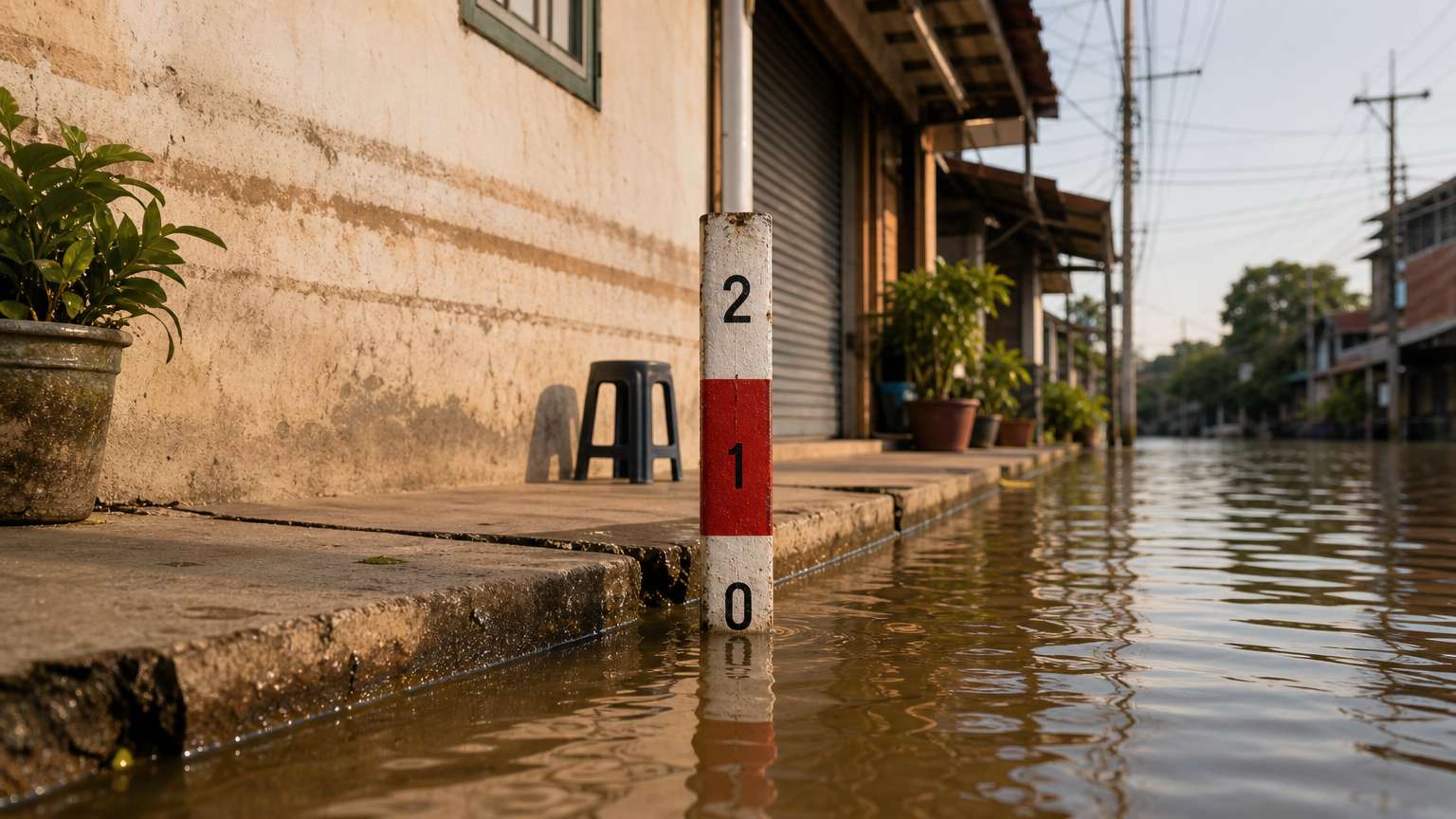
Global sea level has risen about 10 centimeters since 1993, when satellite measurements began. In 2025, however, the global average rose only about 0.08 centimeters, far slower than the 0.59 centimeters recorded in 2024. NASA reported on 29 January 2026 that a weak La Niña was the main cause, but the long-term trend is still upward. Bangkok's land is also sinking by about 8.5 millimeters a year, so rising seas hit the city harder than the global figures suggest.
The NASA figures come from continuous satellite measurements of sea level. The Thailand-specific data comes from research by the Technical University of Munich (TUM) and Tulane University, which TUM announced on 18 May 2026. Both point the same way: the risk to coastal cities depends not only on the sea, but also on the level of the ground.
2025 slowed because of La Niña, even as oceans hit record warmth
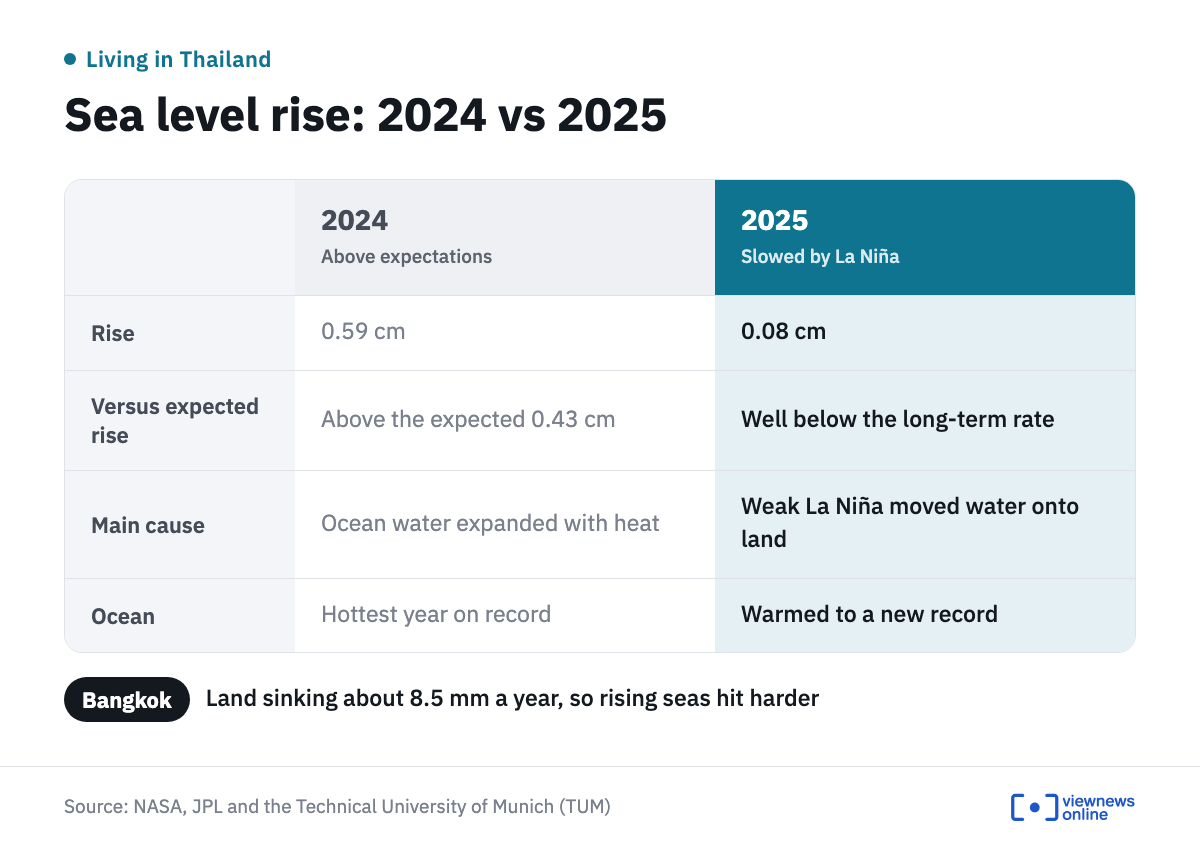
NASA said sea level rose 0.03 inches, or about 0.08 centimeters, in 2025. That is well below the rate used as the long-term expectation. The analysis explains that a weak La Niña brought heavy rain to the Amazon basin. Water moved from the ocean onto land for a time, which lowered the global average sea level during that period.
At the same time, the oceans warmed to a record high, according to Argo floats, the network of drifting ocean sensors. Warmer water expands, which pushes sea level up. Glaciers and ice sheets also kept melting and adding water to the sea. Taking all factors together, the net rise in 2025 was smaller than the long-term average.
Josh Willis, a sea level researcher at NASA's Jet Propulsion Laboratory (JPL), said in the same analysis that faster rises will return before long. Nadya Shiffer, head of NASA's physical oceanography program, said satellite tracking helps communities around the world anticipate risk.
A look back at 2024, when the rise beat expectations
NASA reported on 13 March 2025 that sea level rose 0.59 centimeters in 2024, against an expected 0.43 centimeters. Most of that came from ocean water expanding as it warmed (thermal expansion). 2024 was the hottest year on record, so the sea absorbed a lot of heat and its volume grew.
In the years before, about two-thirds of the rise came from water running into the sea from melting ice sheets and glaciers. The other third came from the sea expanding. In 2024 the split reversed, with two-thirds coming from thermal expansion. The analysis also explains that heat from the surface normally sinks slowly into the deep sea. Strong winds, large currents such as those in the Southern Ocean, and El Niño can carry heat downward more easily.
The data comes from a chain of satellites, from TOPEX/Poseidon in 1992 to Sentinel-6 Michael Freilich, which entered orbit in 2020. Its twin, Sentinel-6B, launched in November 2025. NASA said on 29 January 2026 that Sentinel-6B will take over from Sentinel-6 Michael Freilich in a few months, keeping the record going for at least five more years.
Bangkok faces a double risk from sinking land
The 10 centimeter figure is a global average. Coastal cities whose land is sinking face relative sea-level rise, meaning the water rises while the ground drops. Research by TUM and Tulane published in Nature Communications puts Bangkok's land subsidence at about 8.5 millimeters a year. That figure is the rate at which the ground sinks. It is not the full relative sea-level rise.
TUM's announcement lists Thailand, Bangladesh, Nigeria, Egypt, China and Indonesia among the countries with the largest relative sea-level rise. Weighted by coastal population, their averages are about 7 to 10 millimeters a year. For comparison, the average for densely populated coastal areas worldwide is about 6 millimeters a year. The climate-driven absolute rise is about 3.15 millimeters a year, and the global average weighted by coastline length is 2.1 millimeters a year.
TUM also said that in many large coastal cities, groundwater pumping is a major cause of land sinking. This is a local factor that adds to the global rise in sea level.
Yearly figures swing, but the long-term direction holds
Comparing 2024 and 2025 shows that the yearly rate can swing widely. One year runs above expectations and the next falls well below the average, depending on ocean temperatures and weather. NASA says the annual rate of rise has more than doubled since 1993, and total sea level has risen about 10 centimeters.
Each of the two years is a single data point, not the whole trend. The figures TUM reports for Bangkok and Thailand are long-term, overall estimates. They differ from the annual global average that NASA measures by satellite.
Source: NASA and NASA's Jet Propulsion Laboratory (JPL), in "NASA Analysis Shows La Niña Limited Sea Level Rise in 2025" and "NASA Analysis Shows Unexpected Amount of Sea Level Rise in 2024"; and the Technical University of Munich (TUM), in its announcement of research on land subsidence and coastal sea level.
This article is adapted from ViewNews' Thai-language report.