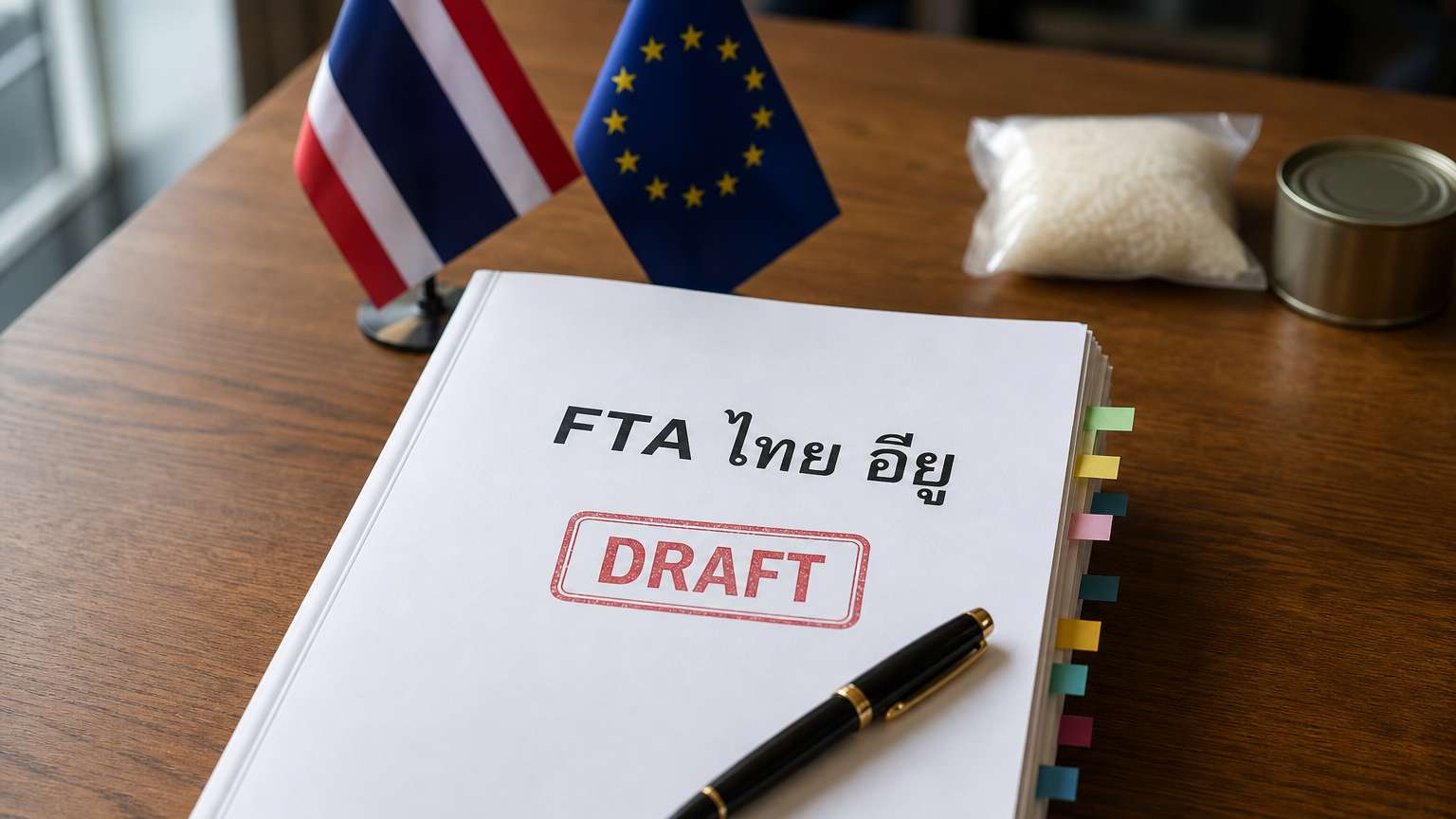
Exporters and businesses waiting to benefit from a free trade agreement (FTA) between Thailand and the European Union (EU) cannot use it yet because negotiations are still under way. After talks on 27 November 2026, Thailand's Commerce Ministry said the shared target was to conclude negotiations within 2026. Prime Minister Anutin Charnvirakul said the following day that the government hoped to conclude them within 2027.
Thailand's Department of Trade Negotiations describes an FTA as an economic grouping that aims to cut customs tariffs among its members to a minimum or to zero. Countries outside the group still pay normal, higher rates. More recent agreements also cover the opening of services and investment.
Two timeframes for concluding the talks
The Commerce Ministry's target followed a meeting between Suphajee Suthumpun, Deputy Prime Minister and Commerce Minister, and Maroš Šefčovič, the European Commissioner for Trade and Economic Security.
The ministry said the talks had entered the final stretch and that Suphajee and Šefčovič were both ready to support their negotiating teams in quickly settling the key outstanding issues so the talks could be completed within the target year.
On 28 November, Anutin said on the programme "Khui Kap Nayok Anutin" (Talking with PM Anutin) that the government hoped to wrap up negotiations within 2027. The information released does not explain how the two timeframes relate. It is therefore not clear that Thailand and the EU have changed their joint target.
Both years refer to the conclusion of negotiations. Neither is a date for tariff cuts to begin. The European Commission, the EU's executive arm, still lists the agreement as under negotiation. It has published negotiation reports up to the 10th round, with that report dated October 2026.
The process has run in several phases. Talks began in March 2013 and were paused in 2014. The two sides announced their resumption in March 2023.
Market access and state procurement still open
The Commerce Ministry said significant progress had been made in concluding the text chapters, which set out the rules on each subject. Some important policy issues remain. So do negotiations on market access for goods, services and investment, and on government procurement, meaning purchases and contracts by state agencies.
The two sides have different priorities. Thailand is focusing on market access for farm and fishery products so that more Thai goods can enter the EU. The EU wants services and investment markets opened in ways that help businesses expand, as well as access to government procurement.
Suphajee said this would be the first time Thailand opened government procurement under an FTA, so it required careful consideration of differences in levels of development and of the need to support Thai businesses, especially small and medium-sized enterprises (SMEs). Suphajee also said both sides must be flexible and work together on the remaining issues to reach a balanced agreement.
The stakes are significant. The EU was Thailand's No. 4 trading partner in 2025, behind China, the United States and Japan, according to the Commerce Ministry. Two-way trade was worth US$45,081 million. Thai exports totalled US$26,491 million and imports US$18,590 million, giving Thailand a surplus of US$7,901 million. The European Commission said the EU accounted for 7.2% of Thailand's trade in goods that year.
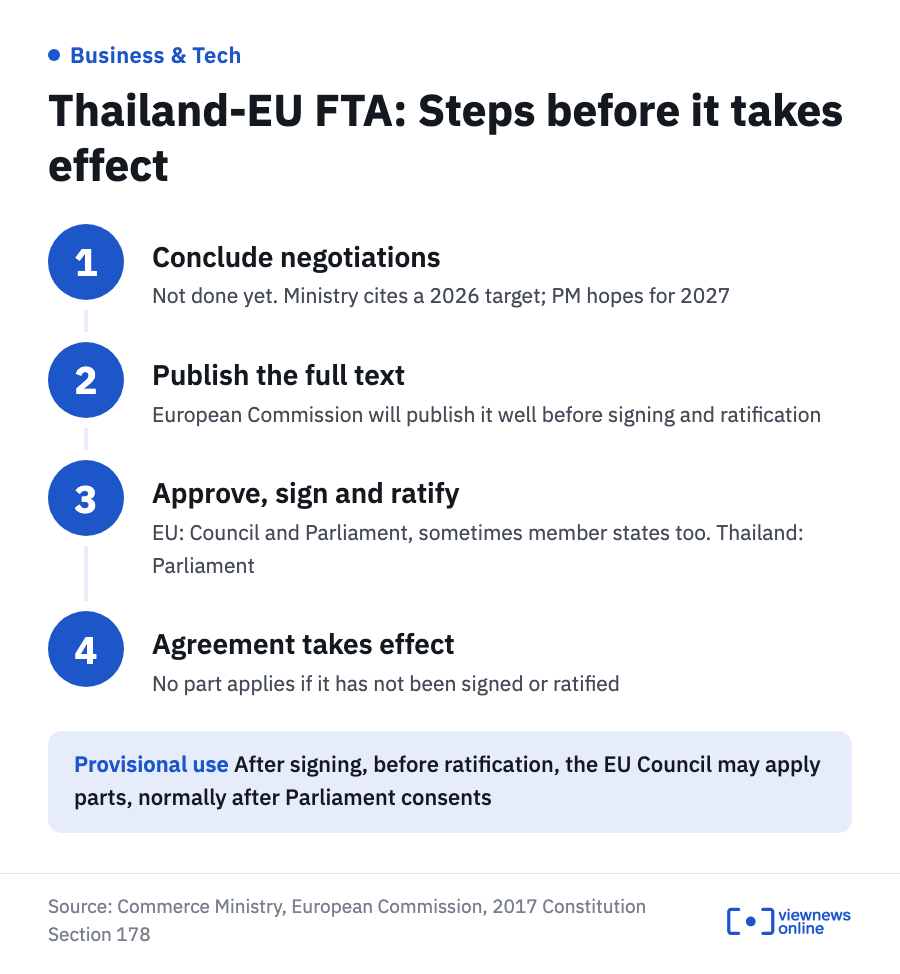
Signing and ratification come after the talks
Even when both sides announce that negotiations have concluded, tariffs will not fall immediately. The European Commission says no part of a negotiated trade agreement applies if it has not been signed or ratified. Exporters should therefore not yet price in tariff savings from this FTA.
On the EU side, the Commission publishes the agreement after talks end and proposes it to the Council of the European Union, which represents member state governments, and the European Parliament. Both must approve it before the EU can conclude the agreement. If parts of it fall under the responsibility of member states, they must also sign and ratify it to complete the process.
Between signing and ratification, the Council may allow parts of an agreement to apply provisionally. This normally takes effect after the European Parliament has given its consent.
In Thailand, Section 178 of the 2017 Constitution requires parliamentary approval for free trade treaties. Parliament must finish its review within 60 days of receiving the matter. If it does not, the treaty is deemed approved. The same section also requires a law setting out how the public can give opinions and receive necessary remedies for the effects of such treaties.
What exporters and SMEs should watch
- Farm and fishery exporters: the outcome on goods market access, which is still being negotiated.
- Service businesses and those involved in investment: the market-opening terms the EU is seeking.
- SMEs that sell to or work for state agencies: how far the agreement opens government procurement.
The Commerce Ministry expects the deal to help more Thai goods enter the EU at lower tariff costs, give SMEs a chance to expand their markets and help attract EU investment. The terms each business can actually use will depend on the agreement's text.
The European Commission says it will publish the full text once negotiations conclude, well ahead of signing and ratification. In the meantime, its page of documents on the Thailand agreement at policy.trade.ec.europa.eu lists reports on negotiating rounds and EU text proposals. These cover topics including rules of origin, sanitary and phytosanitary (food, animal and plant health) measures, services and investment, government procurement and SMEs. The proposals are only the EU's starting position and can change. The final text will depend on negotiations between the two sides.
Source: Thailand's Commerce Ministry, the European Commission, the Department of Trade Negotiations, Section 178 of the 2017 Constitution and Prime Minister Anutin's remarks on the programme "Khui Kap Nayok Anutin". This article is adapted from ViewNews' Thai-language report.