Rubber and several other commodities must be deforestation-free and legally produced before they can enter or leave the European Union market under the EU Deforestation Regulation (EUDR). The rules start to apply to large and medium operators and traders on 30 December 2026. Rubber farmers, cooperatives, factories and exporters in Thailand whose output reaches Europe may be affected, as buyers can ask for data on where it was produced.
The EU aims to reduce its contribution to deforestation, forest degradation, greenhouse gas emissions and biodiversity loss. The EUDR is gradually replacing the older EU Timber Regulation (EUTR).
What the EUDR covers and when it starts
The main commodities are cattle, cocoa, coffee, oil palm, rubber, soya and wood, along with certain products made from them. Annex I of the regulation lists the items in detail. Businesses need to check at product level, because using one of the seven commodities is not enough on its own to bring a product within scope.
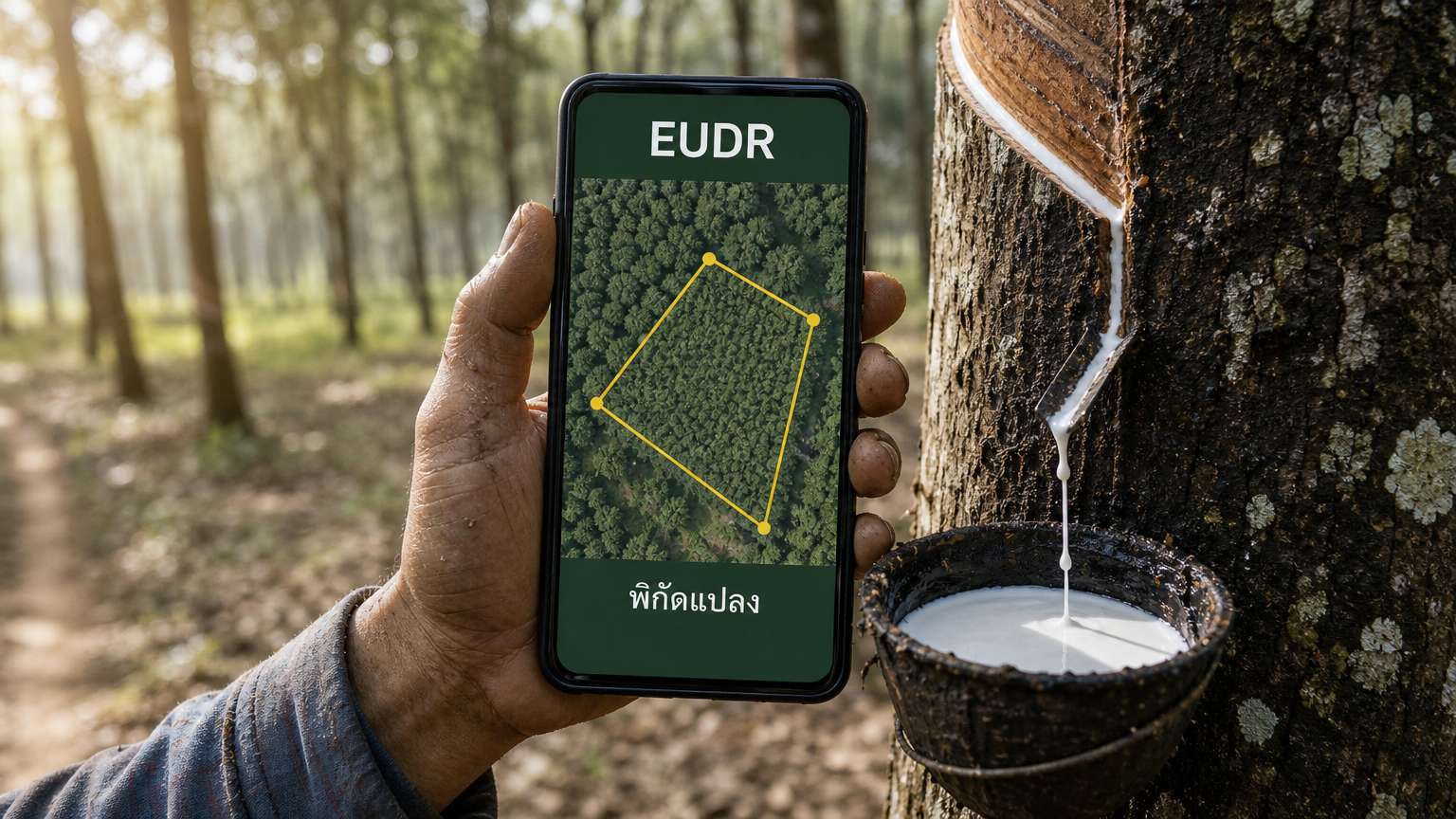
Covered products must not come from land deforested after 31 December 2020. They must also be produced in line with the laws of the producing country. Operators, meaning the businesses responsible for placing goods on the EU market or exporting them from it, must confirm this through a digital due diligence statement or a simplified declaration. Key product data is required, including the geolocation (map coordinates) of production plots.
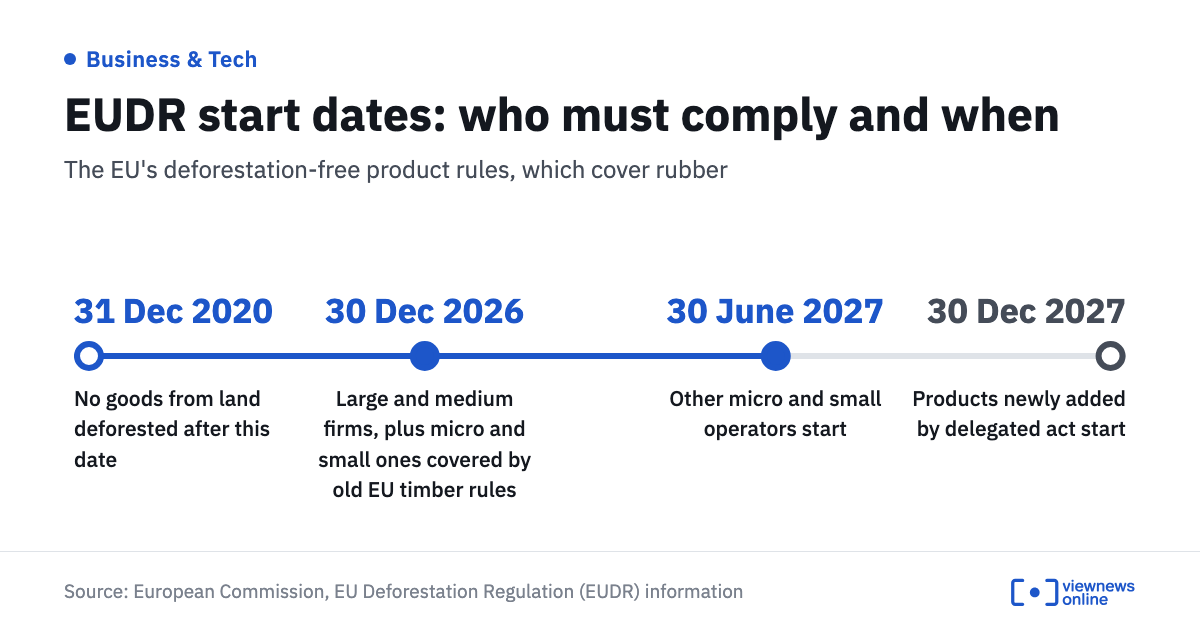
Start dates differ. The first wave on 30 December 2026 covers large and medium businesses, as well as micro and small operators within the scope of the old timber rules. Other micro and small operators follow on 30 June 2027. Products newly added through a delegated act, a form of secondary EU legislation, come under the rules on 30 December 2027.
Thailand is low-risk, but plot data is still needed
The EU classifies countries as low, standard or high risk, based on the risk that covered commodities produced there are not deforestation-free. Thailand is in the low-risk group, as are Vietnam, Laos, China and India. Malaysia, Indonesia and Cambodia are standard risk, while Myanmar is high risk.
Due diligence normally has three steps: collecting information, assessing risk and reducing risk. Operators who can confirm that all their products were produced in low-risk countries or areas need to collect information but can skip the other two steps. Data such as plot geolocation and the date or period of production must still be complete.
This simplified process has conditions. Operators must assess the complexity of the supply chain, the risk of the rules being circumvented, and the chance of goods being mixed with products of unknown origin or from standard-risk or high-risk areas. They must be able to show that the risk is negligible and give documents to the competent authority on request. Factories and cooperatives that buy rubber from many sources should therefore be able to trace each lot to its plot.
Full due diligence applies again if information indicates that products may not comply or that the rules are being circumvented. The operator must then assess and reduce the risk and notify the competent authority immediately. If the required information cannot be collected, the goods may not be placed on the EU market or exported from it.
Duties of Thai producers and exporters
Producers and companies in countries outside the EU have no obligations under the regulation unless they place products on the EU market themselves. Smallholders do not count as doing so directly if they sell to a cooperative or company in their own or another non-EU country, or to an EU buyer who is the importer. They may still be asked for information, such as the growing location and plot coordinates, to help EU companies comply.
The main due diligence duty falls on operators who first place products on the EU market or export them from the EU. A non-EU exporter that places goods on the market itself must carry out due diligence, submit a statement and register in the EU's Information System. The first seller established in the EU must also carry out due diligence and file. Trading partners should agree clearly on who the importer is.
The information that operators must keep can serve as a preparation checklist:
- Product description, trade name, type and quantity
- Country of production, including the area within it where relevant
- Geolocation of every production plot, with the date or period of production
- Names, addresses and email addresses of suppliers, and of the operators or traders receiving the goods
- Verifiable information that the products are deforestation-free
- Verifiable information that they were legally produced, including the right to use the land for that production
If any deforestation or forest degradation, as defined by the regulation, occurs on a plot, all products from that plot fail to qualify. Operators must file the statement before placing goods on the market or exporting them, and keep due diligence records for 5 years.
Some rubber products set to be removed; online training ahead
The European Commission announced in July 2026 that it had adopted a delegated act changing the product list. Items to be removed are raw hides and leather from cattle, retreaded tyres, soybeans for sowing, certain articles of vulcanised rubber, conveyor and transmission belts, and aircraft and motor vehicle seats. Additions are soluble coffee, certain palm oil derivatives and frozen cattle tongues.
Rubber exporters should check their goods against the latest version of Annex I and confirm with buyers before changing data collection plans.
The EU is also running online training on the Information System, which is used to create and submit statements. Sessions for upstream operators (those placing goods on the market or exporting them) are on 1, 8 and 10 December 2026 and 14, 19 and 21 January 2027. They start at 14:00 Central European Time, or 20:00 Thailand time. Registration links are on the EUDR Information System web page.
A separate practice system is available, and submissions there have no legal effect. Statements filed in the live system are legally valid and can be checked.
Source: European Commission, including its information on the EU Deforestation Regulation, implementation guidance, operator roles, the 5th iteration of its frequently asked questions, due diligence, the country risk classification list, the Information System and the product scope announcement. This article is adapted from ViewNews' Thai-language report.