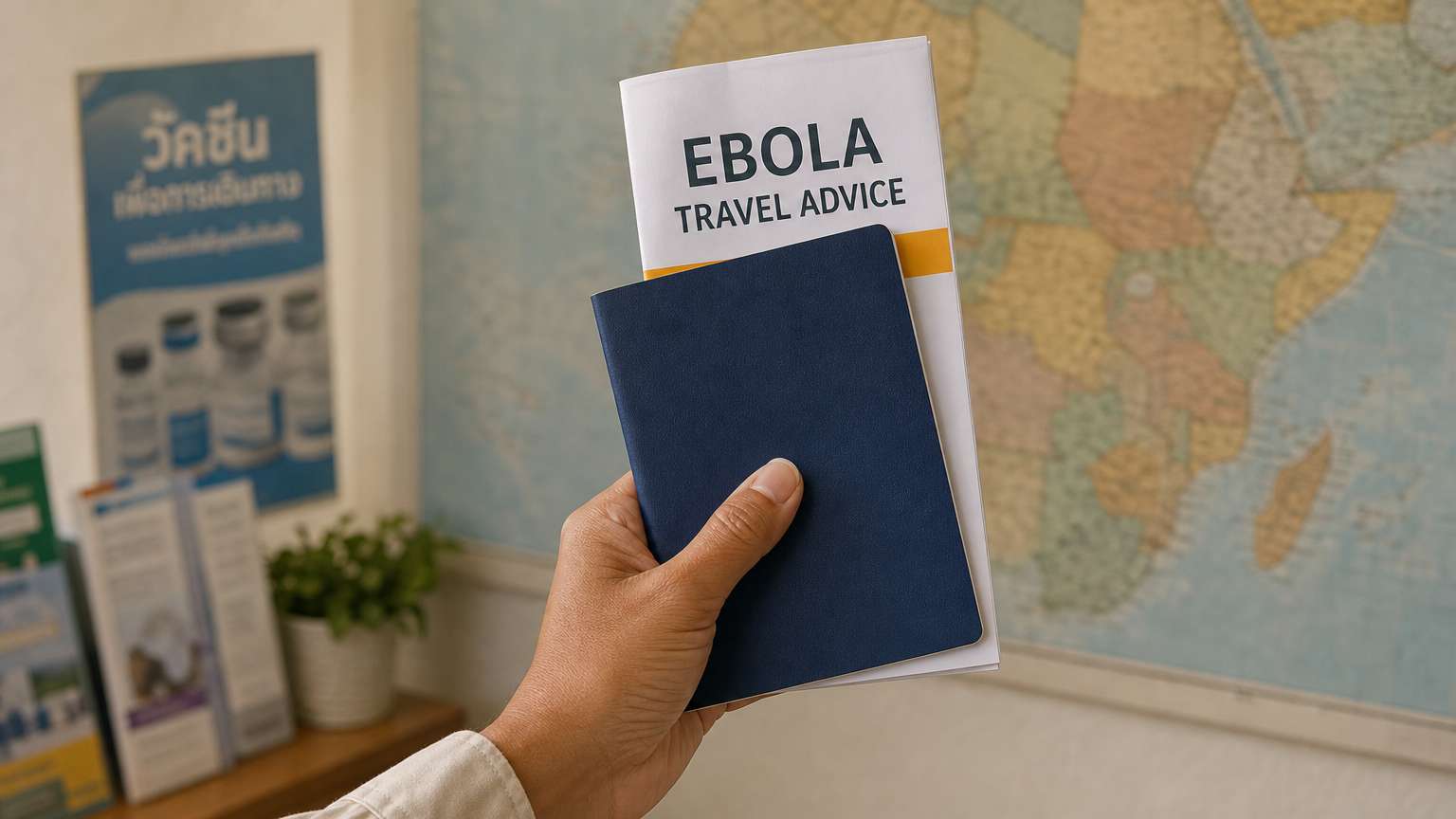
The World Health Organization (WHO) has regrouped countries by Ebola risk in new temporary recommendations dated 25 November 2026. It rates the risk as very high in the Democratic Republic of the Congo (DR Congo) and high in Kenya, Nigeria and several other African countries. Thailand is not named in any group, so it falls among all other countries, where the risk is assessed as low. People in Thailand who plan to travel to or through affected areas, or who are arriving from them, should check the latest conditions.
On 18 November, WHO's director-general determined that the epidemic of Ebola Bundibugyo virus disease remains a Public Health Emergency of International Concern (PHEIC). The decision agreed with the advice of an emergency committee at its third meeting.
Which countries are in each Ebola risk group
The new advice has five groups. The August version had three: DR Congo, countries sharing a land border with places where the virus was spreading in the community, and all other countries. The latest risk assessment reflects the position on 16 November.
- Very high risk: countries with community transmission. DR Congo is the only one.
- High risk: countries with confirmed cases but no community transmission, including Kenya and Nigeria.
- High risk: countries with substantial population links to affected areas, or moderate links and low response capacity. They include Angola, Burundi, the Central African Republic, Ethiopia, the Republic of the Congo, Rwanda, South Sudan, Tanzania, Uganda, Zambia, Djibouti, Somalia and Sudan.
- Low risk: countries with substantial links but high response capacity, including Belgium, France, the United Kingdom, South Africa, Egypt, Saudi Arabia, the United Arab Emirates, India and China.
- Low risk: all other countries, including Thailand.
The changes add a separate group for countries that have cases without community spread, and another for well-connected countries with high response capacity. The old land-border test has been replaced by measures of population links and response capacity. Ethiopia, Djibouti, Somalia and Sudan are new names compared with the earlier neighbouring-country group. The lists show the position when the advice was issued, so check the latest version before travelling.
Thailand's own measures for Ebola-affected areas
WHO's advice is not an entry rule for any country. Thailand announced its own measures on 27 May 2026 for travellers arriving from or transiting through DR Congo and Uganda, which it had designated as dangerous communicable disease areas for Ebola. A Public Health Ministry announcement published in the Royal Gazette on 18 September 2026 later removed Uganda from that designation, effective the following day. It did not remove DR Congo.
The measures announced in May included:
- Entry to Thailand through Bangkok's Suvarnabhumi Airport only.
- Quarantine at a place designated by the authorities for at least 21 days for travellers without symptoms.
- Isolation at a designated public health facility for at least 21 days for travellers with symptoms.
- Registration through the Thailand Digital Arrival Card (TDAC) for foreign nationals from affected areas.
The measures were announced to apply until the situation improved or further notice was issued. Anyone who has been in or passed through DR Congo should confirm the current conditions with their airline, a Thai embassy or the Department of Disease Control (DDC) before booking.
What WHO advises on flights and screening
WHO advises countries in the all-other group to prepare to detect, assess, report and care for travellers who have an unexplained fever and come from a country with community transmission. They should also designate testing laboratories and isolation facilities, give the public accurate and current information, and discourage travel to areas with community transmission.
WHO does not recommend suspending flights, water routes or road links with countries that have community transmission or cases. It also does not recommend refusing entry to people arriving from them. Travellers should still check the latest conditions with airlines, the embassies of destination and transit countries, and the DDC.
WHO recommends entry screening in three groups: countries with cases but no community spread, the high-risk group based on population links or low capacity, and well-connected countries with high capacity. Examples include Kenya, Ethiopia, Uganda, France and China. Screening applies at entry points that receive many travellers from countries with community transmission. It includes collecting personal and contact details, observing general health, assessing travel and exposure history, and taking temperatures.
Anyone travelling from a country with community transmission to a country in those three groups should allow extra time and have travel details ready. For the all-other group, WHO advises giving arriving travellers information at entry points and does not set out the same screening.
For DR Congo, WHO advises stopping patients and their contacts from travelling internationally, except for medical evacuation. It also advises exit screening at airports, ports and border crossings.
Symptoms to watch for over 21 days
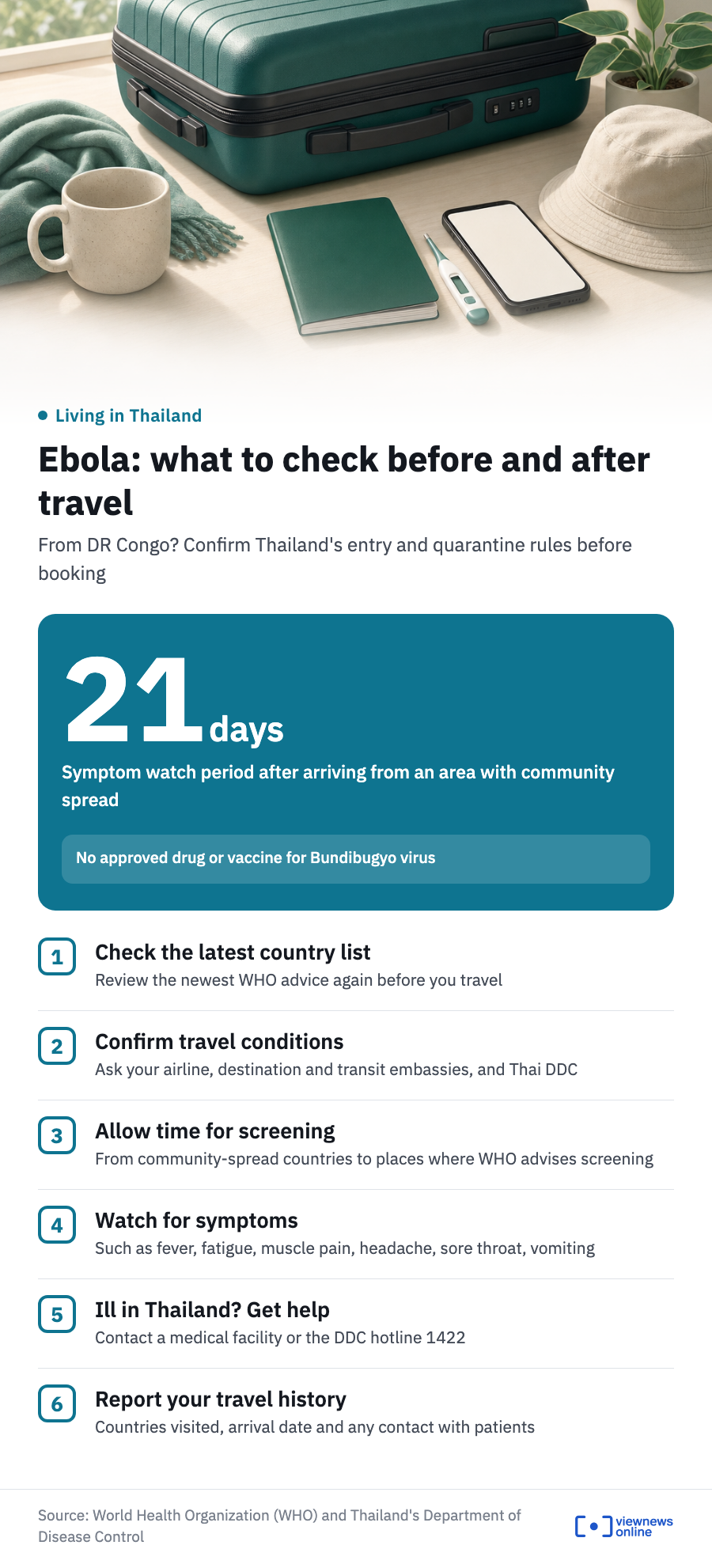
For all other countries, including Thailand, WHO advises that arriving travellers be told about symptoms, risks and what to do if they become ill within 21 days of arriving from an area with community transmission. According to WHO, the incubation period, from infection to the first symptoms, is 2 to 21 days. This advice does not replace any quarantine requirement in Thailand.
Symptoms can start suddenly, with fever, fatigue, malaise, muscle pain, headache and sore throat. Vomiting, diarrhoea, abdominal pain, rash and impaired kidney and liver function can follow.
The virus passes between people when broken skin or mucous membranes come into contact with the blood or body fluids of someone who is sick or has died, or with contaminated objects. Infected people do not spread the disease before symptoms appear.
If you develop symptoms within 21 days of leaving an affected area and are in Thailand, promptly contact a medical facility or the DDC hotline on 1422. Say which countries you visited, when you arrived, and whether you had contact with any patient.
Cases, vaccines and treatment
As of 24 November, DR Congo had reported more than 12,000 cases and 5,900 deaths. The emergency committee said the epidemic was still being driven by severe operational constraints, infections in healthcare settings, deaths in the community and spread across areas.
No drug or vaccine has been approved for Bundibugyo virus, although clinical trials are under way. Thai public health guidance from June 2026 on suspected Ebola patients also says there is no vaccine for this virus and no specific treatment, so care is supportive and based on symptoms. Travellers leaving Thailand therefore cannot rely on a vaccine against this virus.
Country lists, case numbers and trial results may change. Anyone with travel health questions should speak to a doctor or pharmacist before starting or changing any treatment.
Source: World Health Organization (WHO); Thailand's Public Health Ministry, Department of Medical Services and Department of Disease Control; Tourism Authority of Thailand. This article is adapted from ViewNews' Thai-language report.